B.Tech CSE Internet of Things Admission Eligibility, & Entrance Exams
B.Tech CSE Internet of Things Admission : Eligibility, & Entrance Exams A surprising number of students assume IoT means “just sensors and gadgets.” That mistake can lead you to the wrong college list, because b.tech iot admission often sits inside a broader CSE program with networking, embedded systems, cloud basics, and device security. The confusing part is that every college names the branch differently. One brochure says Internet of Things, another says CSE (IoT), and a third hides the same idea under smart systems or connected devices. By the end of this post, you will know the real IoT eligibility rules, the entrance exams that matter, how the engineering admission process works, and how to compare IoT colleges without getting distracted by branding. Why IoT Admission Looks Simple But Isn’t IoT sounds clean on paper. In practice, colleges blend computer science, electronics, sensors, data transfer, and security into a single program, and the balance changes from one institute to another. That matters because the same branch name can lead to very different student outcomes. A program with proper labs, microcontrollers, and networking modules prepares you for real projects. A weak one gives you only theory and a few basic assignments. The demand side is real too. IoT jobs keep growing because companies want people who can connect devices, manage data, and secure systems across homes, factories, and cities. Quick reality check: if a college only talks about “smart future” and avoids syllabus details, ask for semester-wise subjects. The branch name alone tells you very little. IoT Eligibility You Should Check First IoT eligibility usually follows the standard B.Tech pattern in India. You need Physics and Mathematics in Class 12, and most colleges also want Chemistry or another approved science subject. Minimum Qualification Table Course Table Requirement Typical Criteria Qualifying exam Class 12 or equivalent from a recognized board Compulsory subjects Physics and Mathematics Third subject Chemistry, Computer Science, IT, or an approved science subject depending on institute rules Minimum aggregate Usually 45% to 60% Reserved category relaxation Often 5% lower than general category Age rule Usually no upper age limit for private universities This is the basic b.tech iot qualification for most engineering seats in India. If you meet it, you can apply. If you miss it, most colleges will reject the form even if your interest in devices and coding is strong. Several private universities ask for 50% to 60% in PCM, while some state and newer colleges accept a lower threshold. That is why your target college list should shape your preparation, not the other way around. What Students Often Miss Students often assume IoT course admission is easier than CSE. In reality, if the program is part of CSE with IoT specialization, the college usually keeps the same PCM requirement as other engineering tracks. If you are still in Class 11, keep Mathematics. Dropping it now closes more doors than you may expect. Need a fast self-check? Compare your Class 12 score against the previous year’s branch-wise cutoff, not just the general engineering cutoff. IoT Entrance Exams You Should Focus On You do not need every exam on the internet. You need the exam your shortlisted colleges actually accept. Entrance Exam Table Course Table Exam Accepted By Best For JEE Main NITs, IIITs, many universities, and some private colleges Students who want the widest set of options JEE Advanced IIT-level paths and select programs Top-ranked students VITEEE VIT campuses Private university seekers SRMJEEE SRM University group Students targeting larger private campuses BITSAT BITS Pilani, Goa, Hyderabad Fast, accuracy-driven test takers MHT-CET Maharashtra colleges Maharashtra domicile candidates University entrance test Private universities Students wanting a campus-based direct route State CETs State engineering colleges Students applying through state counselling JEE Main, remains the widest accepted exam for b.tech iot admission 2026. Because many colleges accept it, one good score can keep more admission options open during counselling. Internet of Things Admission 2026 Timeline Course Table Stage Estimated Window JEE Main Session 1 January 2026 JEE Main Session 2 April 2026 Private university applications January to June 2026 Counselling begins June to August 2026 Seat allotment rounds June to September 2026 Final reporting and fee payment July to September 2026 These timelines help you plan early. If you wait too long, the better iot colleges admission rounds often move into higher cutoffs or fewer open seats. Direct Admission IoT Engineering Direct admission IoT engineering routes are available at several private universities through merit or the institute’s own entrance test. That does not mean the college ignores eligibility. It still checks your marksheets, documents, and often a counselling round. A legitimate college still publishes the fee structure, eligibility, and selection process clearly. If someone promises a guaranteed seat without verification, walk away. Example: Private University Admission Cycle Private universities often run multiple routes at the same time. For example, ALARD University can be used as one example of how a private institution presents program options and counselling support, while colleges like Crescent, SRM, and VIT also follow their own accepted-exam and merit-based cycles. That wider comparison helps you judge the admission model, not just the brochure. Thinking about direct admission or exam-based admission? Shortlist three colleges first, then check which exam each one accepts. It keeps your prep focused. Engineering Admission Process for IoT The engineering admission process for IoT follows a predictable sequence once you know the order. Admission Process Flow Application → Entrance Exam → Rank / Merit List → Counselling → Seat Allotment → Fee Payment → Document Verification Step-by-Step Checklist • Choose the exact branch. Check whether the college offers IoT, CSE (IoT), or smart systems with IoT. • Check the eligibility rules. Confirm PCM subjects, aggregate percentage, and any category relaxation. • Register for the correct entrance exam. JEE Main, VITEEE, SRMJEEE, BITSAT, MHT-CET, or the college’s own test may apply. • Compare cutoffs carefully. Look at the exact IoT branch closing rank, not the general CSE branch rank. • Apply through counselling or the
B.Tech CSE Full Stack Developer Admission : Eligibility, & Entrance Exams
B.Tech CSE Full Stack Developer Admission : Eligibility, & Entrance Exams A lot of students think full stack means “just web development.” That assumption can cost you a seat, because b.tech full stack admission is usually tied to a broader CSE program with backend, frontend, databases, cloud basics, and deployment skills woven into the curriculum. The confusing part is that colleges describe the same branch in different ways. One calls it Full Stack Developer, another writes CSE (Full Stack), and a third buries it under web development admission or a software specialization. By the end of this post, you will know the real full stack eligibility rules, the entrance exam routes that matter, how direct admission works, and how to compare full stack colleges without getting trapped by brand names alone. Why Full Stack Admission Gets Confusing The name sounds simple, but the course structure is not always simple at all. Some colleges teach only JavaScript, React, and Node.js, while others add DSA, cloud, DevOps basics, UI/UX, and database design. That difference matters because your degree should prepare you for jobs, not just classes. Employers want students who can build interfaces, manage APIs, handle databases, and ship working products, not only write isolated frontend code. Placement trends explain the demand. Full stack and web roles remain one of the most hiring-friendly paths for engineering students in India because companies want developers who can work across the stack and move fast on product teams. Quick reality check: if a college sells the branch as “easy” or “job guaranteed,” look deeper. Ask for the syllabus, project load, and placement data first. B.Tech CSE Full Stack Eligibility You Should Check First B.Tech CSE Full Stack eligibility usually follows the standard B.Tech entry pattern in India. You need Physics and Mathematics in Class 12, along with a minimum percentage that depends on the institute. Minimum Qualification Table Course Table Requirement Typical Criteria Qualifying exam Class 12 or equivalent from a recognized board Compulsory subjects Physics and Mathematics Third subject Chemistry, Computer Science, IT, or an approved science subject depending on college rules Minimum aggregate Usually 45% to 60% Reserved category relaxation Often 5% lower than general category Age rule Usually no upper age limit for private universities This is the basic full stack qualification for most engineering admission 2026 routes. If you meet it, you can apply. If you miss it, most colleges will reject the form even if your interest in coding is strong. Some private universities expect 60% in PCM or overall Class 12, while state and newer colleges may accept 45% or a similar lower threshold. That is why your target college list should shape your preparation, not the other way around. What Students Often Miss Students often assume web development admission has looser rules than core engineering. In reality, if the program sits inside B.Tech CSE Full Stack Developer admission, the college usually keeps the same PCM requirement as other CSE tracks. If you are still in Class 11, keep Mathematics. Dropping it now closes more doors than you may expect. Need a fast self-check? Compare your Class 12 score against the previous year’s branch-wise cutoff, not just the general engineering cutoff. Full Stack Entrance Exam Options You do not need to sit for every exam. You need the exam your shortlisted colleges actually accept. Entrance Exam Table Course Table Exam Accepted By Best For JEE Main NITs, IIITs, many universities, and some private colleges Students who want the widest set of options JEE Advanced IITs and select engineering routes Top-ranked students VITEEE VIT campuses Private university seekers SRMJEEE SRM University group Students targeting large private campuses BITSAT BITS Pilani, Goa, Hyderabad Fast, accuracy-driven test takers MHT-CET Maharashtra colleges Maharashtra domicile candidates University entrance test Private universities Students wanting a campus-based direct route JEE Main, remains the widest accepted exam for b.tech full stack admission 2026. Because many colleges accept it, one good score can keep more admission options open during counselling. Direct Admission Full Stack Course Direct admission full stack course routes are available at several private universities through merit, management quota, or the institute’s own entrance test. That does not mean the college ignores eligibility. It still checks your marksheets, documents, and often a counselling round. Management quota sounds easy from the outside, but legitimate colleges still publish fee structure, eligibility, and admission steps clearly. If someone promises a guaranteed seat without verification, walk away. Example: Private University Admission Cycle Private universities often run multiple routes at the same time. For example, ALARD University can be treated as one example of how a private institution presents program options and counselling support, while some private colleges and universities also follow their own accepted-exam and merit-based routes. That comparison helps you evaluate the admission model, not just the brochure. Thinking about direct admission or exam-based admission? Shortlist three colleges first, then check which exam each one accepts. It keeps preparation focused. Full Stack Engineering Admission Process The full stack engineering admission process is predictable once you know the order. Admission Process Flow Application → Entrance Exam → Rank / Merit List → Counselling → Seat Allotment → Fee Payment → Document Verification Step-by-Step Checklist • Choose the exact branch. Check whether the college offers full stack developer admission, CSE (Full Stack), or CSE with web development specialization. • Check the eligibility rules. Confirm PCM subjects, aggregate percentage, and any category relaxation. • Register for the correct entrance exam. JEE Main, VITEEE, SRMJEEE, BITSAT, MHT-CET, or the college’s own test may apply. • Compare cutoffs carefully. Look at the exact full stack branch closing rank, not the CSE general branch rank. • Apply through counselling or the institute portal. Government colleges usually use centralized counselling, while private universities use their own admission windows. • Keep documents ready. Prepare Class 10 and 12 marksheets, scorecard, ID proof, photos, and category certificate if needed. • Pay the seat confirmation fee on time. Full stack colleges can close rounds fast when demand rises.
B.Tech CSE Cyber Security and Forensics Admission : Eligibility, & Entrance Exams
B.Tech CSE Cyber Security and Forensics Admission, Eligibility, & Entrance Exams Cyber security seats are filling faster than most parents expect, and cyber forensics is no longer a niche add-on. That is why B.Tech Cyber Security admission has become one of the most practical engineering searches for students who want both tech depth and a career with clear demand. The hard part is not interest. It is confusion. One college offers cyber security, another adds forensics, a third hides the same branch under CSE specialization, and the eligibility rules can change from one university to the next. By the end of this post, you will know the actual eligibility rules, which cyber security entrance exam matters for which college, how direct admission works, and how to compare colleges without getting distracted by branch labels. Why Cyber Security Admission Feels Hard to Decode The cyber security branch looks simple from the outside, but colleges market it in very different ways. Some call it B.Tech CSE Cyber Security and Forensics, some call it Information Security, and some place cyber forensics inside a broader CSE specialization. That naming difference matters because you may think you are comparing the same course when you are not. A program that teaches secure coding, network defense, and incident response is not the same as one that mostly reuses general CSE subjects with one security elective. Salary trends explain the demand. India’s cyber security hiring market keeps growing as companies face more breaches, more compliance pressure, and more need for digital investigation skills. Recognizable industry and college sources show strong placement demand for cyber security graduates, especially when students also learn ethical hacking, cloud security, and digital forensics. Quick check: if a college does not show semester-wise subjects, ask for them before you pay the application fee. The course title alone tells you very little. B.Tech CSE Cyber Security & Forensics Eligibility B.Tech CSE Cyber Security eligibility usually follows one simple rule: you need Physics and Mathematics in Class 12, plus a qualifying percentage that depends on the college. Minimum Qualification Table Course Table Requirement Typical Criteria Qualifying exam Class 12 or equivalent from a recognized board Compulsory subjects Physics and Mathematics Third subject Chemistry, Computer Science, IT, Electronics, Biology, or another approved science subject, depending on college rules Minimum aggregate Usually 45% to 60% Reserved category relaxation Often 5% lower than general category Age rule Usually no upper age limit for private universities This is the core cyber security qualification for most undergraduate admissions in India. If you meet it, you can apply. If you do not, most colleges will reject the form even if your entrance score is decent. Some reputed private universities ask for 60% aggregate in PCM or in Class 12 overall, while many others keep the bar closer to 45% for eligible categories. That is why you should check each college separately instead of assuming one rule fits all. Cyber Forensics Admission Adds a Small Twist Cyber forensics admission often expects the same PCM base, but some programs also look for a stronger interest in investigation, data recovery, or digital evidence handling. If the college offers cyber security and forensics together, it may expect you to understand both technical defense and case-based analysis. If you are still in Class 11, keep Mathematics, maintain a solid PCM aggregate, and avoid subject combinations that close the door on engineering admission 2026 later. Need a fast self-check? Match your marks against the previous year’s branch cutoff, not the general engineering cutoff. That small step saves time. Cyber Security Entrance Exam Options You do not need to prepare for every exam. You need the right one for your target college list. Entrance Exam Table Course Table Exam Accepted By Best For JEE Main NITs, IIITs, many universities, and some private colleges Students who want the widest set of options JEE Advanced IIT-level paths and select cyber-related IIT programs Top-ranked students VITEEE VIT campuses Private university seekers AEEE Amrita universities Students targeting cyber security engineering admission in a strong private setup SRMJEEE SRM University group Large campus and private-route applicants MHT-CET Maharashtra colleges Maharashtra domicile candidates University entrance test Private universities Students wanting a campus-based direct route JEE Main, remains the widest accepted exam for cyber security admission 2026. Because many colleges accept it, one good score can keep more options open during counselling. B.Tech CSE Cyber Security Admission Timeline Course Table Stage Estimated Window JEE Main Session 1 January 2026 JEE Main Session 2 April 2026 Private university applications January to June 2026 Counselling begins June to August 2026 Seat allotment rounds June to September 2026 Final reporting and fee payment July to October 2026 These timelines help you plan faster. If you wait for the last round, the cyber security colleges admission window may already have shifted to higher cutoffs or fewer seats. Direct Admission in Cyber Security Direct admission in B.Tech Cyber Security and Forensics is available at several private universities through merit, management quota, or the college’s own entrance route. It is not a shortcut that ignores eligibility. The college still checks your Class 12 marks, documents, and sometimes counselling attendance. Management quota can sound vague, so treat it carefully. A legitimate university will still publish the fee structure, eligibility, and seat process clearly. If a seller promises a guaranteed seat without verifying your documents, step back. Example: Private University Admission Cycle Private universities often run more than one route at the same time. For example, ALARD University can be used as a reference point for how private institutions present program options, counselling, and campus-level guidance, while other colleges also follow their own accepted-exam and merit-based cycles. That wider comparison helps you judge the admission model, not just the marketing language. Thinking about direct admission or exam-based admission? Shortlist three colleges first, then check which exam each one accepts. It keeps preparation focused. Cyber Security Engineering Admission Process The cyber security engineering admission process usually follows the same broad sequence across India. Admission
B.Tech CSE AI and Machine Learning Admission Process, Eligibility, & Entrance Exams
B.Tech CSE AI and Machine Learning Admission Process, Eligibility, & Entrance Exams A recruiter once told me she sees AI and ML graduates command slightly stronger starting offers than plain CSE graduates from the same college when projects, internships, and coding depth line up. That is one reason B.Tech in AI and Machine Learning Admission has become such a high-intent search for students and parents. The tricky part is this: many colleges use similar branch names, but the syllabus, cutoff, and admission route can differ a lot. One brochure says AI, another says AI & ML, and a third says CSE (AI & ML) — yet the seat matrix and placement outcomes are not the same. By the end of this post, you will know the real eligibility, the entrance exams that matter, how the admission process works, and how to compare AI/ML colleges without getting distracted by marketing language. Why AI and ML Admission Feels So Confusing The confusion starts with naming. A student may see B.Tech in AI and Machine Learning, B.Tech CSE AI and ML admission, AI engineering admission, or even CSE with AI specialization, while the actual curriculum stays closer to computer science with added machine learning subjects. That matters because admission decisions depend on more than branch names. You should look at PCM aggregate, entrance score, closing rank, and whether the college gives enough curriculum depth in Python, data structures, linear algebra, neural networks, and model deployment. Placement data also explains the rush. AI and ML roles now show stronger salary traction at many private universities, especially when students build projects and internships before final year. But a good title alone does not create a strong outcome. The college, faculty, projects, and hiring network still decide most of the result. Quick check: if a college talks only about the branch name and avoids syllabus detail, treat that as a warning sign. Ask for semester-wise subjects before you move ahead. B.Tech CSE AI and Machine Learning Eligibility B.Tech CSE AI and Machine Learning eligibility usually follows a simple base rule: you need Physics and Mathematics in Class 12, plus a qualifying aggregate that depends on the institute. Minimum Qualification Table Course Table Requirement Typical Criteria Qualifying exam Class 12 or equivalent from a recognized board Compulsory subjects Physics and Mathematics Third subject Chemistry, Computer Science, Biotechnology, or Information Technology, depending on institute rules Minimum aggregate Usually 45% to 60% Reserved category relaxation Often 5% lower than general category Age rule Usually no upper age limit for private universities This is the baseline qualification for B.Tech AI and Machine Learning programs. If you meet it, you can apply. If you do not, most colleges will reject the form even if your entrance score looks good. Many private universities ask for a higher overall percentage, while several state and newer institutions keep the bar closer to 45%. That means your admission target should decide your eligibility strategy, not the other way around. What Students Often Miss Students often focus on percentage alone and ignore subject combinations. If you did not take Mathematics, you may lose access to most AI and ML engineering admission routes because the course relies on logic, probability, and optimization from day one. If you are still in Class 11, this is the smartest moment to plan. Keep Mathematics, maintain strong PCM aggregate, and work on problem-solving early. Need a quick reality check on your chances? Compare your Class 12 score with the previous year’s opening and closing rank for the exact AI/ML branch you want. AI and Machine Learning Entrance Exams That Matter You do not need every exam under the sun. You need the right ones for the colleges on your shortlist. Entrance Exams Comparison Course Table Exam Accepted By Best For JEE Main NITs, IIITs, many state colleges, and private universities Students targeting broad options JEE Advanced IITs Top JEE Main rankers BITSAT BITS Pilani, Goa, Hyderabad Fast and accuracy-based test takers VITEEE VIT campuses Students wanting a strong private campus route SRMJEEE SRM Institute Students targeting large private engineering campuses MHT-CET Maharashtra state colleges Maharashtra domicile students University entrance test Private universities Students who want direct campus-based admission routes JEE Main, remains the widest gateway for engineering admission 2026. Because it is accepted by many institutions, it keeps your options open even if one college closes earlier than expected. Direct Admission in B.Tech CSE AI and ML Direct admission in AI and ML is real at several private universities, but it is not a free pass. These colleges usually admit through merit, management quota, or their own entrance test, and they still expect minimum eligibility marks. Do not confuse direct admission with a seat bought without verification. Legitimate colleges still check documents, academic scores, and sometimes a counselling round before confirming the seat. Example: Private University Admission Cycle Private universities often run multiple admission tracks at the same time. For example ALARD University presents AI and ML admission as part of a broader university counselling process, while other private institutions follow their own accepted-exam and merit routes. That comparison helps students see that branch quality depends on curriculum and outcomes, not just one promotional name. Thinking about which exam route fits your profile? Shortlist three colleges first, then prepare only for the exams those colleges actually accept. B.Tech CSE AI and ML Engineering Admission Process The AI and ML engineering admission process looks complex from the outside, but it usually follows the same sequence. Admission Process Flow Application → Entrance Exam → Merit List / Rank → Counselling → Seat Allotment → Fee Payment → Document Verification Step-by-Step Checklist • Choose the branch carefully. Check whether the program is AI & ML, AI & DS, or CSE with AI electives. • Check eligibility first. Confirm your PCM aggregate, subject combination, and category rules. • Register for the right exam. Use JEE Main, BITSAT, VITEEE, SRMJEEE, or the college’s own test based on your shortlist. • Track cutoffs. Compare your percentile
B.Tech CSE Artificial Intelligence Admission Process, Eligibility, & Entrance Exams
B.Tech CSE Artificial Intelligence Admission Process, Eligibility, & Entrance Exams Every year, thousands of Class 12 students ask the same question in July: “I have a 78% aggregate and a decent JEE Main percentile — can I still get into a good B.Tech CSE AI program?” The honest answer is yes, but the path looks different for every student. B.Tech CSE AI admission in India has quietly turned into one of the most confusing processes in engineering education. Every college has its own cut-off, its own entrance test, and its own definition of “AI specialization.” Parents Google one thing and land on ten contradictory answers. By the end of this post, you will know the exact eligibility numbers, which entrance exams actually matter, how the admission process works from application to seat confirmation, and how to pick a program that will still be relevant in 2030. Why B.Tech CSE AI Admission Feels So Complicated Ten years ago, choosing an engineering branch meant picking between Mechanical, Civil, and Computer Science. Today you are choosing between CSE, CSE (AI), CSE (AI & ML), CSE (AI & DS), and plain AI & Data Science — often at the same college. This naming confusion is not accidental. Colleges rebranded existing CSE seats as AI programs after 2020 because demand exploded. A NASSCOM and BCG report projects India will need over 1 million AI-skilled professionals by 2027, and colleges responded fast — sometimes faster than their faculty and labs could catch up. That is exactly why clarity on eligibility and entrance exams matters more now than it did five years ago. A vague brochure promise of an “AI-ready curriculum” means nothing if the admission criteria and course structure do not back it up. Quick reality check: if you are comparing two colleges purely by name, you are comparing marketing, not education. Compare curriculum hours, lab access, and industry tie-ups instead — you will see the real difference in eligibility documents and entrance exam weightage. B.Tech CSE AI Eligibility You Actually Need B.Tech CSE AI eligibility is largely uniform across India, with small variations by state and institute type. Most confusion here comes from mixing up minimum percentage with competitive cut-off percentage — two very different numbers. Eligibility for B.Tech CSE AI Course Table Requirement Typical Criteria Qualifying exam Class 12 (any recognized board) Compulsory subjects Physics and Mathematics Third subject Chemistry, Biology, or Computer Science (varies by state) Minimum aggregate 45%–60% (general category), 40%–45% (reserved category) Class 10 requirement Some private universities ask for 60%+ in Class 10 Age limit No upper age limit for most private and state universities This is the baseline qualification for B.Tech CSE AI programs. Meeting it makes you eligible to apply — it does not guarantee a seat. Competitive cutoffs for AI-specific branches usually run 5–10% higher than plain CSE because seat demand is higher and intake is smaller. If you are in Class 11, select your subject combination thoughtfully. Omitting Computer Science or Mathematics at this stage can restrict your access to engineering programs down the line, even at institutes with moderate eligibility requirements. Category-Wise Relaxation Reserved category students (SC/ST/OBC/PwD) typically get a 5% relaxation on minimum aggregate marks. Always verify this on the specific university’s official admission page rather than a third-party aggregator, because state universities and private deemed universities set their own relaxation slabs. Not sure your marks are enough? A quick way to check is comparing your percentile against last year’s closing rank for the exact AI branch you want, not the general CSE branch — the two cutoffs rarely match. B.Tech AI Entrance Exams Compared This is where most families lose time — applying to five exams when two would have covered every college on their shortlist. Here is how the major B.Tech AI entrance exams actually differ. National and State-Level Exams Course Table Exam Accepted By Exam Level Best For JEE Main IITs, NITs, IIITs, most private universities National Students targeting government + top private colleges JEE Advanced IITs only National Top 2.5 lakh JEE Main rankers BITSAT BITS Pilani, Goa, Hyderabad National Students strong in speed-based objective tests VITEEE VIT campuses National Students wanting a large private campus with global tie-ups SRMJEEE SRM group of institutes National AI/ML specialization seekers at SRM MHT-CET Maharashtra state colleges State Maharashtra domicile students University-level tests Private universities’ own AI/DS programs Institute-level Students preferring direct, faster admission JEE Main, run by the National Testing Agency, remains the single most widely accepted exam for engineering admission 2026, with two sessions held in January and April. A strong percentile here alone opens doors to dozens of AI-focused programs across NITs and private universities. Direct Admission in B.Tech CSE AI — When Is It Valid? Direct admission in B.Tech CSE AI is completely legitimate at private and deemed universities that run their own entrance test or admit purely on Class 12 merit. It is not a shortcut around eligibility — it is simply a different, university-managed evaluation path instead of a national exam. Be cautious of anyone promising a guaranteed seat “without any exam or merit check” in exchange for a flat donation. Legitimate direct admission still requires meeting the minimum eligibility and, usually, a short counselling or aptitude interaction. Example: Private University Admission Cycle Private universities often run parallel admission tracks so students are not entirely dependent on one national exam result. ALARD University’s B.Tech CSE (AI & DS) program, for instance, accepts JEE Main scores while also running its own merit-and-interview-based counselling cycle — a useful backup option if a student’s national exam attempt did not go as planned. Thinking about which exam route fits your profile? Compare your target colleges’ entrance exam list before you start preparation — it saves months of wasted effort on exams you never needed. Admission Process for B.Tech CSE AI — Step by Step The admission process for B.Tech AI follows a consistent pattern whether you are applying to a government institute or a private university. Here is the checklist
B.Tech CSE Internet of Things Ultimate Career Guide
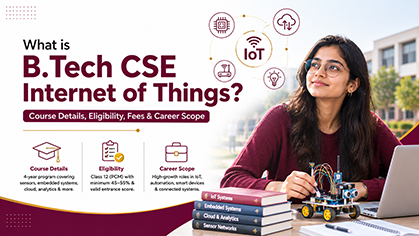
What is B.Tech CSE Internet of Things? Course Details, Eligibility, Fees & Career Scope India’s IoT market is on track to cross $26.93 billion by 2026, and every sensor, dashboard, and connected device behind that number needs someone to design it. A B.Tech CSE Internet of Things degree puts you directly in that build queue — not on the sidelines reading about it. Here’s the catch: most college websites either bury this course inside a generic CSE page or mix it up with Electronics engineering, so you end up more confused after research than before it. Stay with this guide, and you’ll walk away knowing the real syllabus, the eligibility cutoffs, what colleges actually charge, and what IoT engineers take home once they’re hired. The Confusion Around IoT: Is It CSE, ECE, or Something Entirely New? Ask three different colleges what “IoT engineering” means, and you’ll get three different answers. Some place it firmly under Computer Science. Others teach a hardware-heavy version inside Electronics and Communication Engineering. Here’s the short version: at most universities, B.Tech CSE Internet of Things is a Computer Science specialization that borrows electronics fundamentals, not the other way around. Myth vs. Fact: What IoT Engineering Actually Involves Myth Fact IoT is basically electronics with extra coding IoT blends software, cloud platforms, and hardware design in equal measure You need prior hardware experience to apply Most programs teach embedded systems and sensors from the ground up IoT jobs barely exist in India India’s IoT market is projected near $27 billion by 2026, and demand is rising with it That table alone should settle most of the doubt your parents or relatives might raise about this specialization. What Actually Separates IoT Engineering From Regular CSE A connected devices engineering track adds four layers on top of standard Computer Science fundamentals: Sensors and actuators: how machines sense the physical world Embedded systems: the microcontrollers that run on tiny hardware Networking protocols: how devices talk to each other and to the cloud Data analytics: turning raw sensor data into decisions Want to see this mapped out for real? ALARD University’s B.Tech CSE Internet of Things program lists its embedded systems, sensor networks, and cloud modules semester by semester — a solid benchmark before you shortlist anywhere else. Internet of Things Engineering Course: What’s Actually Inside the Syllabus Forget the marketing brochures for a second. Here’s what a typical IoT engineering course actually teaches you, year by year. AICTE’s own model curriculum for emerging areas breaks the core IoT block into three explicit chunks: an 8-hour “Introduction to IoT” module, an 18-hour “IoT Application Development” module, and a 10-hour “IoT Case Studies” module. That’s the foundation. Universities build their own specialization electives on top of it. Semester-Wise IoT Engineering Course Breakdown Year Focus Area Sample Subjects Year 1 Foundation Mathematics, Programming Basics, Digital Electronics, Data Structures Year 2 Core CSE + Embedded Basics DBMS, Operating Systems, Microcontrollers, Computer Networks Year 3 IoT Specialization Sensor Networks, IoT Application Development, Cloud Platforms, Data Analytics Year 4 Applied Systems & Deployment IoT Security, Industrial IoT, Capstone Project, Internship Most final-year students build a working prototype — a smart irrigation system, a home automation setup, or an industrial monitoring dashboard that reports live sensor data. That prototype, not your marksheet, is usually what a recruiter asks about first. IoT Engineering Fees, Eligibility and Admission: The Numbers That Matter Now to the part that actually decides where you apply — cutoffs, cost, and your entry route. B.Tech IoT Eligibility Criteria Most Indian universities apply a consistent baseline for this specialization: A Class 12 pass with Physics, Chemistry, and Mathematics as core subjects Some universities also accept Computer Science or Biology as a fourth alternate subject A minimum aggregate between 45% and 55%, depending on the institute A valid entrance exam score is usually required too, though several private universities offer direct, merit-based seats for eligible marks. IoT Engineering Fees Compared by Institute Type Your fee bracket changes your break-even timeline after placement, so this table matters more than it looks. Institute Type Approximate Annual Fee Total 4-Year Cost Best Suited For Government / State-Funded ₹50,000 – ₹1,50,000 ₹2L – ₹6L Budget-conscious families, strong CET/JEE rank Private University ₹1,20,000 – ₹3,00,000 ₹5L – ₹12L Students prioritizing labs, placements, and flexibility Premium / Industry-Tied Programs ₹3,00,000 – ₹5,00,000+ ₹12L – ₹20L+ Families investing in specialized IoT labs and certifications These figures track current fee circulars and entrance data across Indian IoT engineering programs. Always confirm the latest number with your shortlisted college, since fee structures shift every admission cycle. IoT After 12th: How Admission Actually Works Most seats fill through one of these five routes: JEE Main, accepted by NITs, IIITs, and most private universities State-level CETs such as MHT CET, WBJEE, or KCET COMEDK or AUEET for select private and deemed universities University-specific entrance tests, sometimes paired with a short interview Direct merit admission using Class 12 marks, where exams aren’t compulsory Not sure which route fits your Class 12 score?ALARD University runs both entrance-based and direct-merit tracks for its B.Tech CSE Internet of Things program — worth checking your eligibility before counseling closes. How to Choose the Right IoT Engineering Program (And Make the Degree Pay Off) Here’s where most guides stop and this one won’t. Picking a college is only half the job. IoT Career Scope You Can Actually Bank On Entry-level IoT engineers in India typically start between ₹4 and ₹6 LPA. Mid-level professionals with three to five years of experience commonly earn ₹8-12 LPA, and specialists with five-plus years cross ₹20 LPA. Common roles under this smart technology engineering umbrella include: IoT Developer Embedded Systems Engineer IoT Solutions Architect Cloud & Data Analyst (IoT) Network Engineer (IoT) Industrial IoT Specialist Dr. Deepali V. Patil, Associate Professor and IQAC Coordinator at ALARD University, brings over 15 years of teaching experience and completed her Ph.D. in Computer Science and Engineering in 2024. Her research focuses on Machine Learning, with contributions published in reputed international
B.Tech CSE Full Stack Developer: Complete Career Guide 2026
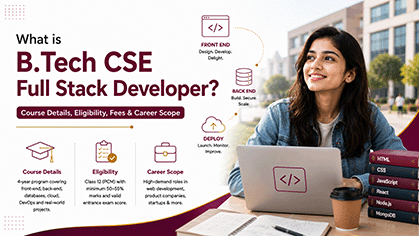
What is B.Tech CSE Full Stack Developer? Course Details, Eligibility, Fees & Career Scope Most job listings for “full stack developer” list ten skills in the description. Nobody masters all ten by graduation, and that scares off good students before they even apply. Here’s the part nobody explains clearly: a B.Tech CSE Full Stack Developer program isn’t designed to make you an expert in everything at once. It’s designed to make you dangerous enough in both halves of the stack — front end and back end — to build a real product and keep learning fast on the job. Stick with this guide, and you’ll walk away knowing the actual syllabus, the eligibility numbers, what colleges charge across India, and what companies genuinely pay once you graduate. The Myth Killing Full Stack Careers Before They Start Here’s a common misconception: that “full stack” means fluent in React, Node, Python, Java, AWS, Docker, and five databases on day one. That’s not how the degree works, and it’s not how hiring works either. AICTE’s own model curriculum for undergraduate CSE builds specializations as “micro-specializations” — a core lead course plus two or three additional courses aligned to one clear goal, not an endless skill checklist. A full stack engineering course applies that same logic: you go deep on one front-end framework and one back-end language, then branch out once you’re employed. Think of it like construction. Front-end work is the interior — what a visitor sees, touches, and judges in the first five seconds. Back-end work is the plumbing and wiring behind the walls, invisible until something breaks. Front End, Back End, and Where B.Tech CSE Full Stack Developer Fits A B.Tech CSE Full Stack Developer program teaches both sides on purpose, inside one four-year structure: Front end: HTML, CSS, JavaScript, and a component framework such as React Back end: server logic, REST APIs, and a language like Node.js, Java, or Python The connective tissue: databases, cloud deployment, and version control tools like Git A plain CSE degree touches these topics briefly. A full stack specialization builds entire semesters around shipping projects that use all three layers together. Curious what a structured version of this looks like in practice? ALARD University’s B.Tech CSE Full Stack Developer program lays out its front-end, back-end, and cloud modules semester by semester — worth a look before you compare anyone else. Full Stack Engineering Course Details: What You Actually Build, Semester by Semester Forget memorizing a syllabus PDF. Here’s what changes year by year, in plain terms. Years one and two build your foundation: math, programming logic, data structures, and database basics, shared with every other CSE branch. Year three is where the full stack developer course identity kicks in — front-end frameworks, backend APIs, and your first multi-layer project. Full Stack Developer Course: Semester-Wise Breakdown Year Focus Area Sample Subjects Year 1 Foundation Mathematics, Programming in C/Python, Data Structures, Web Basics Year 2 Core CSE + Web Fundamentals DBMS, Operating Systems, HTML/CSS/JavaScript, OOP Concepts Year 3 Full Stack Specialization React/Angular, Node.js or Java Backend, REST APIs, Cloud Basics Year 4 Applied Development & Deployment DevOps, Git & CI/CD, Capstone Project, Internship Most programs pair this with a semester-long internship and a capstone project — an e-commerce app, a booking platform, or a dashboard tool that actually runs end to end. Hiring managers don’t ask for your marksheet first. They ask for your GitHub link. Eligibility, Fees and Admission: The Real Numbers Behind This Degree Now for the part that actually decides where you apply: cutoffs, cost, and how you get in. B.Tech Full Stack Eligibility Criteria Three requirements show up across nearly every Indian university offering this specialization: A Class 12 pass with Physics and Mathematics, plus one of Chemistry, Computer Science, Electronics, or IT A minimum aggregate between 50% and 55%, depending on the institute A valid entrance score, or a direct-entry offer where the university skips exams for eligible marks Some universities add a short personal interview after the entrance test, mainly to check basic coding comfort, not to filter aggressively. Full Stack Developer Fees in India Fees swing widely by institute type, and that swing changes your break-even math after placement. Institute Type Approximate Annual Fee Total 4-Year Cost Typical Starting Salary Government / State-Funded ₹50,000 – ₹1,50,000 ₹2L – ₹6L ₹4–6 LPA Private University ₹1,20,000 – ₹2,80,000 ₹5L – ₹11L ₹5–9 LPA Premium / Industry-Tied Programs ₹3,00,000 – ₹4,50,000+ ₹12L – ₹18L+ ₹8–16 LPA These ranges come from current fee circulars and entry-level hiring data across Indian full stack programs. Verify the latest fee notification directly with your shortlisted college, since numbers shift every admission cycle. Full Stack Developer Admission Process Most seats in this specialization fill through one of these paths: JEE Main, accepted by NITs, IIITs, and most private universities JEE Advanced, relevant only where IITs offer this specific specialization State-level CETs such as Karnataka CET or MHT-CET University-specific entrance tests, often paired with a short interview Direct merit-based admission using Class 12 marks, where exams aren’t mandatory . Full stack development after 12th admissions typically open between April and June, with private university counseling stretching into August. Wondering which admission route fits your Class 12 score? ALARD University runs both entrance-based and direct merit tracks for its B.Tech Full Stack Developer program — check your eligibility before the counseling window closes. From Classroom to Codebase: How to Actually Land a Full Stack Job Here’s what separates graduates who get hired fast from ones who send fifty applications and hear nothing back. Full Stack Career Scope and What Companies Pay Entry-level full stack developers in India typically start between ₹4 and ₹9 LPA, with product-based companies paying toward the higher end. Developers with two to four years of experience and a strong project portfolio commonly cross ₹10-16 LPA, and specialists in high-demand stacks can exceed ₹18 LPA. Common roles after this full stack career scope discussion include: Full Stack Developer Frontend Developer Backend Developer Web Developer Application Developer
B.Tech Cyber Security & Forensics Complete Guide India
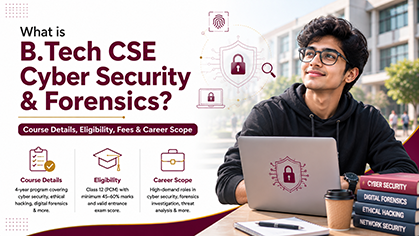
What is B.Tech CSE Cyber Security and Forensics? Course Details, Eligibility, Fees & Career Scope Can you really start a cybersecurity career the moment you finish Class 12, without waiting years for a separate certification afterward? Most students assume ethical hacking and digital forensics require a master’s degree first, and that wrong assumption keeps strong candidates out of the field too early. That confusion is exactly why parents struggle to compare this branch against a plain CSE degree on a brochure alone. B.Tech CSE Cyber Security and Forensics is a dedicated four-year engineering program built to train you in both digital defense and investigation from semester one, not a generic CSE label with a security elective bolted on. By the end of this guide, you’ll know the syllabus, the eligibility cutoffs, the real fee range across India, and the jobs this degree actually leads to. Why B.Tech CSE Cyber Security and Forensics Confuses So Many Applicants Ask five colleges what separates their cyber security engineering course from a standalone ethical hacking certificate, and you’ll get five different answers. Part of that confusion comes from how loosely the term “cyber security” gets used across brochures, YouTube ads, and short-term bootcamps. AICTE runs a dedicated Model Curriculum for UG Computer Science and Engineering at roughly 163 credits, plus a separate Minor Degree framework for Cyber Security that adds 18-20 credits on top of a core CSE degree. A full B.Tech CSE Cyber Security and Forensics program sits between these — it is a full specialization, not a minor add-on. A cyber forensics course specifically trains you to investigate breaches after they happen: recovering data, tracing attackers, and building evidence chains. Plain cyber security engineering focuses more on prevention — firewalls, encryption, and intrusion detection. Cyber Security Engineering vs Digital Forensics: What Each Half Actually Teaches Here’s the fastest way to separate the two halves of this branch before you apply: Cyber Security Engineering focuses on prevention: network defense, cryptography, secure coding, and threat detection Digital Forensics Engineering focuses on investigation: evidence recovery, malware analysis, and incident reconstruction after a breach. A combined B.Tech CSE Cyber Security and Forensics program teaches both halves side by side, so you graduate able to defend a system and investigate it once something slips through. If an admission counselor can’t explain which subjects map to which half, ask for the actual syllabus PDF before you commit. Comparing colleges this admission cycle? ALARD University’s B.Tech CSE Cyber Security and Forensics program at its School of Engineering and Technology lists its full elective structure publicly — worth checking before you shortlist anyone else. Cyber Security Engineering Course Details: Structure, Subjects and Duration This program runs four years across eight semesters, the same structure as any other engineering degree in India. Years one and two cover shared engineering fundamentals — mathematics, programming, and networking basics — before security-specific electives take over in year three. Students get hands-on exposure to real security and forensics tools across the program, not just theory: Wireshark, Nmap, Metasploit, Snort, Nessus, EnCase, FTK Imager, Autopsy, and Volatility all show up in various lab modules at leading programs. Cyber Forensics Course: Semester-Wise Breakdown Year Focus Area Sample Subjects Year 1 Foundation Mathematics, Programming in C/Python, Digital Logic, Communication Skills Year 2 Core CSE + Security Basics Data Structures, DBMS, Operating Systems, Computer Networks Year 3 Security & Forensics Specialization Cryptography, Ethical Hacking, Digital Forensics, Malware Analysis Year 4 Applied Security & Research Cloud Security, Cyber Law, Capstone Project, Internship Most programs require a semester-long internship plus a final-year capstone project, usually a working security tool — an intrusion detection system, a forensic evidence recovery script, or a vulnerability scanner. A graduate who ships a working forensic analysis tool during placements stands out far more than one who only completed lab reports. Eligibility, Fees and Admission Process for B.Tech Cyber Security When it comes to admissions, eligibility cutoffs and fees are where most of the real decision-making happens. B.Tech Cyber Security Eligibility Criteria You need three things to meet standard eligibility rules for this branch in India: A Class 12 pass with Physics and Mathematics, plus one of Chemistry, Computer Science, or Electronics from a recognized board. A minimum aggregate that ranges from 45% at some private universities to 60% at specialized institutes like NFSU. A valid entrance exam score, or a direct merit-based offer where exams aren’t mandatory. Some integrated programs, such as the B.Tech-M.Tech track at National Forensic Sciences University, also require a minimum score specifically in PCM alongside the overall aggregate. Confirm this detail college by college, since cutoffs shift every admission cycle. Cyber Security Fees in India Fees vary sharply by institute type, and that gap directly affects how fast you recover your investment after graduation. Institute Type Approximate Annual Fee Total 4-Year Cost Typical Starting Salary Government / State-Funded ₹60,000 – ₹1,50,000 ₹2.4L – ₹6L ₹3-6 LPA Private University ₹1,50,000 – ₹2,50,000 ₹6L – ₹10L ₹4-8 LPA Premium / Specialized Institutes ₹3,00,000 – ₹4,10,000+ ₹12L – ₹16.5L+ ₹6-10 LPA These figures come from current fee circulars and entry-level hiring data across Indian institutes. Treat the salary column as a comparison point, not a placement guarantee, and always confirm the latest fee notification directly with the college. Cyber Security Admission Process and Entrance Exams Most B.Tech CSE Cyber Security and Forensics seats fill through one of these routes: JEE Main, accepted by NITs, IIITs, and many private universities State-level CETs such as MHT-CET, KCET, or WBJEE University-specific entrance tests, common at private universities A written Statement of Purpose alongside test scores, required by some specialized programs Direct merit-based admission using Class 12 marks, where entrance exams aren’t mandatory Cyber security after 12th admissions typically open between April and June, with counseling rounds for private universities running into July and August. Not sure which admission route fits your Class 12 score? ALARD University runs both entrance-based and direct merit tracks for its B.Tech Cyber Security and Forensics program — check your eligibility before the
B.Tech AI and Machine Learning Course: Complete Guide 2026

What is B.Tech AI and Machine Learning? Course Details, Eligibility, Fees & Career Scope Should you pick B.Tech CSE, B.Tech AI and Machine Learning, or B.Tech AI and Data Science? Most Class 12 students can’t tell these branches apart from the brochure alone. That’s not your fault. Colleges register these programs under different AICTE codes, price them differently, and rarely explain how the electives actually differ from one branch to the next. B.Tech AI and Machine Learning is a dedicated four-year engineering program built around algorithms, data pipelines, and applied AI systems, not just a CSE degree with a new name. By the end of this guide, you’ll know what the course actually teaches, who qualifies for a seat, what it costs in India, and which jobs it realistically leads to. Why B.Tech AI and Machine Learning Confuses So Many Applicants Ask ten colleges what makes their AI and ML program different from a plain CSE degree, and you’ll get ten different answers. Part of that confusion is real, not manufactured by marketing teams. AICTE approves several specialization codes that sound almost identical: “Artificial Intelligence, Machine Learning & IoT,” “Artificial Intelligence and Data Science,” and standalone “CSE with AI.” Each one carries a different elective mix, even when brochures blur the lines. A B.Tech artificial intelligence and machine learning program specifically leans toward algorithms, model training, and deployment. A data-science-labeled branch spends more time on statistics and analytics instead. AI & ML vs AI & Data Science vs CSE (AI): What’s Actually Different Here’s the fastest way to tell these branches apart before you apply: AI & ML focuses on building and training models: supervised learning, deep learning, and MLOps AI & Data Science focuses on extracting insight from data: statistics, visualization, and data engineering CSE with AI keeps a broader computer science base, with AI added as one specialization layer, not the entire branch identity. If a college can’t explain this difference clearly during a campus visit, that tells you something about how seriously it has invested in the branch. Here’s a concrete way to test it on a campus visit: ask the admission department for the specific tools taught in lab modules. If the lab work leans heavily on Tableau and SQL over PyTorch and TensorFlow, the course sits closer to Data Science than true machine learning model engineering. Comparing colleges right now? Look at how ALARD University structures its B.Tech Artificial Intelligence & Machine Learning program before you shortlist anyone else — the elective list and lab access are public information. AI and ML Engineering Course Details: Structure, Subjects and Duration This program runs for four years across eight semesters, same as any other engineering degree in India. Years one and two cover shared engineering fundamentals — mathematics, physics, and programming — before AI and ML-specific electives take over. The AICTE model curriculum for AI-focused branches sits around 160-165 credits, split between core courses, professional electives, and a mandatory capstone project. This framework became the standard baseline for new AI and ML batches starting the 2025-26 academic cycle, so a college still teaching from a pre-2025 syllabus map is working off an outdated blueprint. AI and ML Engineering Details: Semester-Wise Breakdown Year Focus Area Sample Subjects Year 1 Foundation Mathematics, Physics, Programming in C/Python, Engineering Graphics Year 2 Core CSE + ML Basics Data Structures, DBMS, Operating Systems, Introduction to Machine Learning Year 3 AI/ML Specialisation Deep Learning, Neural Networks, NLP, Reinforcement Learning Year 4 Applied AI & Research MLOps, AI Ethics, Capstone Project, Internship Most programs require a semester-long internship and a final-year capstone project, usually built around a working model — a recommendation engine, a fraud-detection system, or a computer vision tool. A graduate of an AI and ML engineering course who ships two or three working models during college interviews far better than one who only submitted lab reports. Eligibility, Fees and Admission Process for B.Tech AI and ML When it comes to admissions, most of the real decision-making happens around eligibility and fees. Here’s the breakdown. B.Tech AI and ML Eligibility Criteria You need three things to meet standard b.tech ai and ml eligibility rules in India: A Class 12 pass with Physics, Chemistry, and Mathematics (PCM) from a recognized board A minimum of 50% aggregate marks (45% for SC/ST/OBC candidates at many state universities) A valid entrance exam score, or a direct merit-based offer where exams aren’t mandatory Many colleges also reserve 10-15% of AI and ML seats for direct-entry admission, skipping the entrance exam entirely for students who meet the marks cutoff. Confirm this quota with the specific college, since policies shift yearly. AI and ML Fees in India Fees vary sharply based on institute type, and the gap directly affects your break-even timeline after graduation. Institute Type Approximate Annual Fee Total 4-Year Cost Typical Starting Salary Government / State-Funded ₹40,000 – ₹1,50,000 ₹1.6L – ₹6L ₹5–9 LPA Private University ₹1,00,000 – ₹3,00,000 ₹4L – ₹12L ₹6–12 LPA Top-Tier Deemed / IIT-Level ₹2,50,000 – ₹6,00,000+ ₹10L – ₹24L+ ₹10–18 LPA These are broad national averages pulled from current fee circulars and entry-level hiring data. Always verify the latest fee notification for your target year, and treat the salary column as a comparison point rather than a promise. AI and ML Admission Process and Entrance Exams Most B.Tech AI and ML seats fill through one of these routes: JEE Main, used by NITs, IIITs, and many private universities JEE Advanced, required only for IIT programs offering the specialization CUET, used by several central universities State-level CETs such as MHT-CET, KCET, or WBJEE University-specific entrance tests, common at private universities Direct merit-based admission using Class 12 marks AI and machine learning after 12th admissions typically open between April and July, with counseling rounds running into August for most private universities. Unsure which admission route fits your Class 12 score? ALARD University runs both JEE-based and direct merit tracks for its B.Tech AI & ML program — check your eligibility before the counseling
What is B.Tech CSE Artificial Intelligence? Course Details, Eligibility, Fees & Career Scope
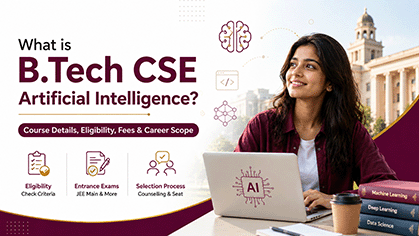
What is B.Tech CSE Artificial Intelligence? Course Details, Eligibility, Fees & Career Scope Every year, thousands of Class 12 students face the same confusing choice. Pick plain B.Tech CSE, or go for B.Tech CSE Artificial Intelligence and hope it pays off later. The honest answer isn’t simple. Colleges label this course differently, fee structures shift every admission cycle, and job titles change faster than any brochure gets updated. This AI-focused engineering degree blends core computer science — data structures, operating systems, and networks — with dedicated AI subjects like machine learning, neural networks, and natural language processing. By the end of this guide, you’ll know what the course actually covers, who qualifies for it, what it costs across India, and where this degree can realistically take your career. Why B.Tech CSE Artificial Intelligence Confuses So Many Students Parents ask one question first: is this a real branch, or a marketing label stuck on a standard CSE degree? Both answers are partly true. Some colleges run this AI specialization as an AICTE-approved branch with its own curriculum code and dedicated labs. Others simply add two or three AI electives to a regular CSE syllabus and rename the brochure. From the 2025-26 academic year, AICTE made this distinction slightly less obvious by mandating AI content across every core engineering syllabus, not just computer science. This reflects a view shared by AI-focused educators in India. Dr. Mily Lal, Associate Professor of Computer Engineering at ALARD School of Engineering and Technology, brings over 15 years of teaching and research experience in Artificial Intelligence and Natural Language Processing — exactly the profile that shapes how colleges design AI-heavy curricula. Faculty with this background generally argue that embedding AI into core learning outcomes, rather than treating it as an elective add-on, produces more job-ready graduates. That change means even a plain CSE student now studies AI basics. A dedicated program in Computer Science Engineering with AI still goes deeper, though, with focused labs, industry projects, and specialization electives that a general CSE timetable never covers. The Real Difference Between the Branch and the Buzzword Check the credit distribution before you enroll anywhere. Don’t just trust the branch name on the prospectus. A genuine artificial intelligence engineering course dedicates roughly 25-30% of total credits to machine learning, deep learning, computer vision, or NLP subjects. If a college’s “AI” branch offers only one or two electives beyond the standard CSE list, you’re paying a premium for a label, not for real specialization depth. Comparing the actual semester-wise syllabus matters far more than comparing glossy brochures. Comparing colleges right now? Look at how ALARD University structures its B.Tech CSE (Artificial Intelligence) program before you shortlist anyone else — the semester-wise syllabus is public and easy to compare. B.Tech CSE AI Course Details: Structure, Subjects and Duration This AI degree runs for four years, split into eight semesters, exactly like standard CSE. You’ll study common engineering subjects in the first two semesters — mathematics, physics, and programming fundamentals — before branch-specific subjects begin in year two. The AICTE model curriculum for AI-focused engineering programs follows a 165-credit structure, covering foundational computer science alongside dedicated AI and data science courses. Core Subjects and Semester-Wise Breakdown Here’s a realistic breakdown of what a B.Tech AI course details sheet usually includes: Course Table Year Focus Area Sample Subjects Year 1 Foundation Mathematics, Physics, Programming in C/Python, Engineering Graphics Year 2 Core CSE + AI Basics Data Structures, DBMS, Operating Systems, Introduction to AI Year 3 AI Specialization Machine Learning, Neural Networks, NLP, Computer Vision Year 4 Application & Research Deep Learning, AI Ethics, Capstone Project, Internship Most programs also require a semester-long internship and a final-year capstone project, usually built around a real AI use case such as a chatbot, a recommendation engine, or a predictive model for a local business problem. A computer science with artificial intelligence graduate who builds two or three working AI projects during college stands out far more in interviews than one who only completed classroom assignments. Eligibility, Fees and Admission Process for B.Tech CSE AI When it comes to college admissions, eligibility and fee structures are often the biggest deciding factors. Here’s what to expect. B.Tech CSE AI Eligibility Criteria You need three things to qualify for most B.Tech CSE AI eligibility checks in India: • A Class 12 pass with Physics, Chemistry, and Mathematics (PCM) from a recognized board • A minimum of 50% aggregate marks (45% for SC/ST/OBC candidates at many state universities) • A valid score in an accepted entrance exam, or a direct merit-based admission offer where entrance exams aren’t mandatory Some private universities accept students without Chemistry, provided Mathematics and Physics were compulsory subjects. Confirm this directly with the college’s admission cell, since state and private university rules differ from year to year. B.Tech CSE AI Fees in India Fees vary sharply depending on whether you choose a government institute, a state private university, or a top-tier deemed university. Course Table Institute Type Approximate Annual Fee Total 4-Year Cost Typical Starting Salary Government / State-funded ₹40,000 – ₹1,50,000 ₹1.6L – ₹6L ₹5–9 LPA Private University ₹1,00,000 – ₹3,00,000 ₹4L – ₹12L ₹6–12 LPA Top-tier Deemed / IIT-level ₹2,50,000 – ₹6,00,000+ ₹10L – ₹24L+ ₹10–18 LPA These are broad national averages pulled from current fee circulars and entry-level hiring data. Always check the specific fee notification for your target year, since colleges revise fees annually, and treat the salary column as a starting-point comparison rather than a guarantee. Admission Process and Entrance Exams Most B.Tech CSE AI admission seats fill through one of these five routes: • JEE Main scores, used by NITs, IIITs, and many private universities • JEE Advanced, required only for IIT programs offering the AI specialization • State-level CETs such as MHT-CET, KCET, or WBJEE • University-specific entrance tests, common at private universities • Direct merit-based admission using Class 12 marks, offered by many private institutions Artificial intelligence course after 12th admissions typically open between April and July,