
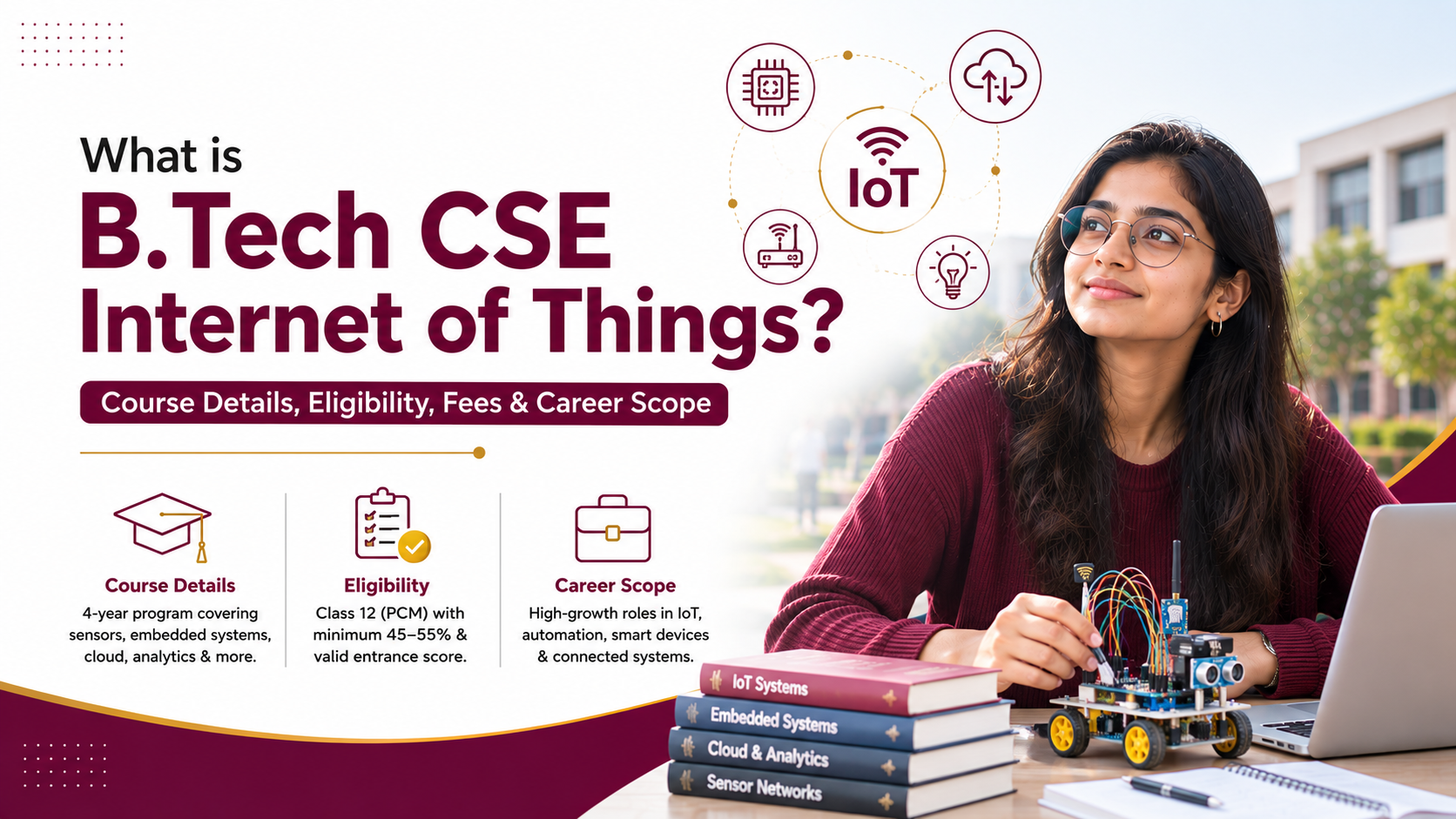
What is B.Tech CSE Internet of Things? Course Details, Eligibility, Fees & Career Scope
India's IoT market is on track to cross $26.93 billion by 2026, and every sensor, dashboard, and connected device behind that number needs someone to design it.
A B.Tech CSE Internet of Things degree puts you directly in that build queue — not on the sidelines reading about it.
Here's the catch: most college websites either bury this course inside a generic CSE page or mix it up with Electronics engineering, so you end up more confused after research than before it.
Stay with this guide, and you'll walk away knowing the real syllabus, the eligibility cutoffs, what colleges actually charge, and what IoT engineers take home once they're hired.
The Confusion Around IoT: Is It CSE, ECE, or Something Entirely New?
Ask three different colleges what "IoT engineering" means, and you'll get three different answers.
Some place it firmly under Computer Science. Others teach a hardware-heavy version inside Electronics and Communication Engineering.
Here's the short version: at most universities, B.Tech CSE Internet of Things is a Computer Science specialization that borrows electronics fundamentals, not the other way around.
Myth vs. Fact: What IoT Engineering Actually Involves
| Myth | Fact |
|---|---|
| IoT is basically electronics with extra coding | IoT blends software, cloud platforms, and hardware design in equal measure |
| You need prior hardware experience to apply | Most programs teach embedded systems and sensors from the ground up |
| IoT jobs barely exist in India | India's IoT market is projected near $27 billion by 2026, and demand is rising with it |
That table alone should settle most of the doubt your parents or relatives might raise about this specialization.
What Actually Separates IoT Engineering From Regular CSE
A connected devices engineering track adds four layers on top of standard Computer Science fundamentals:
- Sensors and actuators: how machines sense the physical world
- Embedded systems: the microcontrollers that run on tiny hardware
- Networking protocols: how devices talk to each other and to the cloud
- Data analytics: turning raw sensor data into decisions
Want to see this mapped out for real? ALARD University's B.Tech CSE Internet of Things program lists its embedded systems, sensor networks, and cloud modules semester by semester — a solid benchmark before you shortlist anywhere else.
Internet of Things Engineering Course: What's Actually Inside the Syllabus
Forget the marketing brochures for a second. Here's what a typical IoT engineering course actually teaches you, year by year.
AICTE's own model curriculum for emerging areas breaks the core IoT block into three explicit chunks: an 8-hour "Introduction to IoT" module, an 18-hour "IoT Application Development" module, and a 10-hour "IoT Case Studies" module.
That's the foundation. Universities build their own specialization electives on top of it.
Semester-Wise IoT Engineering Course Breakdown
| Year | Focus Area | Sample Subjects |
|---|---|---|
| Year 1 | Foundation | Mathematics, Programming Basics, Digital Electronics, Data Structures |
| Year 2 | Core CSE + Embedded Basics | DBMS, Operating Systems, Microcontrollers, Computer Networks |
| Year 3 | IoT Specialization | Sensor Networks, IoT Application Development, Cloud Platforms, Data Analytics |
| Year 4 | Applied Systems & Deployment | IoT Security, Industrial IoT, Capstone Project, Internship |
Most final-year students build a working prototype — a smart irrigation system, a home automation setup, or an industrial monitoring dashboard that reports live sensor data.
That prototype, not your marksheet, is usually what a recruiter asks about first.
IoT Engineering Fees, Eligibility and Admission: The Numbers That Matter
Now to the part that actually decides where you apply — cutoffs, cost, and your entry route.
B.Tech IoT Eligibility Criteria
Most Indian universities apply a consistent baseline for this specialization:
- A Class 12 pass with Physics, Chemistry, and Mathematics as core subjects
- Some universities also accept Computer Science or Biology as a fourth alternate subject
- A minimum aggregate between 45% and 55%, depending on the institute
A valid entrance exam score is usually required too, though several private universities offer direct, merit-based seats for eligible marks.
IoT Engineering Fees Compared by Institute Type
Your fee bracket changes your break-even timeline after placement, so this table matters more than it looks.
| Institute Type | Approximate Annual Fee | Total 4-Year Cost | Best Suited For |
|---|---|---|---|
| Government / State-Funded | ₹50,000 – ₹1,50,000 | ₹2L – ₹6L | Budget-conscious families, strong CET/JEE rank |
| Private University | ₹1,20,000 – ₹3,00,000 | ₹5L – ₹12L | Students prioritizing labs, placements, and flexibility |
| Premium / Industry-Tied Programs | ₹3,00,000 – ₹5,00,000+ | ₹12L – ₹20L+ | Families investing in specialized IoT labs and certifications |
These figures track current fee circulars and entrance data across Indian IoT engineering programs. Always confirm the latest number with your shortlisted college, since fee structures shift every admission cycle.
IoT After 12th: How Admission Actually Works
Most seats fill through one of these five routes:
- JEE Main, accepted by NITs, IIITs, and most private universities
- State-level CETs such as MHT CET, WBJEE, or KCET
- COMEDK or AUEET for select private and deemed universities
- University-specific entrance tests, sometimes paired with a short interview
- Direct merit admission using Class 12 marks, where exams aren't compulsory
Not sure which route fits your Class 12 score?ALARD University runs both entrance-based and direct-merit tracks for its B.Tech CSE Internet of Things program — worth checking your eligibility before counseling closes.
How to Choose the Right IoT Engineering Program (And Make the Degree Pay Off)
Here's where most guides stop and this one won't. Picking a college is only half the job.
IoT Career Scope You Can Actually Bank On
Entry-level IoT engineers in India typically start between ₹4 and ₹6 LPA.
Mid-level professionals with three to five years of experience commonly earn ₹8-12 LPA, and specialists with five-plus years cross ₹20 LPA.
Common roles under this smart technology engineering umbrella include:
- IoT Developer
- Embedded Systems Engineer
- IoT Solutions Architect
- Cloud & Data Analyst (IoT)
- Network Engineer (IoT)
- Industrial IoT Specialist
Dr. Deepali V. Patil, Associate Professor and IQAC Coordinator at ALARD University, brings over 15 years of teaching experience and completed her Ph.D. in Computer Science and Engineering in 2024. Her research focuses on Machine Learning, with contributions published in reputed international journals, giving students valuable exposure to research-driven and practical applications of emerging technologies.
The 3-Stage IoT Career Ladder
Treat this as your personal roadmap through the degree, not just a placement-season checklist::
- Stage 1 — Build: ship one personal IoT project, such as a Raspberry Pi home automation setup or a sensor-based monitoring tool
- Stage 2 — Apply: complete an internship on an embedded systems or cloud integration team, even a short one
- Stage 3 — Specialize: pick a niche such as Industrial IoT, Smart Cities, or Healthcare IoT once you've seen the field firsthand
Graduates who finish all three stages consistently out-interview candidates who only have textbook knowledge and zero shipped projects.
Conclusion
B.Tech CSE Internet of Things trains you to design, build, and deploy the connected systems already reshaping homes, factories, and cities across India.
Check your eligibility, compare fees against realistic starting salaries, and pick an admission route that matches your Class 12 score before committing four years.
Done right, this degree moves you from a Raspberry Pi hobby project to a paid IoT role faster than a generic engineering path ever could.
If you're shortlisting programs this admission cycle, review ALARD University's B.Tech CSE Internet of Things curriculum and talk to their admission counselors about your specific score before the next counseling round closes.
Frequently Asked Questions
1. What is B.Tech CSE Internet of Things?
A B.Tech CSE in Internet of Things is a four-year undergraduate engineering degree that trains students to design, build, and manage connected devices, sensor networks, and cloud-linked systems. It combines core Computer Science fundamentals with embedded systems, networking, and data analytics from the third year onward.
2. What is the eligibility for B.Tech IoT programs?
The minimum eligibility is a Class 12 pass with Physics, Chemistry, and Mathematics, with some universities also accepting Computer Science or Biology as a fourth subject. Most institutes require 45-55% aggregate marks, plus a valid entrance score or a direct-merit offer.
3. How much do IoT engineering fees cost in India?
IoT engineering fees range from around ₹50,000 per year at government institutes to over ₹5,00,000 per year at premium, industry-tied programs. Total four-year costs typically fall between ₹2 lakh and ₹20 lakh, excluding hostel charges.
4. What is the career scope after B.Tech CSE Internet of Things?
The career scope after B.Tech CSE Internet of Things spans roles like IoT developer, embedded systems engineer, and IoT solutions architect. Entry-level salaries typically start at ₹4-6 LPA, rising past ₹20 LPA for specialists with five-plus years of experience.
5. How is IoT engineering different from a regular CSE degree?
IoT engineering adds embedded systems, sensor networks, and connected-device architecture on top of standard Computer Science fundamentals. A regular CSE degree touches these topics briefly, while an internet of things engineering course dedicates entire semesters to building and deploying working hardware-software systems.
6. Which entrance exams work for internet of things admission?
JEE Main covers NITs, IIITs, and most private universities, while state-level CETs like MHT CET, WBJEE, and KCET cover regional institutes. COMEDK, AUEET, university-specific entrance tests, and direct merit-based admission cover most remaining private university seats.