
MHT CET: Syllabus, Exam Pattern & B.Tech Admission Process
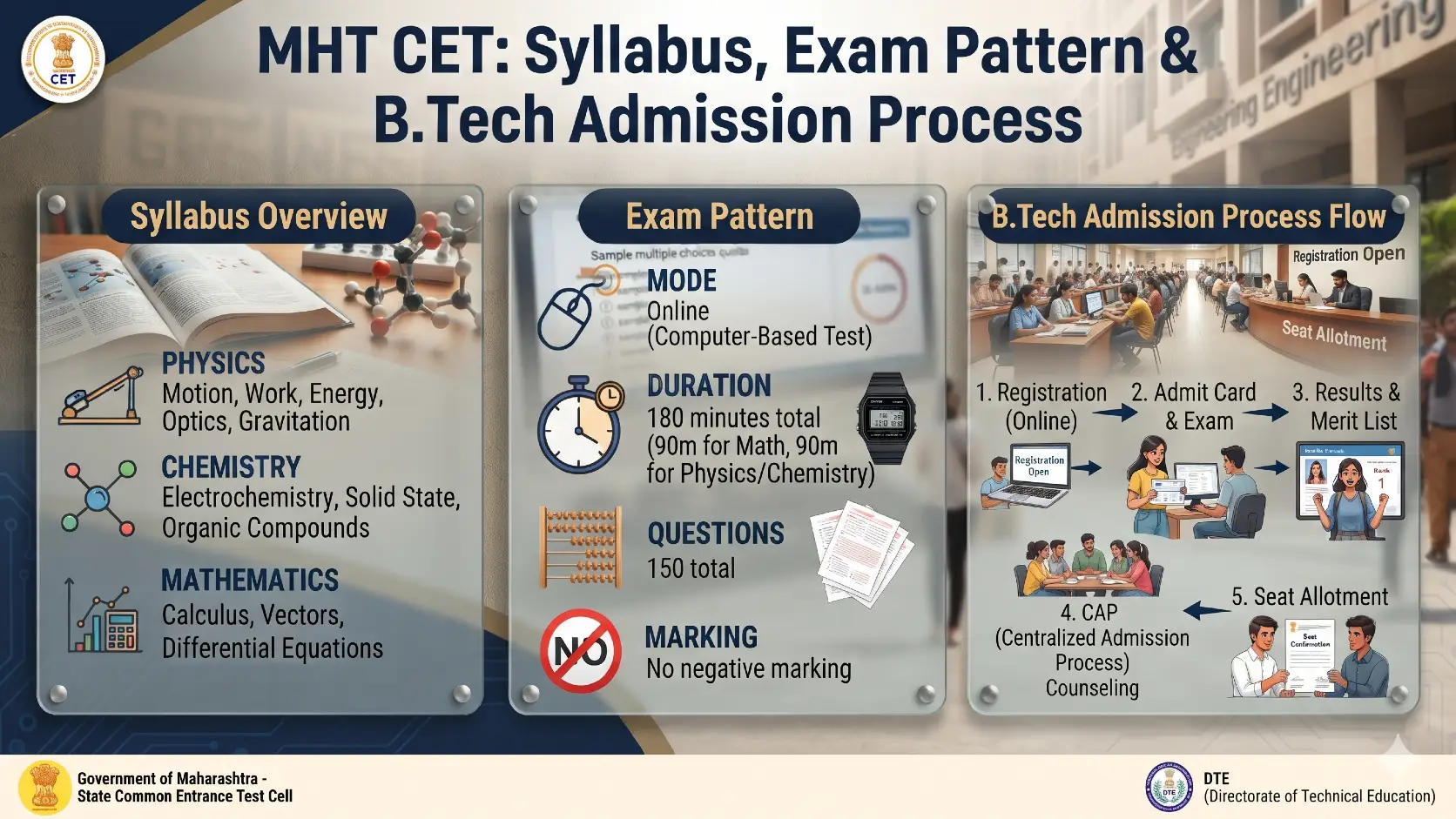
Quick answer: MHT CET is a computer-based entrance examination conducted by Maharashtra’s State CET Cell. The PCM group has 150 questions for 200 marks; PCB has 200 questions for 200 marks. Both follow a three-hour pattern with no negative marking. Engineering admission also requires the applicable eligibility checks and a separate admission application.
Preparing for MHT CET involves two different tasks: studying for the examination and completing the admission process afterwards. A strong score cannot replace a confirmed admission application, verified documents or timely choice filling.
This guide explains the syllabus, paper structure and route to B.Tech admission using the official 2026 documents. Dates, fees and admission procedures are cycle-specific, so applicants preparing for a later year should use that year’s notices.
What is MHT CET, and which group should you choose?
What is MHT CET, and which group should you choose?
MHT CET stands for Maharashtra Common Entrance Test. The State Common Entrance Test Cell, Maharashtra, conducts the examination for admission to specified undergraduate and integrated technical programmes.
Candidates can choose:
For the broad engineering admission route, PCM is the relevant group. However, saying that PCB candidates cannot enter any B.Tech programme would be incorrect. The 2026 rules allow eligible PCB candidates to apply for specified engineering disciplines; this does not make them eligible for every branch.
MHT CET syllabus: what you need to study
The official syllabus uses the curriculum prescribed by the State Council of Educational Research and Training, Maharashtra. For 2026, it includes:
• The entire prescribed Class 12 syllabus for the relevant subjects.
• Selected Class 11 chapters, listed subject by subject.
• Approximately 20% Class 11 weightage and 80% Class 12 weightage.
For Mathematics, the official distribution is 10 Class 11 questions and 40 Class 12 questions. Physics and Chemistry each follow the same 10-and-40 distribution, while Biology has 20 Class 11 questions and 80 Class 12 questions.
Selected Class 11 chapters for 2026
| Subject | Officially listed chapters or units |
|---|---|
| Physics | Vectors; Error Analysis; Motion in a Plane; Laws of Motion; Gravitation; Thermal Properties of Matter; Sound; Optics; Electrostatics; Semiconductors |
| Chemistry | Some Basic Concepts of Chemistry; Structure of Atom; Chemical Bonding; Redox Reactions; Elements of Groups 1 and 2; States of Matter—Gaseous and Liquids; Adsorption and Colloids—Surface Chemistry; Hydrocarbons; Basic Principles of Organic Chemistry; Chemistry in Everyday Life |
| Mathematics | Trigonometry II; Straight Line; Circle; Probability; Complex Numbers; Permutations and Combinations; Functions; Limits; Continuity; Conic Section |
| Biology | Biomolecules; Respiration and Energy Transfer; Human Nutrition; Excretion and Osmoregulation |
These entries follow the official 2026 syllabus document.
How to use the weightage in your preparation
Give Class 12 topics a larger share of your revision schedule, but do not treat Class 11 as optional. Some earlier concepts also support your understanding of later chapters.
A practical method is to make a syllabus checklist and mark each topic as:
• Not yet studied.
• Understood but not practised.
• Practised accurately without a time limit.
• Practised accurately under timed conditions.
This helps you distinguish familiarity with a chapter from the ability to answer its questions during the examination.
Use the official syllabus as the master list. A short chapter summary should not become your only guide to what is examinable.
Exam pattern and marking scheme
| Group | Subject | Questions | Marks per question | Maximum marks |
|---|---|---|---|---|
| PCM | Physics | 50 | 1 | 50 |
| PCM | Chemistry | 50 | 1 | 50 |
| PCM | Mathematics | 50 | 2 | 100 |
| PCM total | - | 150 | - | 200 |
| PCB | Physics | 50 | 1 | 50 |
| PCB | Chemistry | 50 | 1 | 50 |
| PCB | Biology | 100 | 1 | 100 |
| PCB total | - | 200 | - | 200 |
The question counts and marks follow the official marking scheme.
The two sections have separate time limits
For both groups, Physics and Chemistry are available during the first 90 minutes. That section is then automatically submitted.
The next 90 minutes are used for:
• Practised accurately without a time limit.
• Practised accurately under timed conditions.
You cannot carry unused time from the first section into the second. Practise the two timed blocks separately so your preparation reflects the actual paper structure.
MHT CET exam dates and attempts in 2026
The official notices published the following examination windows:
| Group | First attempt | Second attempt |
|---|---|---|
| PCM | April 11, 2026 → April 20, 2026 | May 12, 2026 → May 21, 2026, excluding May 16, 2026 → May 17, 2026 |
| PCB | April 21, 2026 → April 26, 2026 | May 10, 2026 → May 11, 2026 |
The first-attempt windows were published in the technical examination schedule. The later notice revised the second PCM attempt’s window.
These are examination windows, not a candidate’s individual appointment. The admit card provides the allotted date, shift and centre.
The 2026 brochure provided for a first-attempt option and a both-attempts option. For candidates appearing in both attempts, the better total percentile was considered for admission. Candidates could not combine their best subject-wise percentiles from different attempts.
The 2026 engineering admission portal now states that the admission process is closed. These dates should therefore be presented as 2026 reference information, not as upcoming deadlines.
Percentile is not the same as percentage marks
MHT CET is administered in multiple shifts. The official normalisation method converts raw scores into percentiles based on candidates’ relative performance within each shift.
A percentile indicates the proportion of candidates in that shift who scored equal to or below the candidate’s raw score.
For example, a 95 percentile does not mean that the candidate scored 95% of the available marks. It also does not directly state the candidate’s final CAP merit rank.
The total percentile is calculated from the total raw score; it is not an average of the individual subject percentiles.
Check B.Tech eligibility before applying for admission
Eligibility depends on your candidature type, qualifying examination, subject combination and intended course.
Under the broad 2026 Maharashtra State candidature route, applicants needed:
• Physics and Mathematics as compulsory qualifying-examination subjects, together with an approved additional subject.
• At least 45% in the prescribed subjects taken together, or 40% for the specified reserved-category, EWS and PwD candidates belonging to Maharashtra.
• Appearance in all PCM MHT CET subjects and a non-zero PCM score.
Important alternative routes
All India candidature: Eligible applicants could apply using JEE Main. Under the applicable engineering route, qualifying JEE Main scores received preference over MHT CET scores.
Specified PCB-based engineering options: The rules permitted eligible PCB candidates to apply for disciplines including agricultural engineering, biotechnology, food engineering, leather technology, packaging technology, pharmaceutical engineering, printing engineering, fashion technology and textile chemistry.
Other qualification and candidature routes have separate conditions. Check the complete admission notice rather than using a general summary to decide your personal eligibility.
From scorecard to admission: the CAP process
The Centralised Admission Process, or CAP, is separate from entrance-examination registration. The 2026 admission framework provided four CAP rounds.
1. Complete the admission application
Register on the official engineering admission portal during the notified window. Enter the required academic, examination and candidature details, then upload the supporting documents.
Having an MHT CET application number or scorecard does not complete your CAP application.
2. Get your documents verified and application confirmed
The 2026 notice offered two verification modes:
• E-scrutiny: Documents and the application are checked online.
• Physical scrutiny: The candidate attends the selected scrutiny or facilitation centre with the required documents.
Uploading documents alone is not enough. Check that verification and application confirmation are complete, and resolve any discrepancies within the permitted time
3. Check the provisional and final merit lists
Review your details when the provisional merit list is published. Use the official grievance process if a correction is needed, then check the final merit list.
4. Fill and confirm your option form
Enter institute and course choices in your genuine order of preference. Check the choice codes carefully and complete the required confirmation.
Include options you would realistically accept. A longer list is not automatically better if it contains courses you do not want to study.
5. Follow the allotment and seat-acceptance instructions
After allotment, check whether your seat is automatically frozen, whether you can freeze it voluntarily, or whether you remain eligible for betterment. These conditions depend on the CAP round and your allotted preference.
Complete the applicable self-verification, seat-acceptance payment and reporting requirements within the deadline.
6. Confirm admission with the allotted institute
Report as instructed, submit the required documents and pay the applicable institute fees. Keep the admission acknowledgement and payment records.
Seats remaining after CAP and institute-level seats follow additional procedures. They should not be treated as an informal admission route that bypasses registration or eligibility checks.
Examination fees and admission fees are different
For one examination group, the 2026 brochure listed:
| Fee category | First-attempt option | Both-attempts option |
|---|---|---|
| General/Open, Outside Maharashtra State and J&K migrant candidates | ₹1,300 | ₹2,600 |
| Candidates eligible for the specified concession | ₹1,000 | ₹2,000 |
The concession covered the specified Maharashtra reserved-category, EWS and PwD candidates, along with the orphan and transgender categories identified in the brochure. Applicable service charges or late fees were additional.
For admission registration, candidates already registered for MHT CET 2026 did not have to pay a separate CAP registration fee. Applicants using other eligible examination scores who had not registered for MHT CET needed to pay the applicable admission registration fee.
This exemption did not remove seat-acceptance charges or institute tuition fees.
Choosing study material without buying too much
Start with the prescribed textbooks and official syllabus. When selecting additional practice material, check whether it:
• Matches the current chapter list.
• Uses the correct PCM or PCB question distribution.
• Provides worked explanations.
• Includes timed practice.
• Identifies its edition and any corrections.
Use the official computer-based mock-test link when available to become familiar with the examination interface.
Keep a short error log after each practice session. Record whether you missed a question because of a concept gap, calculation error, misreading or time pressure. Your next revision session can then address a specific problem.
Frequently Asked Questions (FAQs)
1. What is included in the MHT CET syllabus?
The MHT CET syllabus includes the entire prescribed Class 12 syllabus and selected Class 11 chapters. For 2026, the approximate weightage is 80% from Class 12 and 20% from Class 11. Use the official subject-wise list, particularly for Class 11, rather than relying on a shortened coaching summary.
2. What is the MHT CET exam pattern?
The MHT CET exam pattern provides 180 minutes for either group. Physics and Chemistry occupy the first 90 minutes, followed by Mathematics for PCM or Biology for PCB. PCM contains 150 questions worth 200 marks; PCB contains 200 questions worth 200 marks. Neither group has negative marking.
3. Does a 95 percentile mean 95% marks?
A percentile is a measure of relative performance, not the percentage of available marks you scored. MHT CET uses shift-wise percentiles to account for papers administered in different shifts. A 95 percentile therefore does not mean 95% marks, and the total percentile is not the average of subject percentiles.
4. Is MHT CET compulsory for every B.Tech applicant?
Not necessarily. The 2026 engineering admission rules allow eligible All India candidature applicants to apply using JEE Main, with preference over MHT CET scores under that route. Maharashtra State candidature applicants generally require the relevant MHT CET score. Check the rule for your candidature, qualification and chosen course.
5. Can PCB candidates apply for B.Tech?
The broad PCM route requires the prescribed Physics and Mathematics qualifications and PCM test performance. However, the 2026 rules also permit eligible PCB candidates to apply for specified engineering disciplines, including biotechnology and food engineering. PCB eligibility does not extend automatically to every B.Tech branch or seat category.
6. Is examination registration the same as CAP registration?
No. MHT CET registration is for the entrance examination; CAP registration is a separate application for admission. Eligible candidates must complete the admission form, document verification, merit-list checks and option-form requirements. A scorecard alone does not complete the process or guarantee a B.Tech seat in a preferred institute.