

Career After B.Tech CSE Full Stack Developer: Top Jobs, Salary & Future Scope
Quick answer: A career after B.Tech CSE full stack developer typically starts between ₹3–8 LPA, with growth to ₹15–30 LPA by mid-career and ₹30 LPA+ in senior/lead roles. Growth estimates for end-to-end software developer demand in India range from 20–25% by 2030, making it one of the more durable specializations within CSE even as AI reshapes coding work.
If you're a B.Tech CSE graduate deciding between specializations, full stack development has a quiet advantage over narrower paths: you're not betting on one layer of the stack staying relevant. You build the interface, the logic behind it, and the systems that ship it — which is exactly why companies from early-stage startups to global tech giants keep this role near the top of their hiring lists. This guide covers what that career actually looks like: the jobs available, what they pay in India, how the path progresses, and where it's headed.
B.Tech CSE Full Stack Developer Career Scope
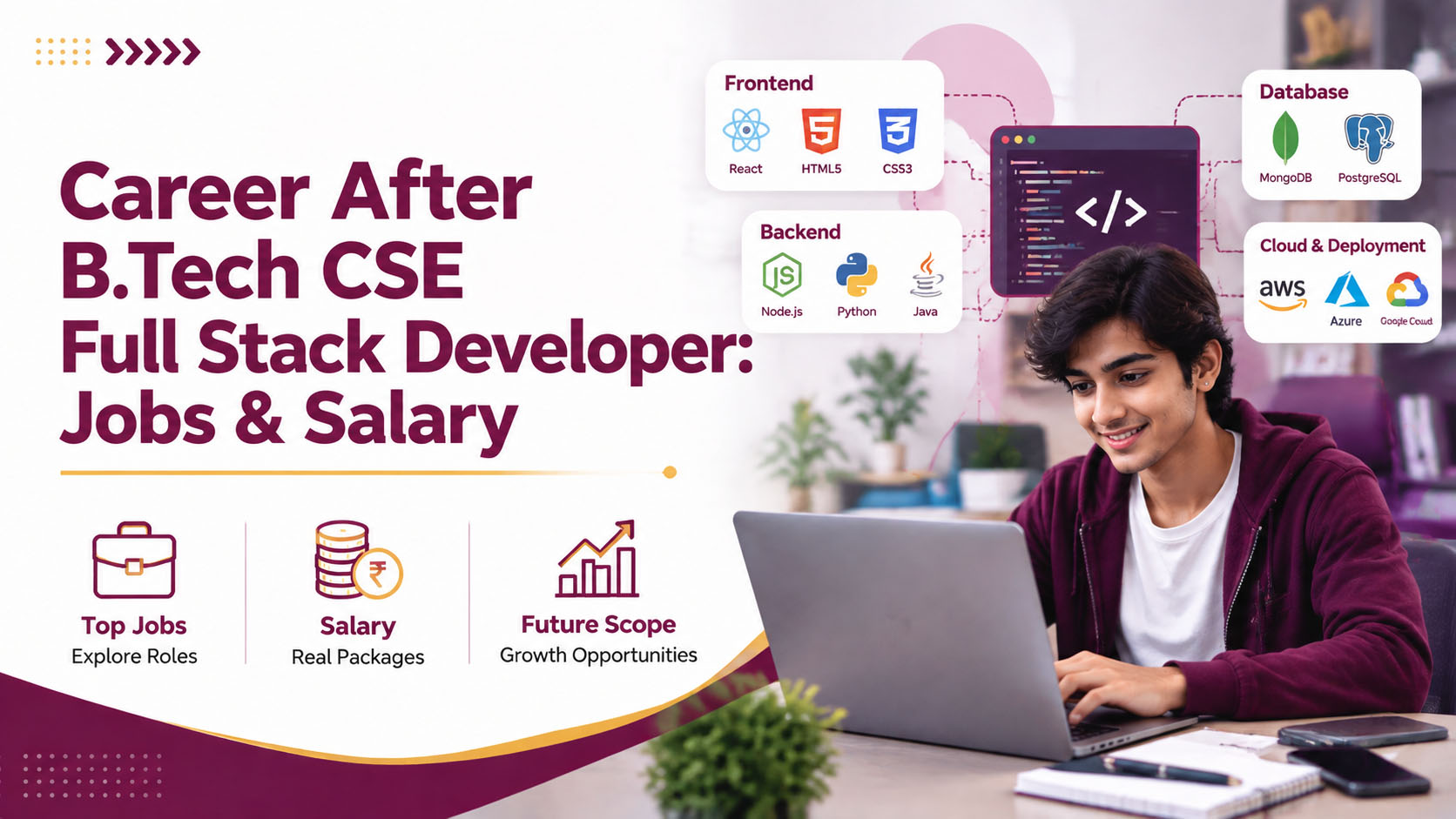
A B.Tech CSE full stack developer career scope spans both ends of software development — frontend interfaces (HTML, CSS, JavaScript frameworks like React), backend logic (Node.js, Python, Java), databases, and increasingly, deployment and cloud basics. This breadth is deliberate: the role exists because companies need people who can own a feature end-to-end rather than hand it between three specialists.
Your CSE foundation matters more here than it might seem. Data structures and algorithms show up constantly in technical interviews for this role, and system design knowledge — how databases, APIs, and servers actually talk to each other — separates candidates who can build a working prototype from those who can build something that survives production traffic.
The practical upside: because you're trained across the stack, you can pivot toward frontend-heavy, backend-heavy, or DevOps-adjacent work later without starting over. Few CSE specializations offer that kind of internal flexibility.
Jobs After B.Tech CSE Full Stack Development: Where Freshers Start
Jobs after B.Tech CSE full stack development for freshers rarely start with the full "full stack" title in practice — most graduates enter through one of these doors:
• Junior Full Stack Developer: Working under a senior developer on scoped features across the stack, typically at product startups or mid-sized service companies.
• Frontend/Backend Associate: A narrower entry point at larger companies that split roles by layer initially, with full stack ownership coming after 1–2 years.
• Software Development Engineer (SDE-1): Product companies often use this generic title for what is functionally a full stack role early in your career.
What actually gets freshers hired isn't the degree alone — it's demonstrable projects. A deployed personal project (not just a GitHub repo of tutorials) that handles real users, real data, and real edge cases signals more to a hiring manager than a high GPA, because it proves you can finish something, not just study it.
Top B.Tech Full Stack Developer Jobs You Can Target
As you gain experience, B.Tech full stack developer jobs open up across a clear role hierarchy:
| Role | Core Responsibility | Career Stage |
|---|---|---|
| Full Stack Developer | Build and maintain features across frontend and backend | Entry to mid |
| Frontend Developer | Specialize in UI/UX implementation and client-side performance | Entry to mid |
| Backend Developer | Own APIs, databases, and server-side logic | Entry to mid |
| DevOps-Leaning Full Stack Engineer | Combine development with CI/CD and cloud deployment | Mid |
| Technical Lead | Guide a small team's architecture and code quality | Mid to senior |
| Solutions Architect | Design system-wide technical strategy across products | Senior |
Notice that the highest-paying roles (Technical Lead, Solutions Architect) aren't necessarily "more full stack" — they're full stack experience combined with people or systems-level thinking. That's the real ceiling on this path: technical breadth gets you promoted; leadership or architecture skill gets you promoted again.
Career Options After B.Tech CSE Beyond Full Stack
Before committing, it's worth knowing how career options after B.Tech CSE compare. Full stack development sits alongside AI/ML engineering, cloud computing, cybersecurity, and data science as the five most common specialization paths for CSE graduates. Here's the honest tradeoff:
• AI/ML and data science often start at similar or slightly higher salaries but require deeper math and statistics comfort — if you're weighing this against full stack, our Career After B.Tech CSE AI guide breaks down exactly how much of that math-heavy foundation you'd actually need day-to-day.
• Cloud and cybersecurity offer strong government and enterprise demand but narrower skill scope than full stack's breadth, with a heavier compliance and security-audit workload — our B.Tech CSE Cyber Security and Forensics career guide covers what that compliance-heavy day-to-day actually involves.
• Full stack development trades a slightly lower ceiling at the very top end (compared to specialized AI roles) for significantly broader job availability — full stack roles exist at almost every company with a digital product, while AI and security roles concentrate in tech-first, regulated, or government-adjacent firms with correspondingly different salary ceilings.
If you value optionality — the ability to work at a startup, an enterprise, or freelance — full stack is usually the safer bet. If you want to maximize peak compensation and don't mind narrower job availability, AI/ML or cloud may pay off more.
Full Stack Developer Career in India: Junior to Senior Growth Path
A full stack developer career in India follows a fairly predictable progression, though the pace varies by company type:
• Junior Developer (0–2 years): Learning production codebases, shipping small features under review.
• Full Stack Engineer (2–5 years): Owning features independently, mentoring juniors, contributing to architecture decisions.
• Senior Engineer / Technical Lead (5–8 years): Leading design for larger systems, making stack and tooling decisions.
• Architect / Engineering Manager (8+ years): Setting technical direction across teams or products.
Service-company engineers (TCS, Infosys, Wipro) tend to move from ₹4–6 LPA to ₹8–12 LPA over roughly three years, while product-company and startup engineers often progress faster but with more variance — a strong performer at a fast-growing startup can outpace the service-company timeline by 1–2 years, while a slower-growth startup might lag it.
Full Stack Developer Jobs in India: Demand and Hiring Trends
Full stack developer jobs in India remain consistently high-volume — job boards routinely list several thousand open full stack roles at any given time across metros and tier-2 cities alike. Three hiring trends stand out right now:
• Startups and product companies prioritize full stack generalists over narrow specialists, since small teams need people who can move across the stack as priorities shift.
• In-demand stacks are shifting toward React/Node.js and Python-based frameworks, with legacy stacks (older PHP, jQuery-heavy setups) seeing comparatively less new hiring.
• AI-enabled full stack roles are emerging — job postings increasingly ask for comfort working alongside AI coding assistants, not competing against them.
This is a genuinely different hiring signal than five years ago: companies aren't just hiring for coding speed anymore, they're hiring for judgment about what to build and how to integrate AI tooling into the workflow.
Full Stack Developer Salary in India
Full stack developer salary in India varies by experience, city, and company type, but the overall trajectory is strong relative to other CSE specializations at the entry level:
| Experience Level | Typical Salary Range (Annual) |
|---|---|
| Entry-level (0–2 years) | ₹3–8 LPA |
| Mid-level (2–5 years) | ₹8–16 LPA |
| Senior (5–10 years) | ₹15–30 LPA |
| Lead/Architect (10+ years) | ₹30 LPA+ |
For context on scale: a full stack developer in the U.S. earns roughly $95,000–$135,000 on average, compared to the Indian equivalent of roughly ₹8–16 LPA at similar experience — a gap that's precisely why global companies continue expanding full stack hiring in India, and why remote/freelance opportunities with international clients (often ₹50,000–₹3,00,000 per month depending on project scope) are increasingly viable for experienced developers.
B.Tech CSE Career Opportunities Across Industries and Companies
B.Tech CSE career opportunities in full stack development span nearly every industry with a digital product:
• Product startups: Fast-paced, broad ownership, equity-linked compensation.
• Fintech and e-commerce: High-scale systems, strong pay premiums for reliability and security-conscious development.
• Enterprise IT services (TCS, Infosys, Accenture): Structured career ladders, lower starting pay, high job security.
• Global Capability Centers (GCCs): Increasingly hiring full stack talent directly for product work rather than only support functions, often at product-company-level pay.
• Freelance/remote international clients: Growing option for developers with 3+ years of experience and a strong portfolio.
The breadth here is the actual career advantage: unlike some specializations that concentrate in specific sectors, full stack skills transfer cleanly across all of these, so a lateral move rarely requires retraining.
Future Scope of Full Stack Development
The future scope of full stack development is stronger than the "AI will replace coders" narrative suggests. Growth estimates for end-to-end software developer demand in India range from 20–25% by 2030 — and the reason isn't that AI can't write code, it's that someone still needs to decide what to build, integrate AI-generated code into real systems, and take responsibility when it breaks in production.
Three shifts worth tracking:
• AI-assisted development becomes table stakes: Developers who can effectively direct AI coding tools will out-produce those who can't, but the underlying judgment about architecture and tradeoffs stays human.
• Full stack + cybersecurity is an emerging premium combination: As companies face more security and compliance pressure, full stack developers who understand secure coding practices command higher pay.
• Cloud-native development becomes the default, not a specialization — meaning basic cloud deployment literacy is shifting from "nice to have" to expected baseline for full stack roles.
The honest takeaway: this isn't a career that's safe because it's untouched by AI — it's safe because it sits at the intersection of judgment, integration, and accountability, which AI tools support but don't replace.
Your Next Step
Pick one layer of the stack you're weakest in — frontend, backend, or deployment — and build one complete, deployed project around it in the next 30 days. In a field this broad, a finished project that proves you can own something end-to-end beats a longer list of half-learned frameworks every time.
Frequently Asked Questions (FAQs)
1. Is full stack development a good career after B.Tech CSE?
Yes. A career after B.Tech CSE full stack developer offers broad job availability, strong entry salaries, and flexibility to pivot toward frontend, backend, or leadership tracks later. It's one of the more resilient CSE specializations because it isn't tied to one narrow industry or skill set.
2. What is the starting salary for a full stack developer in India?
Full stack developer salary in India for freshers typically ranges from ₹3–8 LPA, depending on company type and city. Product startups and top-tier recruiters often pay toward the higher end, while service companies typically start closer to ₹3–6 LPA.
3. What skills do I need to become a full stack developer after B.Tech?
Beyond B.Tech CSE fundamentals, you need frontend skills (React or similar), backend skills (Node.js, Python, or Java), database knowledge, and basic cloud/deployment familiarity. Strong data structures and algorithms knowledge remains essential for clearing technical interviews.
4. How does full stack developer career growth work in India?
A full stack developer career in India typically progresses from Junior Developer to Full Stack Engineer (2–5 years), then Senior/Technical Lead (5–8 years), and Architect or Engineering Manager beyond that, with salary and scope expanding at each stage.
5. Is full stack development at risk from AI coding tools?
Not significantly. AI tools speed up code generation, but full stack developers still make architecture decisions, integrate systems, and own production reliability — judgment work that AI assists rather than replaces, keeping demand for full stack development stable.
6. What is the future scope of full stack development in India?
The future scope of full stack development remains strong, with growth estimates for end-to-end developer demand ranging from 20–25% by 2030. Demand is shifting toward AI-assisted, cloud-native, and security-conscious full stack skills rather than shrinking overall.