

AI vs Cyber Security vs Full Stack: Which B.Tech CSE Specialisation Offers Better ROI?
Quick answer: No B.Tech CSE specialisation has a guaranteed ROI advantage. Compare total education cost, relevant placement outcomes, time to employment and realistic take-home income. AI/ML, Cyber Security and Full Stack lead to different kinds of work, but salary ranges and automation claims alone cannot establish which degree will repay its cost fastest.
A salary headline can make a specialisation look attractive without answering the question that matters to a family: what is the likely financial outcome of this particular programme at this particular cost?
The comparison becomes more useful when you separate three decisions:
• What kind of work you want to learn.
• Which college provides credible learning and placement opportunitie.
• Whether the complete cost fits your financial circumstances.
AI/ML, Cyber Security and Full Stack are different areas of computing. None comes with a guaranteed salary, employment timeline or return on investment.
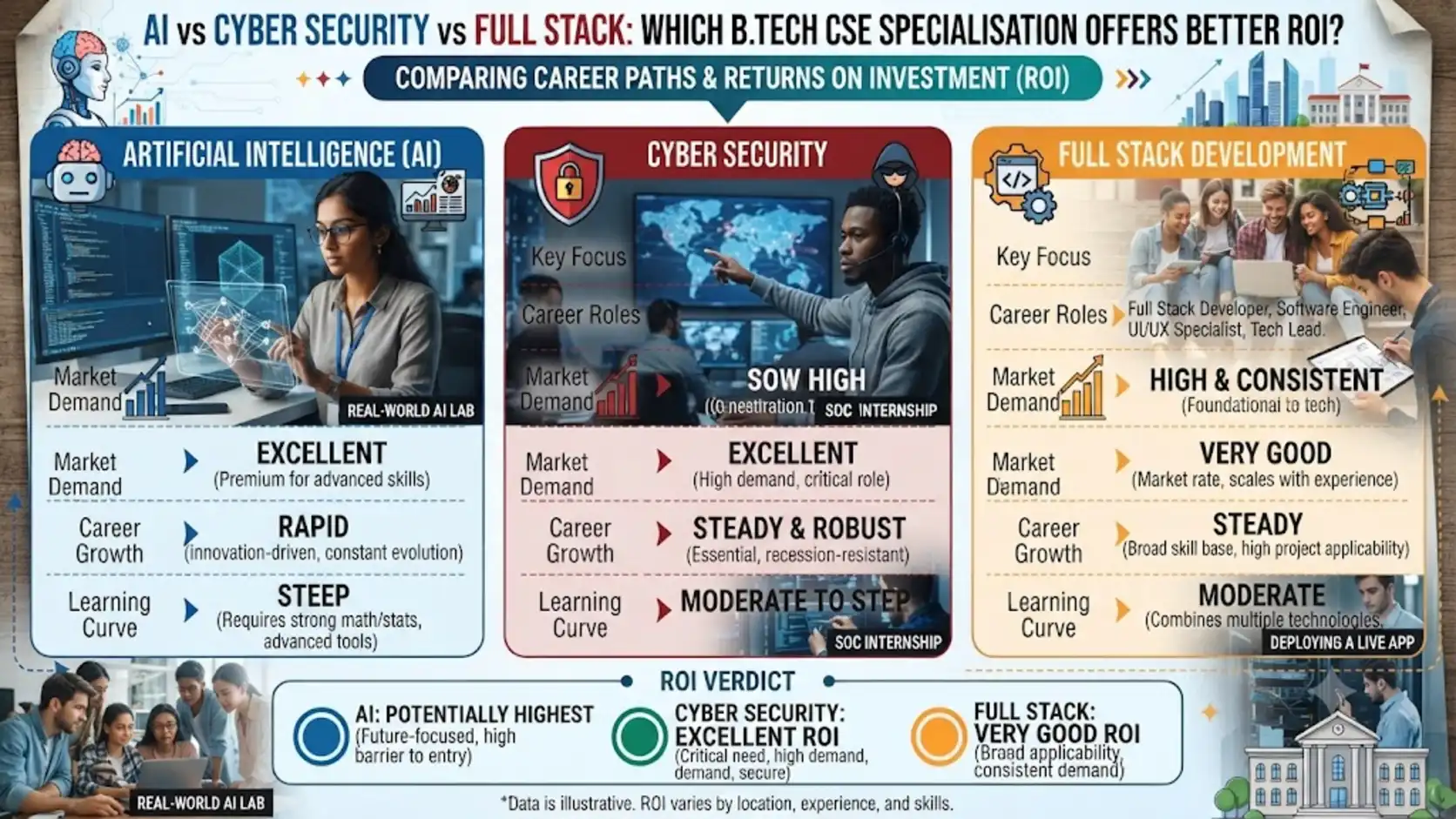
First, distinguish ROI from payback
Return on investment compares benefits and costs over a defined period. A fuller educational comparison considers earnings attributable to the qualification relative to an alternative, alongside education costs, financing, employment uncertainty and the value of time.
Payback asks how long it takes to recover an initial cost. It is a narrower measure.
Dividing a degree’s cost by gross annual salary does not establish either one reliably. It assumes the entire salary is available to recover that cost and ignores the expenses of earning and living.
A worked example—not a salary forecast
Suppose a student has:
• Total education expenditure: ₹10 lakh.
• Monthly take-home income after starting work: ₹50,000.
• Necessary monthly living expenses: ₹30,000.
• Monthly amount available for cost recovery: ₹20,00.
The simplified calculation is: ₹10,00,000 ÷ ₹20,000 = 50 months, or approximately four years and two months after employment starts.
This is a hypothetical, unfinanced cost-recovery example. It assumes stable income and expenses. It excludes the study period, job-search delays, loan interest and opportunity cost.
It also does not measure how much better off the student is compared with another education or employment route. That requires a separate comparison.
Build the cost side before comparing salaries
Use the actual fee schedule for each programme on your shortlist. Do not assume that one specialisation is cheaper because its learning resources are easier to access.
Your household budget should account for:
• Tuition and compulsory institutional charges.
• Accommodation, food and travel.
• Laptop and other required equipment.
• Examination or laboratory charges.
• Optional training and certifications.
• Financing charges, where applicable.
• A buffer for employment-search expenses after graduation.
For a strict comparison between alternatives, distinguish additional costs caused by studying from expenses you would incur anyway.
If you use an education loan, model its repayment schedule separately. Avoid counting the tuition principal once as education cost and again as an additional cost simply because it is repaid through instalments.
A lower-priced programme with credible outcomes may offer better financial value than a more expensive programme carrying a fashionable label. The label alone does not establish the difference.
Compare the learning, not an invented salary hierarchy
The table below is a curriculum and fit checklist—not a ranking of earnings.
| Area | What to investigate in the curriculum | A useful learning demonstration | Questions to ask the college |
|---|---|---|---|
| AI/ML | Mathematics, statistics, data preparation, model evaluation and deployment | Evaluate a model against a simple baseline and explain its limitations | How are mathematical foundations and evaluation assessed? |
| Cyber Security | Operating systems, networks, secure software, monitoring and risk analysis | Analyse permitted lab logs and explain the evidence behind a finding | Are labs authorised, supervised and supported by systems fundamentals? |
| Full Stack | Programming, databases, APIs, interface development, testing and deployment | Build and test an application with clear requirements and access controls | Do projects assess reliability and design, or only framework familiarity? |
The exact coverage varies by programme. Check the current syllabus, assessment tasks and degree title rather than assuming every institution uses these labels in the same way.
AI/ML: investigate the depth behind the label
AI/ML can be a suitable choice if you enjoy working with data, mathematical reasoning and uncertain results.
A useful programme should help you explain why a model performs as it does—not just run a library or connect to an AI service. Ask how students learn to identify data leakage, compare baselines, evaluate errors and communicate limitations.
There is evidence of demand. JobSpeak reported AI/ML hiring growth of 37% year on year for @March 1, 2026 → March 31, 2026. Its release also showed that growth varied across compensation bands.
That finding does not tell you the probability that a graduate from your shortlisted programme will enter an AI role. For that, you need the college’s actual graduate outcomes.
Cyber Security: distinguish organisational need from vacancies
Cyber Security can suit students who enjoy understanding systems, investigating evidence and explaining risk.
Check whether the course builds strong computing foundations alongside security tools. Projects should use authorised systems and data, with clear boundaries on what students may test.
Workforce-shortage figures need careful interpretation. The cybersecurity workforce study defines its gap as the difference between the workforce organisations say they need and the available workforce. It explicitly states that this is not an estimate of current job openings.
Regulation can make security and privacy responsibilities important, but it does not guarantee funded graduate vacancies. India’s DPDP commencement notification also brings provisions into force in phases, rather than implementing the entire Act at once.
Choose this area for the learning and work it involves, not because a shortage headline promises easy entry.
Full Stack: look beyond a framework checklist
Full Stack projects let students demonstrate how an application works from interface to database. That can provide tangible evidence of learning.
However, a working demonstration is only a starting point. Ask whether students also learn testing, authentication, database design, error handling, accessibility and deployment.
There is no basis here for calling Full Stack the fastest route to employment or assigning it the lowest career ceiling. Those claims require comparable hiring and career-progression evidence.
A developer’s opportunities depend on the work they can handle, the employer, experience and progression—not simply the specialisation printed on the degree.
A practical verification checklist before paying fees
The Centralised Admission Process, or CAP, is separate from entrance-examination registration. The 2026 admission framework provided four CAP rounds.
| Evidence to request | Why it matters |
|---|---|
| Graduating batch and programme breakdown | Establishes which students the results describe |
| Number seeking placement and number placed | Provides the denominator behind a placement rate |
| Median compensation and distribution | Gives more context than the highest offer |
| Actual job titles and responsibilities | Shows whether roles match the advertised specialisation |
| Fixed pay versus total CTC | Helps estimate realistic recurring income |
| Offers versus students who joined | Distinguishes an offer announcement from employment |
| Treatment of off-campus placements | Makes the reporting method clearer |
| Outcomes across several batches | Reduces dependence on one exceptional year |
Do not treat a university-wide highest package as the expected salary for a particular CSE track. Also check whether a report separates software roles, support roles, internships and other employment. A specialisation-level ROI claim needs specialisation-level evidence.
Automation exposure is not a job-security guarantee
The useful question is which tasks may change, not which degree is “automation-proof.” Research from the International Labour Organization distinguishes potential exposure to generative AI from actual job losses. It emphasises that task transformation is more likely than wholesale replacement across many exposed occupations.
This does not establish a permanent ranking in which Cyber Security is safe, AI/ML is moderately exposed and Full Stack is unsafe.
Across all three areas, look for learning that goes beyond producing an output:
• Checking whether the output is correct.
• Understanding the system in which it will be used.
• Testing assumptions and failure cases.
• Protecting data and managing permissions.
• Explaining decisions to other people.
These are curriculum-selection criteria, not promises about future employment.
Compare take-home income and living costs together
A larger CTC does not necessarily leave more money available each month.
When comparing actual offers or plausible scenarios, consider:
• Recurring fixed pay.
• Variable-pay conditions.
• Deductions and taxes.
• Stock vesting, where relevant.
• Rent, commuting and relocation costs.
• Loan repayments.
• Household responsibilities.
Broad city salary averages cannot establish that two employees perform identical work. Employer type, role, experience, seniority and sample composition can differ.
Use an explicit budget for each location you are realistically considering. Do not add a standard number of months to payback simply because a job is outside a major hiring hub.
Test your assumptions before choosing
Start with a realistic base case, then ask what happens if:
• Employment begins later than expected.
• The first role is adjacent to your preferred specialisation.
• Starting take-home income is lower.
• Living costs are higher.
• A scholarship changes the education cost.
• Additional training is needed.
These questions help you understand financial exposure. Without evidence-based probabilities, however, the result is a scenario analysis—not a statistically established “risk-adjusted ROI.”
Try a small task in each area
Before committing, complete three introductory exercises:
• AI/ML: Compare a simple model with a baseline and explain where it fails.
• Cyber Security: Review authorised sample logs and write an evidence-based finding.
• Full Stack: Build a small application, test it and explain one design decision.
Notice which work you want to improve—not just which result looks impressive.
Then ask colleges about shared CSE foundations, elective choices and any formal rules for changing tracks. Do not assume switching will be available.
The decision to make
There is no evidence here for a universal winner.
Choose AI/ML if its learning demands and available programme evidence fit your goals. Choose Cyber Security if you want to study systems, investigation and risk. Choose Full Stack if you want to develop and maintain applications across their components.
For financial value, compare the actual programmes available to you: complete cost, credible graduate outcomes, realistic cash flow and the consequences of a less favourable result.
Frequently Asked Questions (FAQs)
1. Which B.Tech CSE specialisation has the best ROI?
There is no verified universal winner. B.Tech CSE specialisation ROI depends on the actual degree cost, relevant placement outcomes, employment timing and earnings after necessary expenses. Compare the programmes available to you using consistent assumptions. A lower-cost course with credible outcomes may offer better value than a higher-priced specialisation.
2. Is AI better than Cyber Security for B.Tech?
AI/ML can be a good fit if you enjoy mathematics, data analysis and evaluating models. Cyber Security can suit an interest in systems, investigation and risk. Neither is automatically better for financial returns. Compare curriculum quality, assessed projects, graduate roles and total cost at the institutions you are considering.
3. Is Cyber Security automation-proof?
No. Security teams can use automation for parts of monitoring, analysis and response, while human responsibilities remain important. Research on generative AI exposure does not establish a permanent automation-proof ranking between these specialisations. Choose Cyber Security for the work and learning opportunities, not a promise of immunity from change.
4. Does Full Stack guarantee a faster first job?
Full Stack projects let students demonstrate a working application, but this does not prove universally faster hiring. Employers can also assess programming fundamentals, testing, database design and communication. Check which graduate roles your target college actually places students into and whether its published outcomes support the claimed entry advantage.
5. How should I estimate degree payback?
Build a total-cost budget, then divide that cost by the monthly amount you can realistically set aside after deductions and necessary expenses. This gives a simplified cost-recovery estimate once employment starts. It is not full educational ROI; job-search delays, financing costs, opportunity costs and alternative career earnings need separate treatment.
6. What placement information should I request?
Ask for the graduating batch, programme breakdown, number seeking placement, number placed, median compensation and actual job roles. Clarify fixed pay versus total CTC, whether offers became joining outcomes, and how off-campus placements were counted. Compare this evidence alongside the complete fee schedule rather than relying on the highest package.