

10 High-Paying Career Paths After B.Tech CSE in India
Quick answer: AI and machine learning engineering, data science, cloud, cybersecurity, DevOps, software development and data engineering can offer well-paid careers after B.Tech CSE. Software architecture and technical product management are additional progression paths. Compare the actual responsibilities, experience requirements, employer and compensation structure rather than assuming that one title guarantees the highest salary.
A salary headline is a poor starting point for choosing a career. An offer for a graduate developer cannot be compared directly with an experienced architect’s package. Nor can fixed annual pay be compared with a figure that includes bonuses and several years of stock options.
The ten paths below cover different kinds of computing work. They are not listed in salary order. Some offer graduate-entry opportunities; others are roles to work towards after gaining relevant experience.
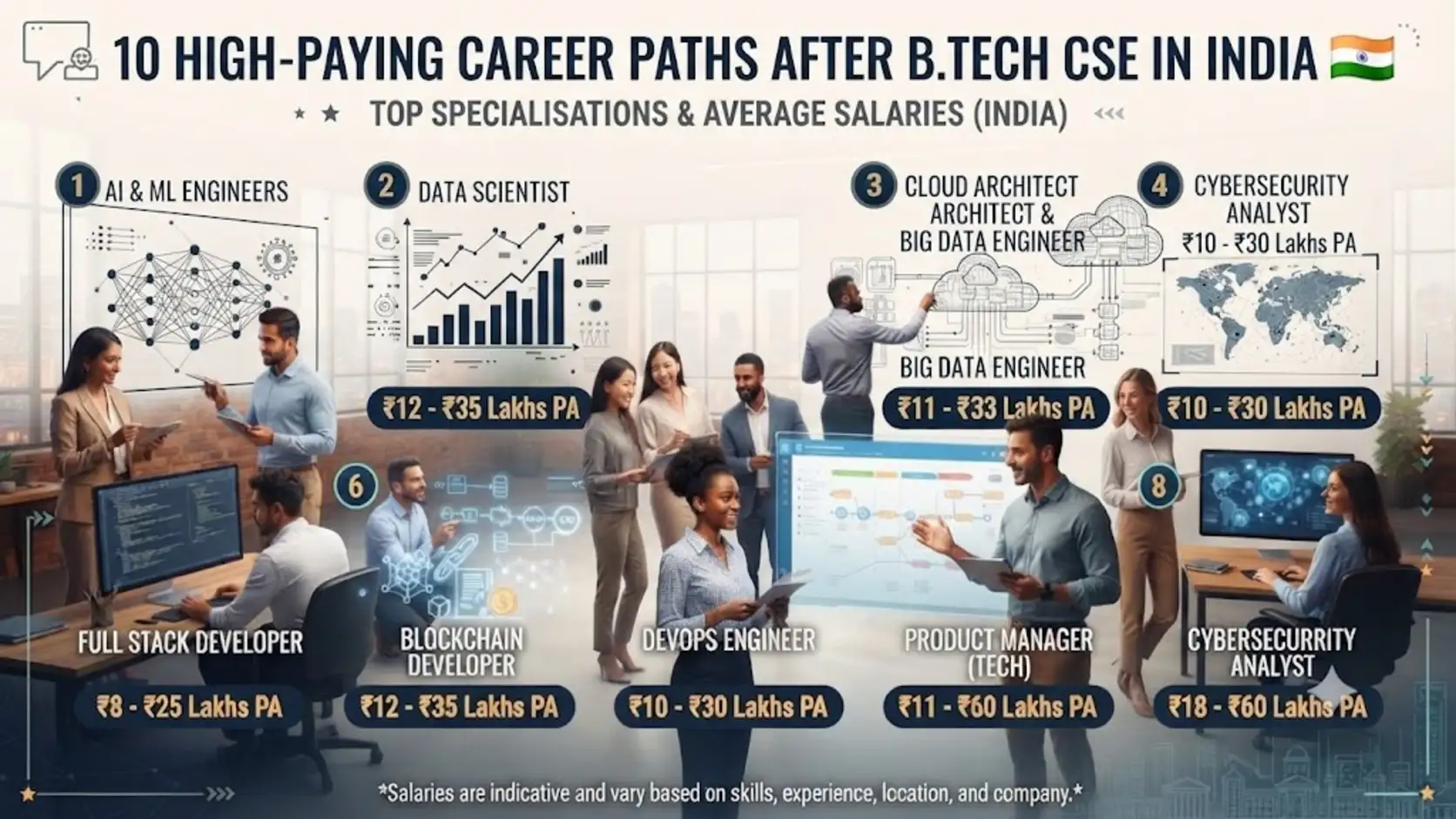
What the salary evidence actually supports
One published benchmark provides useful context. A salary-primer summary for FY2025–26 reports starting salaries of ₹7–8.5 lakh per annum for freshers in AI and cloud, drawing on insights from more than 30,000 salaries.
That is a dated finding from a particular dataset—not a guaranteed offer for every graduate. The public summary does not provide enough detail to assign a reliable salary range to every role in this article or establish whether all figures use the same compensation basis.
Broader industry growth also needs careful interpretation. An industry strategic review estimates technology-sector revenue of $315.4 billion for FY26, with approximately 135,000 net employment additions. These are sector-wide estimates, not a measure of how many fresh CSE graduates will be hired or what they will earn.
When researching salary after B.Tech CSE, look for a source that identifies:
• The job role and experience level.
• The location and employer segment.
• The period covered and size of the sample.
• Whether the figure is a median, average or selected offer.
• Whether compensation means fixed pay, total cash or total CTC.
Without those details, a precise-looking number can still be a weak comparison.
Ten career paths—and what the work involves
1. AI engineer: building useful AI applications
AI engineers develop or integrate AI capabilities into software. The work may involve prediction, language processing, image analysis or other applications, depending on the team.
Programming is only part of the job. You also need to understand the problem, assess the available data and decide how to evaluate whether the system works adequately.
For an illustrative student project, build a small application with an AI component and document its mistakes as carefully as its successful outputs. Explain the evaluation method, limitations and situations in which the application should not be relied upon.
Before applying, check whether a vacancy concerns application development, model engineering or research. Employers can use the same title for substantially different responsibilities.
2. Machine learning engineer: making models work reliably
Machine learning engineering combines software development with model-related work. A role may include preparing data, training models, integrating them into an application and monitoring their behaviour after deployment.
It overlaps with AI engineering, so the distinction is not identical at every employer.
A useful portfolio project should show more than a model’s final accuracy. Include a baseline, a clear separation between training and evaluation data, reproducible instructions and an explanation of errors.
Research-heavy positions may have requirements beyond an undergraduate degree. Read the eligibility criteria rather than assuming that every machine learning vacancy is open to freshers.
3. Data scientist: answering questions with evidence
Data scientists use data, statistics and computational methods to investigate questions. The output might be an analysis, an experiment, a forecast or a model—not necessarily an AI application.
The central skill is connecting the analysis to a question someone needs answered.
For example, a project using a permitted public dataset could investigate whether a pattern remains after accounting for missing records or differences between groups. Present the limitations alongside the findings.
Some graduates build relevant experience through analyst roles. That is a possible entry route, not a promise that every analyst position leads to data science.
4. Cloud engineer: running dependable infrastructure
Cloud engineers help configure, deploy and maintain the infrastructure supporting applications. Relevant foundations include operating systems, networking, access controls, automation, monitoring and cost awareness.
A small deployment project can demonstrate these skills. Explain how access is restricted, how failures are detected, how backups are handled and what the setup costs to run.
Cloud engineer and cloud architect should not be treated as interchangeable fresher roles. Architect positions generally involve broader design decisions and responsibility for trade-offs. The actual vacancy requirements matter more than the title.
5. Cybersecurity engineer: reducing technical risk
Cybersecurity work can include implementing security controls, reviewing configurations, investigating alerts or helping teams develop safer software.
Entry opportunities may also use titles such as junior security analyst, depending on the organisation. Practise only in environments where you have permission. An isolated lab, a deliberately vulnerable training application or an authorised student project can support learning without exposing someone else’s systems.
Document the scope, the issue found, the proposed remediation and any remaining limitations. A technical result is more useful when another person can understand what was tested and why.
Do not choose this field on the assumption that it is automation-proof or easier to enter than AI. Those claims need evidence and vary by role.
6. DevOps engineer: improving how software is delivered
DevOps-related roles work on the processes and systems used to build, test, release and operate software. Responsibilities can include deployment automation, configuration, monitoring and incident support.
Job titles vary considerably. Some employers seek experienced engineers; others offer junior positions or related infrastructure roles.
An illustrative project could automate testing and deployment for a small application. Add a rollback procedure and explain how you would detect a failed release.
The aim is not simply to list tools. Show how the process makes a release repeatable and recoverable.
7. Full-stack developer: connecting the whole application
Full-stack developers work across a web application’s user interface, server-side logic and data storage. The balance between those areas depends on the team.
A portfolio application should do a few things properly rather than contain many unfinished features. Demonstrate input validation, access permissions, sensible error handling and tests for important behaviour.
Include setup instructions and an honest contribution statement if the project uses templates, tutorials or team work.
Full-stack development can be a practical direction for students who enjoy building applications. It should not be described as universally lower-paid or as having a fixed career ceiling.
8. Data engineer: making data usable and dependable
Data engineers build and maintain systems that collect, transform and deliver data for other applications or teams.
SQL, programming and data modelling are useful foundations. So are careful handling of duplicates, missing values and changing source formats.
For an illustrative project, create a pipeline using permitted sample data. Make the transformations traceable and show what happens when an input is incomplete or invalid.
A working pipeline is only part of the evidence. Explain who needs the output, what quality checks apply and how a failed run would be investigated.
9. Software architect: a longer-term design path
Software architects make or guide decisions about the structure of software systems. The work involves understanding requirements, evaluating alternatives and communicating technical trade-offs.
This is generally a progression path rather than a standard first job after B.Tech CSE.
Development experience can help build the necessary judgement: how systems behave under load, how teams maintain them and what happens when requirements change.
There is no universal number of years after which someone becomes an architect. Responsibility, demonstrated ability and the employer’s expectations matter more than a fixed timetable.
10. Technical product manager: connecting the problem and the product
Technical product managers help teams decide which problems to address and how to evaluate the value of a proposed solution. They work with engineering and other stakeholders rather than simply directing what developers must build.
A CSE background can help when understanding technical constraints. The role also requires clear communication, prioritisation and an interest in users and business needs.
Some employers offer associate product opportunities; others expect previous experience. Senior product-management compensation should not be presented as a typical graduate salary.
To explore the work, write a short proposal for a hypothetical product improvement. Identify the user problem, competing priorities, constraints and a measurable outcome.
Compare the offer, not just the headline package
When two offers look different, break each one into comparable components.
| Component | What to check |
|---|---|
| Fixed pay | The annual contractual amount before deductions. |
| Variable pay | Conditions, targets and whether payment is guaranteed. |
| Joining or retention bonus | Whether it is one-off and whether repayment conditions apply. |
| Employer benefits | What is included in CTC but not paid into your account. |
| Equity | Whether the figure represents options, shares or a multi-year grant. |
| Work location | Relocation, travel, housing and routine living costs. |
| Employment terms | Probation, notice period, working arrangements and contract type. |
Ask for clarification when a component is unclear. A larger CTC figure does not automatically mean more monthly cash.
For campus outcomes, review the reporting method as well as the headline. Check whether figures cover placed students or the whole eligible cohort, and whether they are relevant to your programme. One unusually high offer does not describe the typical outcome.
Remote work: check the arrangement before comparing pay
An overseas remote opportunity may be an employment contract or an independent-contractor arrangement. Those are not equivalent.
Before comparing it with a domestic offer, establish:
• Who the contracting employer or client is.
• Whether leave, insurance and other benefits are provided.
• The payment currency and schedule.
• Required working hours and time-zone overlap.
• Contract termination and dispute terms.
• Tax, invoicing and compliance responsibilitie.
Do not assume that an overseas salary is automatically higher after accounting for benefits, uncertainty and expenses.
For cross-border tax or contractual questions, obtain advice suited to your circumstances before signing.
ESOPs are not annual cash salary
An Employee Stock Option Plan gives employees options under the employer’s scheme. It is different from receiving the same amount as cash salary.
Read the scheme and grant documents carefully. Important details include the exercise price, vesting schedule, any cliff, exercise deadlines, dilution and restrictions on selling.
A grant covering several years should not be compared directly with one year of fixed pay. Its eventual value is uncertain, and tax consequences may arise before an employee receives cash from a sale.
Treat equity as a separate part of the decision. Obtain current professional advice where the exercise or tax implications are material.
Government careers need a different pay comparison
Government and public-sector opportunities should be assessed using the official advertisement for the specific post.
For example, an official 2026 recruitment advertisement for Scientist/Engineer ‘SC’ positions, including computer science, specifies Level 10 minimum basic pay of ₹56,100 per month, with applicable allowances. It describes written-test and interview selection and states that employees are governed by the New Pension Scheme.
That is a documented example—not a universal government salary and not private-sector CTC.
For each vacancy, check the eligible degree, selection method, appointment terms, pay level, allowances and benefits. Do not assume that every role requires GATE or offers identical pension arrangements.
A practical way to choose your direction
Start with the work rather than the largest advertised salary.
Choose two or three role families to investigate. Read actual junior-level vacancies and note the recurring requirements. Then try a manageable project that lets you test whether you enjoy the underlying tasks.
Build strong computing foundations alongside that exploration. Programming, databases, operating systems, networking and clear technical communication remain useful across several paths.
A certification can be worthwhile when it matches a genuine requirement, your current level and your budget. It is not compulsory for every graduate, and it does not replace evidence that you can apply what you have learned.
When evaluating a first job, consider the responsibilities, feedback, working conditions and financial terms together. None guarantees rapid progression, but each affects whether the opportunity is suitable for you.
Frequently Asked Questions (FAQs)
1. What are the highest-paying jobs after B.Tech CSE?
AI/ML engineering, data science, cloud engineering, cybersecurity, DevOps, software development and data engineering are career paths worth investigating. Architecture and technical product management can become options with relevant experience. This is not a definitive salary ranking; the highest-paying jobs after B.Tech CSE vary by employer, seniority and compensation structure.
2. Which job has the highest salary after B.Tech CSE?
No single role is verified here as the highest-paying choice for every graduate. AI and ML positions can attract strong offers, but so can other specialised engineering roles. Compare positions requiring similar experience and distinguish fixed salary from bonus and equity. A high senior-level package does not establish typical fresher pay.
3. What is the salary after B.Tech CSE in India?
There is no single salary after B.Tech CSE that represents every graduate. Published figures depend on the role, employer, location, experience and reporting method. Use a dated benchmark for the relevant population, then check current job advertisements and campus outcomes. Median compensation is more informative than an isolated highest offer.
4. Can a fresher become a cloud architect?
Cloud engineer or junior infrastructure roles may provide an entry route, while architect positions usually involve broader design responsibility and relevant experience. Some employers use titles differently, so inspect the requirements rather than relying on the name. The same caution applies to software architect and senior technical product positions.
5. Are ESOPs the same as salary?
No. An Employee Stock Option Plan provides options under the employer’s scheme, not guaranteed annual cash. Check grant size, exercise price, vesting, exercise deadlines, dilution and sale restrictions. A total grant covering several years should not be compared directly with one year of salary, and tax consequences require separate review.
6. Do government CSE jobs always require GATE?
Not necessarily. Recruitment methods, eligible qualifications and selection stages vary by organisation and post. Check the current official advertisement for the exact role, rather than assuming a common route for every CSE graduate. Read the pay level, allowances, appointment terms and benefits separately; basic pay is not total CTC.