
Is ALARD University UGC Recognised? AICTE Rules and a Parents’ Verification Checklist
Quick answer: ALARD University has a published UGC letter confirming inclusion under Section 2(f) and degree-awarding powers subject to regulatory conditions. AICTE approval is not mandatory for state private universities under its current rules. Parents should separately verify the chosen course, campus, study mode and any professional-council permissions before paying fees.
When checking a university, an approval logo is only a starting point. The useful questions are: who will award the degree, where will the student study, which permissions apply to the course, and what do the supporting documents actually cover?
For ALARD University, the state legislation and published UGC letter provide evidence of its university status. Course-specific permissions need their own checks. An older approval letter, a document issued to a different college or a general recognition statement should not be treated as proof for every programme.
What the documents establish about ALARD University
ALARD University is listed in Part II of the Schedule to the Maharashtra Private Universities (Establishment and Regulation) Act, 2023, Maharashtra Act No. VIII of 2024. The Schedule identifies Alard Charitable Trust as the sponsoring body and gives the university’s location at Alard Knowledge Park, Marunji, Hinjewadi, Pune.
The university’s published UGC establishment letter records:
• State establishment with effect from @February 15, 2024.
• Operationalisation from @June 19, 2024.
• Inclusion in the UGC-maintained university list under Section 2(f).
• Authority to award specified degrees through its main campus in regular mode, subject to the stated statutory and regulatory requirements.
This is stronger evidence than an education-directory entry.
Keep the university and legacy colleges separate
An earlier ALARD college and ALARD University should not be treated as interchangeable names when checking approval documents.
Match the institution named on the document with the institution offering admission. A letter issued to a legacy college does not, by itself, establish approval or accreditation for the university.
The admission offer should clearly identify the degree-awarding university, teaching location, programme and study mode.
Keep the university and legacy colleges separate
What “UGC recognised” means—and what it does not mean
The phrase “UGC approved” is common in searches, but it can obscure several different questions. Under the UGC Act:
| Provision | What it addresses |
|---|---|
| Section 2(f) | The definition of a university within the Act |
| Section 12B | Fitness to receive specified grants |
| Section 22 | The right to confer degrees and the specification of degree nomenclature |
These provisions should not be presented as three identical approval certificates.
ALARD University’s published UGC letter confirms its inclusion under Section 2(f). However, the letter expressly states that inclusion alone does not authorise admissions without the required academic infrastructure, faculty and compliance with the relevant norms.
University recognition therefore does not remove the need to examine course-specific requirements.
Does ALARD University require AICTE approval?
The answer needs to distinguish a state private university from a standalone technical institution. AICTE’s 2026–27 addendum states that approval is not mandatory for state public universities, state private universities and central universities, referring to the Supreme Court’s decision in Bharathidasan University vs AICTE. It also addresses seeking approval for access to AICTE schemes and initiatives under the applicable policies and standards.
Consequently, the absence of a state private university from an AICTE approval list should not automatically be described as evidence that its engineering degree is invalid.
At the same time, if ALARD University advertises a specific AICTE approval, parents should request the actual document and check:
• The institution and campus named.
• The programme covered.
• The applicable academic year or validity period.
• The approved intake and conditions.
• Whether the document concerns the university or a different ALARD institution.
Avoid blanket statements about BBA, MBA and other courses
It is also unsafe to state that every BBA is outside AICTE’s scope or that every MBA requires the same approval process. The institution’s legal category and the applicable programme rules matter. AICTE’s current framework expressly addresses management and computer-application courses at institutions.
The correct verification question is: Which requirements apply to this programme at this institution?
Pharmacy, law and accreditation require separate checks
Pharmacy: check the exact course and session
The inspected PCI decision letter identifies Alard School of Pharmacy, PCI-70, with Alard University, Pune as the university. It lists the following permissions for 2025–26:
| Programme | Admissions listed in the decision |
|---|---|
| D.Pharm | 60 |
| B.Pharm | 100 |
| M.Pharm—Pharmaceutical Quality Assurance | 15 |
| M.Pharm—Pharmaceutics | 12 |
The decision includes conditions and directs readers to verify course details through PCI.
This establishes what the inspected letter covers. It does not automatically establish permission for a later academic session, another specialisation or a different intake.
Law: match the approval to the qualification
ALARD University’s disclosure page links a BCI approval document. However, a link or approval logo is not enough to confirm the current scope of permission.
For a law course, check the exact school, qualification, permitted intake and period covered in the BCI record or order. The BCI maintains an approved list of Centres of Legal Education.
Do not assume that a document for a three-year LL.B. also covers every integrated law programme or postgraduate law course.
The current ALARD law-course approval period was not independently confirmed in this review.
NAAC: accreditation is not university incorporation
NAAC assesses institutional quality. It is separate from the university’s legal establishment and degree-awarding authority. Its published information also distinguishes existing graded accreditation from newer accreditation frameworks.
Before publishing a NAAC claim, obtain the certificate and match:
• The exact institution name.
• Accreditation cycle.
• Grade or status under the applicable framework.
• Validity period.
A certificate belonging to an earlier ALARD college should not be described as ALARD University’s accreditation. No current university-level NAAC certificate was verified for this article.
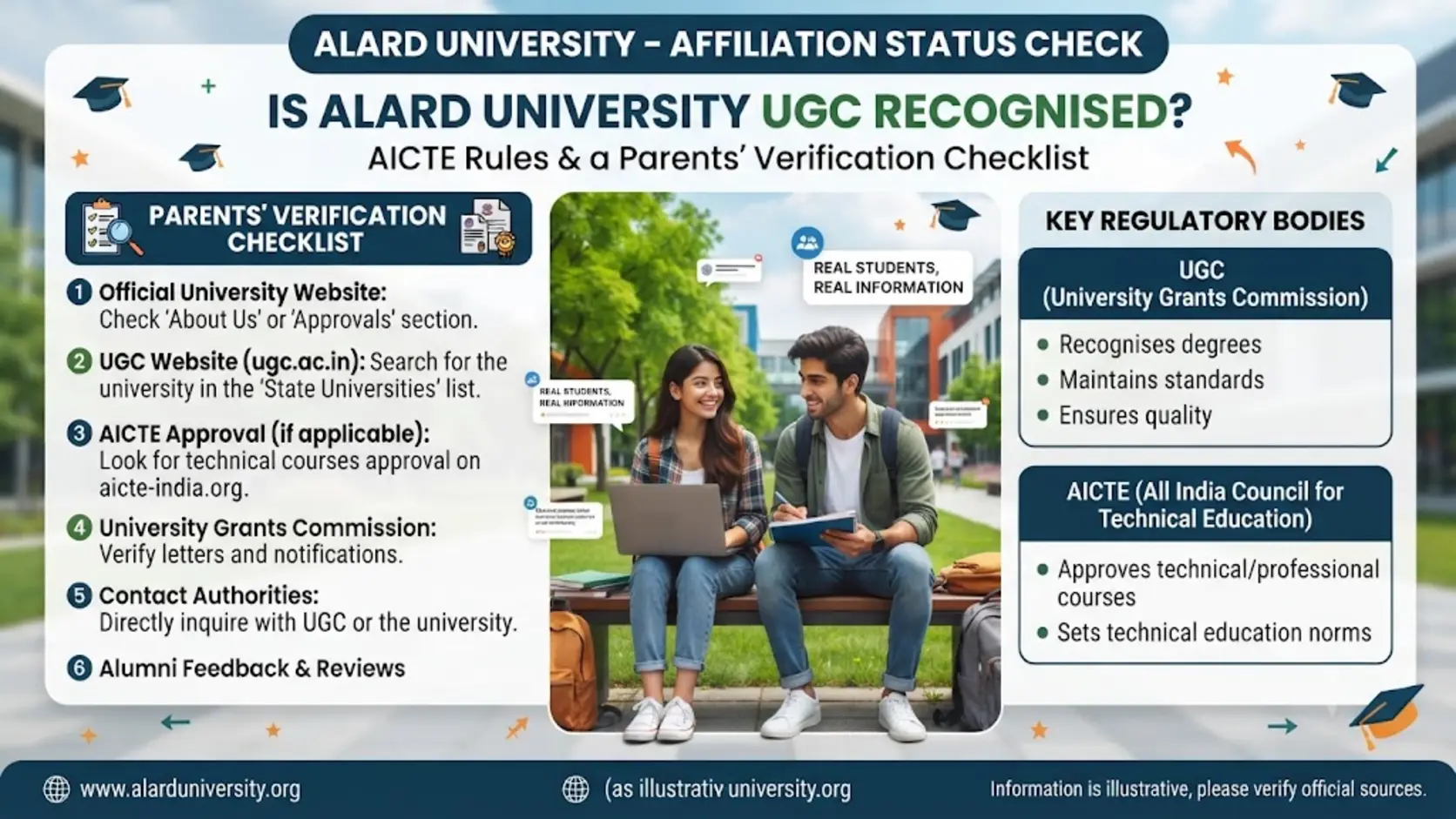
A practical verification checklist before paying fees
The Centralised Admission Process, or CAP, is separate from entrance-examination registration. The 2026 admission framework provided four CAP rounds.
1. Identify the institution awarding the degree
Check the admission offer and programme documents. Confirm that the university name and address match the legal and UGC records.
2. Read the recognition document—not just the logo
Use the UGC university directory and the published establishment letter. Check for later notices or restrictions relevant to the university.
ALARD University’s letter sets conditions for infrastructure, degree nomenclature, statutory permissions and academic operation.
3. Check campus and study mode
Confirm whether the offer is for regular on-campus study, online learning, distance education or another arrangement.
The inspected UGC letter authorises specified degrees through the main campus in regular mode, subject to conditions. It states that online and distance programmes require prior UGC approval.
4. Verify professional-course permissions
Where applicable, check the relevant council’s decision for the exact course, institution, intake and academic session.
An application for approval or renewal is not the same as an approval decision.
5. Check accreditation separately
If a NAAC status is advertised, obtain its supporting certificate. Do not infer accreditation from UGC recognition or from another institution in the same group.
6. Read the financial terms
Request the written fee schedule, payment instructions and refund policy. Pay through an official channel and retain the receipt.
7. Resolve document mismatches in writing
If the brochure, admission offer and approval letter use different names or course descriptions, ask the registrar or admissions office to explain the difference before paying.
Save dated copies of the records and written responses.
Which warning signs deserve further investigation?
For one examination group, the 2026 brochure listed:
| What you encounter | What to check next |
|---|---|
| An approval logo without a document | Request the order or letter and verify its scope |
| A letter issued to a different institution | Ask how it applies to the offered programme |
| A previous-session professional approval | Obtain the decision applicable to the intended intake |
| “Renewal applied for” | Check whether a decision has been issued |
| An unexplained online, franchise or off-campus offer | Check the permission for that mode and location |
| Pressure to pay before documents are available | Request written clarification and financial terms |
These are reasons to investigate, not automatic findings that an institution is fake.
Similarly, admission without a separate entrance test is not, by itself, proof of wrongdoing. Check the published eligibility and selection rules for the particular course.
Does recognition guarantee acceptance for jobs and further study?
No single recognition letter guarantees eligibility for every employment opportunity, competitive examination or postgraduate programme.
The UGC Act addresses degree-awarding authority. The receiving employer, examination body or university may impose additional requirements concerning subjects, marks, degree level, study mode or professional registration.
International admission or employment may also require a separate credential assessment. Parents should therefore check two things independently:
• Whether the programme is lawfully offered under the applicable requirements.
• Whether that qualification meets the rules of the intended next step.
Avoid assurances that approval at enrolment alone guarantees acceptance everywhere. If a later regulatory change affects a cohort, obtain clarification from the relevant authority.
Frequently Asked Questions (FAQs)
1. Is ALARD University UGC recognised?
ALARD University’s published UGC establishment letter confirms that its name was included in the Section 2(f) university list. The letter also sets conditions for academic infrastructure, degree nomenclature and statutory permissions. Parents should check the current UGC entry and any later notices rather than treating recognition as approval of every course.
2. Is ALARD University AICTE approved?
AICTE’s 2026–27 rules state that approval is not mandatory for state private universities in the same way as for standalone technical institutions. This review did not verify an ALARD University-specific AICTE approval letter. If such approval is advertised, request the document and check its institution, programme, campus and validity.
3. What pharmacy approval evidence is available?
The inspected PCI decision letter identifies Alard School of Pharmacy, PCI-70, and lists D.Pharm, B.Pharm and two M.Pharm specialisations for 2025–26. That is evidence for the stated session, not automatic confirmation for a later intake. Check the current PCI decision for the exact course and permitted admissions.
4. Is ALARD University NAAC accredited?
A university’s UGC status and its NAAC accreditation answer different questions. This review did not verify a current NAAC accreditation record for ALARD University itself. Do not transfer a grade from an earlier ALARD college to the university; request the certificate and match the institution, cycle and validity dates.
5. Is an ALARD University degree accepted for every job or higher-study application?
University recognition supports lawful degree awarding subject to the applicable conditions, but it does not guarantee eligibility for every job, examination or postgraduate course. Check the specific qualification, subject, marks, study mode and professional-registration requirements in the receiving authority’s notice. International acceptance may also require a separate credential assessment.
6. What documents should parents retain before paying?
Keep the admission offer, exact degree and campus details, applicable regulator letters, approved intake information, fee schedule, refund policy and official payment receipt. Save dated copies of the records you checked. If an approval claim is unclear, obtain a written explanation from the university and clarify it with the regulator.