

JEE Main vs MHT CET: Which Score Matters More for Pune Engineering Colleges?
Quick answer: Neither examination is universally more important for Pune engineering admission. MHT CET is relevant to Maharashtra State candidature seats, while JEE Main receives preference under the applicable All India CAP route. ALARD University lists both examinations for B.Tech admission; applicants must also meet eligibility requirements and follow the appropriate application process.
If you are comparing JEE Main vs MHT CET, start with two questions: Where do you want to study, and which admission routes are you eligible to use?
Pune has institutions that participate in Maharashtra’s Centralised Admission Process, known as CAP, as well as universities with their own application and selection procedures. An entrance score can therefore serve different purposes at different institutions.
This guide draws on official 2026 admission documents and institution pages. For a later intake, check the corresponding notices before relying on accepted examinations, seat allocations or counselling procedures.
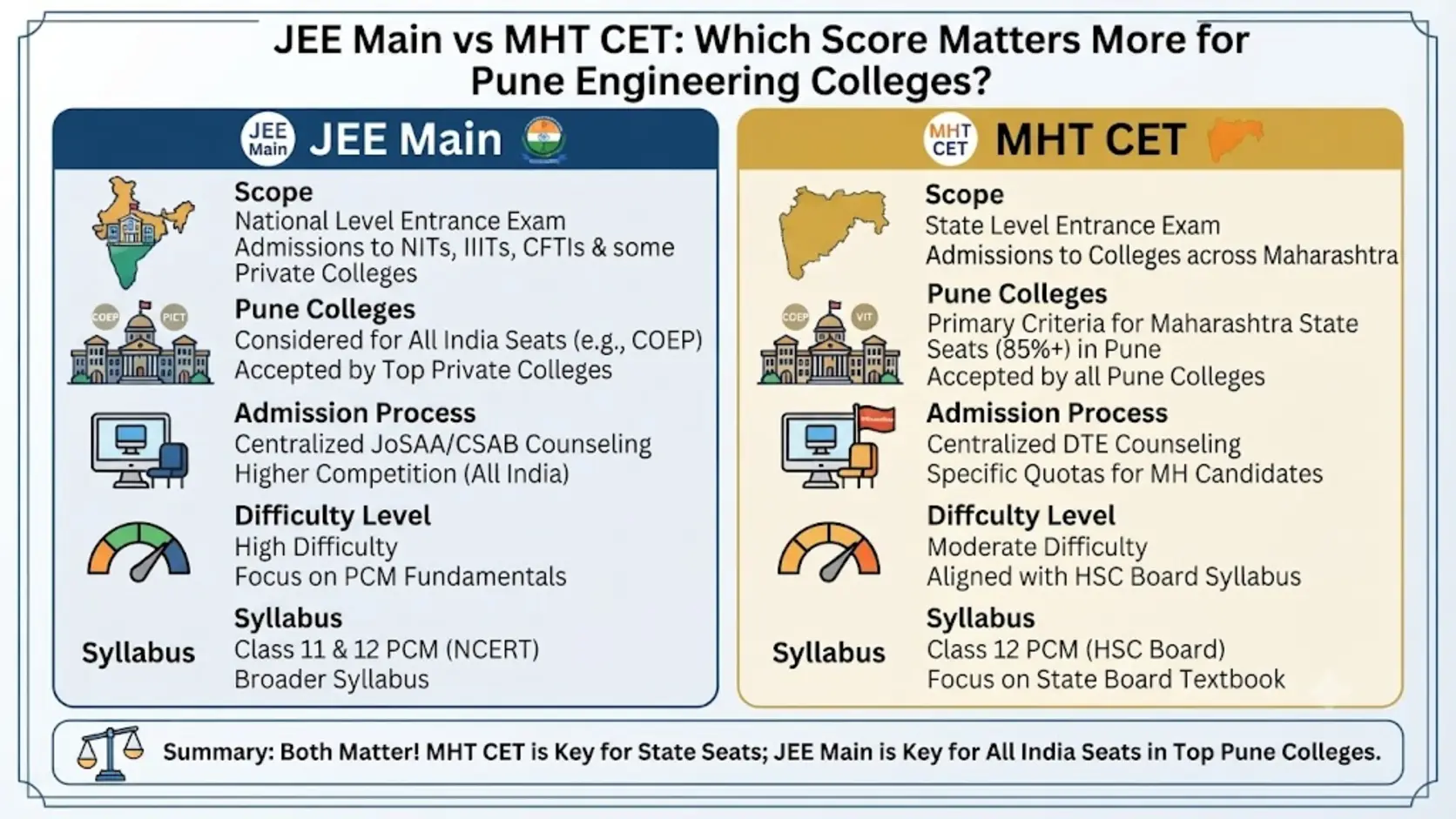
Start with the admission route
Your preferred examination should support the seats and programmes you intend to apply for.
| Your intended route | Examination or process to investigate |
|---|---|
| Maharashtra State candidature seats through engineering CAP | MHT CET, together with the relevant academic and candidature requirements |
| Applicable All India engineering seats through CAP | JEE Main, which receives preference over MHT CET under this route |
| NITs, IIITs and other participating NIT+ institutions | JEE Main and the applicable JoSAA/CSAB process |
| Institution-run B.Tech admission | The examinations and selection requirements listed in the university’s programme policy |
The Maharashtra routes follow the state admission framework, while the NIT+ route follows the national counselling framework.
There is also an important distinction for students considering IITs: JEE Main alone is not the standard entrance route for IIT undergraduate engineering admission. That route requires JEE Advanced, subject to its eligibility conditions and rank requirements.
Which Pune institutions accept which scores?
A college shortlist is more useful when it records the accepted examination, programme eligibility and application route—not just the institution’s name.
ALARD University, Pune
ALARD University’s official engineering page lists JEE Main and MHT CET among the accepted entrance examinations for B.Tech admission. Candidates must also satisfy the academic eligibility requirements and follow the applicable admission procedure for their chosen programme.
The page refers to admission through CAP or direct admission under university norms. Applicants should confirm which route applies to the specific programme and intake, including registration, document verification and selection requirements.
If this university is on your shortlist, check the programme requirements before deciding which examination to prioritise. Acceptance of both scores does not mean that either score guarantees admission or that another institution’s seat allocation applies here.
COEP Technological University
COEP’s first-year admission page publishes an allocation of 80% of sanctioned intake through MHT CET and 20% through JEE Main under the All India route
For an eligible Maharashtra State candidature applicant targeting its state seats, MHT CET is therefore a relevant preparation priority. An applicant using the All India route should focus on the applicable JEE Main requirements.
Candidates must follow the admission and counselling procedures rather than treating a score as a direct offer. COEP also states that admissions are merit-based and warns against agents or intermediaries claiming influence over the process.
Pune Institute of Computer Technology
PICT’s admission guidance identifies CAP routes involving MHT CET and JEE Main. Its FAQ explains that an eligible applicant with JEE Main but without Maharashtra domicile can apply under the All India quota. Institute-level admissions have separate published procedures.
Check the relevant seat category and instructions before applying. The requirements for a CAP seat and an institute-level vacancy should not be assumed to be identical.
Dr. D. Y. Patil Institute of Technology, Pimpri
The institute’s undergraduate admission page directs applicants to appear for MHT CET or JEE Main, register for CAP, complete the application and verification process, participate in allotment rounds and confirm admission.
Having an accepted examination result is therefore one part of the process. Registration, eligibility verification and the applicable allotment requirements remain necessary.
MIT World Peace University
MIT-WPU operates its own application process. Its 2026–27 B.Tech admission policy lists JEE, MHT CET and PERA CET scores for selection, together with a 500-word Statement of Purpose. It lists MHT-CET-B and NEET options specifically for Bioengineering.
Applicants must submit the required material through the university’s process. A CAP application does not replace a separate university application.
MIT World Peace University
The university’s 2026 B.Tech brochure describes selection through BV-BTECH-2026. Its engineering FAQ states that admissions are not through MHT CET, JEE or other state CETs.
This illustrates why checking each institution matters. An examination accepted by one university may not provide an admission route at another. If a subsequent notice introduces an additional route, verify that it applies to the exact programme and intake you are considering.
Why one college’s seat allocation cannot represent all of Pune
COEP’s 80:20 CET–JEE split is institution-specific. It should not be presented as the standard allocation at every Pune engineering college.
The 2026 admission brochure gives the following general allocation for unaided, non-minority private engineering institutions:
| Seat category | Share of sanctioned intake |
|---|---|
| Maharashtra State candidature seats | 65% |
| All India seats | 15% |
| Institutional quota | 20% |
These percentages apply to the specified institution category. Applicants should still check the individual institute’s published seat matrix and any applicable exceptions.
Minority institutions follow a different allocation. The relevant table specifies a minimum 51% minority share, subject to the applicable rules and declared allocation. Not every private engineering college has minority status.
Institutional quota is also distinct from ordinary CAP allotment. Applicants must follow the institute’s application and merit procedures, along with the applicable registration and verification requirements.
A larger seat share does not automatically make one route easier. Admission chances depend on the branch, category, competing applicants, merit position and available seats.
Maharashtra candidature is more than a domicile check
A domicile certificate is important in some circumstances, but it is not the only factor used to determine Maharashtra candidature.
The official rules provide several candidature types involving different combinations of:
• Schooling or qualifying education in Maharashtra.
• Birth or domicile conditions.
• A parent’s domicile.
• Specified government employment or posting conditions.
• Maharashtra–Karnataka border-area conditions.
The documents required depend on the category claimed.
Before assuming that only All India seats are available, identify your applicable candidature type and check its supporting evidence. Equally, studying or currently living in Pune should not be treated as automatic eligibility for every Maharashtra State seat.
Resolve uncertainty through the official admission guidance before submitting your application.
Why JEE Main and MHT CET percentiles are not interchangeable
A 95 percentile in JEE Main does not represent the same result or admission opportunity as a 95 percentile in MHT CET.
The examinations have different papers and candidate groups. Their percentile methods use performance within examination shifts; a percentile is not simply the percentage of marks scored.
Compare each result with cutoffs published for its own admission route. A useful cutoff comparison should identify:
• The admission year.
• The institute and branch.
• The Maharashtra State or All India seat type.
• The category and other applicable seat conditions.
• The counselling round.
• Whether the figure is a percentile, score or merit rank.
Without that context, a cutoff can be misleading. Avoid converting one examination’s percentile into the other or using an isolated historical figure to predict admission.
CAP, national counselling and university applications are separate
An accepted score and a completed application are different things. Understand the process attached to each programme on your shortlist.
Maharashtra CAP
MHT CET-based Maharashtra State seats and applicable JEE Main-based All India seats can both be handled within Maharashtra engineering CAP. The examination used does not automatically change the counselling authority.
The process includes admission registration, document scrutiny, application confirmation, merit-list checks, option-form submission, allotment, seat acceptance and institute reporting. The 2026 framework provided four CAP rounds.
Follow the instructions for the relevant round, including acceptance and reporting requirements.
JoSAA and CSAB
JEE Main also provides an admission route through the national NIT+ system. JoSAA and the applicable CSAB counselling processes have separate requirements for registration, choice filling, eligibility and reporting.
Participation in national counselling does not replace a Maharashtra CAP application.
University-specific applications
Where a university operates its own admission process, complete that application separately. Submit the required examination results, academic records and other selection material.
If an institution lists more than one route, confirm which applies to your programme rather than assuming that one application covers every option.
Should you prepare for JEE Main, MHT CET or both?
Use your shortlist—not a general ranking of examinations—to make the decision.
Prioritise MHT CET when your main targets are Maharashtra State candidature seats at CAP institutions and you meet the relevant requirements.
Prioritise JEE Main when your targets include the applicable All India CAP route, NIT+ institutions or university programmes that accept JEE Main.
Consider both when both sets of routes matter to you and your schedule allows meaningful preparation for each examination.
The examinations share core Physics, Chemistry and Mathematics concepts. However, that does not establish a fixed syllabus-overlap percentage. Compare the official syllabi and practise for each examination’s question format, timing and marking rules.
Taking both can broaden your options, but it also adds preparation, application and possibly travel requirements. It should be a deliberate choice rather than an automatic recommendation.
Build a shortlist you can act on
For every programme, record the following information:
| Detail | What to confirm |
|---|---|
| Institution and programme | Exact name of the university or institute and the course |
| Accepted examinations | Current intake’s published examination requirements |
| Eligibility | Academic requirements and applicable candidature or seat category |
| Application route | CAP, national counselling or the institution’s own process |
| Documents | Required academic, identity and category evidence |
| Previous cutoffs | Relevant year, branch, category and round |
| Deadlines | Application, verification, acceptance and reporting windows |
This changes the question from “Which examination is better?” to “Which examination supports the admission routes I can actually use?”
Once those routes are clear, you can plan preparation and applications without relying on broad claims about which score matters most across Pune.
The question counts and marks follow the official marking scheme.
The two sections have separate time limits
For both groups, Physics and Chemistry are available during the first 90 minutes. That section is then automatically submitted.
The next 90 minutes are used for:
• Practised accurately without a time limit.
• Practised accurately under timed conditions.
You cannot carry unused time from the first section into the second. Practise the two timed blocks separately so your preparation reflects the actual paper structure.
Frequently Asked Questions (FAQs)
1. Is JEE Main or MHT CET better for engineering admission in Pune?
For eligible Maharashtra State candidature applicants targeting state-quota CAP seats, MHT CET is the relevant examination. For the applicable All India engineering route, JEE Main receives preference. The better priority depends on your candidature, target institutes and courses, rather than one examination being stronger across every Pune college.
2. Does ALARD University accept JEE Main and MHT CET for B.Tech admission?
Yes. ALARD University’s official engineering page lists both JEE Main and MHT CET among accepted entrance examinations for B.Tech admission. Applicants must also satisfy academic eligibility and follow the applicable admission procedure. Confirm the programme, intake and application route before assuming that an entrance score alone is sufficient.
3. Can I get admission to a Pune engineering college through JEE Main?
Yes. COEP publishes a 20% JEE Main intake, and eligible applicants can use JEE Main under the applicable All India CAP route at participating institutes. Some universities also accept it through their own processes. Check the programme’s policy because a score does not replace eligibility, registration or document verification.
4. Is MHT CET enough for engineering admission in Pune?
MHT CET can provide an admission route to eligible state-quota seats at participating Pune institutes. However, you must also satisfy the academic and candidature requirements, complete CAP registration, verify documents and follow allotment instructions. An MHT CET score alone does not guarantee a seat or cover every institution.
5. Is the same percentile equally useful in JEE Main and MHT CET?
No. The two percentiles arise from different examinations and candidate groups. They cannot be converted directly into one another or used to predict equivalent admission chances. Compare each result with the official cutoff for the relevant institute, branch, seat category, counselling round and year within that examination route.
6. Should I take both entrance examinations?
Taking both can be useful if your shortlist includes Maharashtra state-quota seats and JEE-based routes. It is less useful if your target programme requires a different entrance test. Decide after checking accepted examinations and deadlines, and allow time for separate practice rather than assuming the additional workload is negligible.