
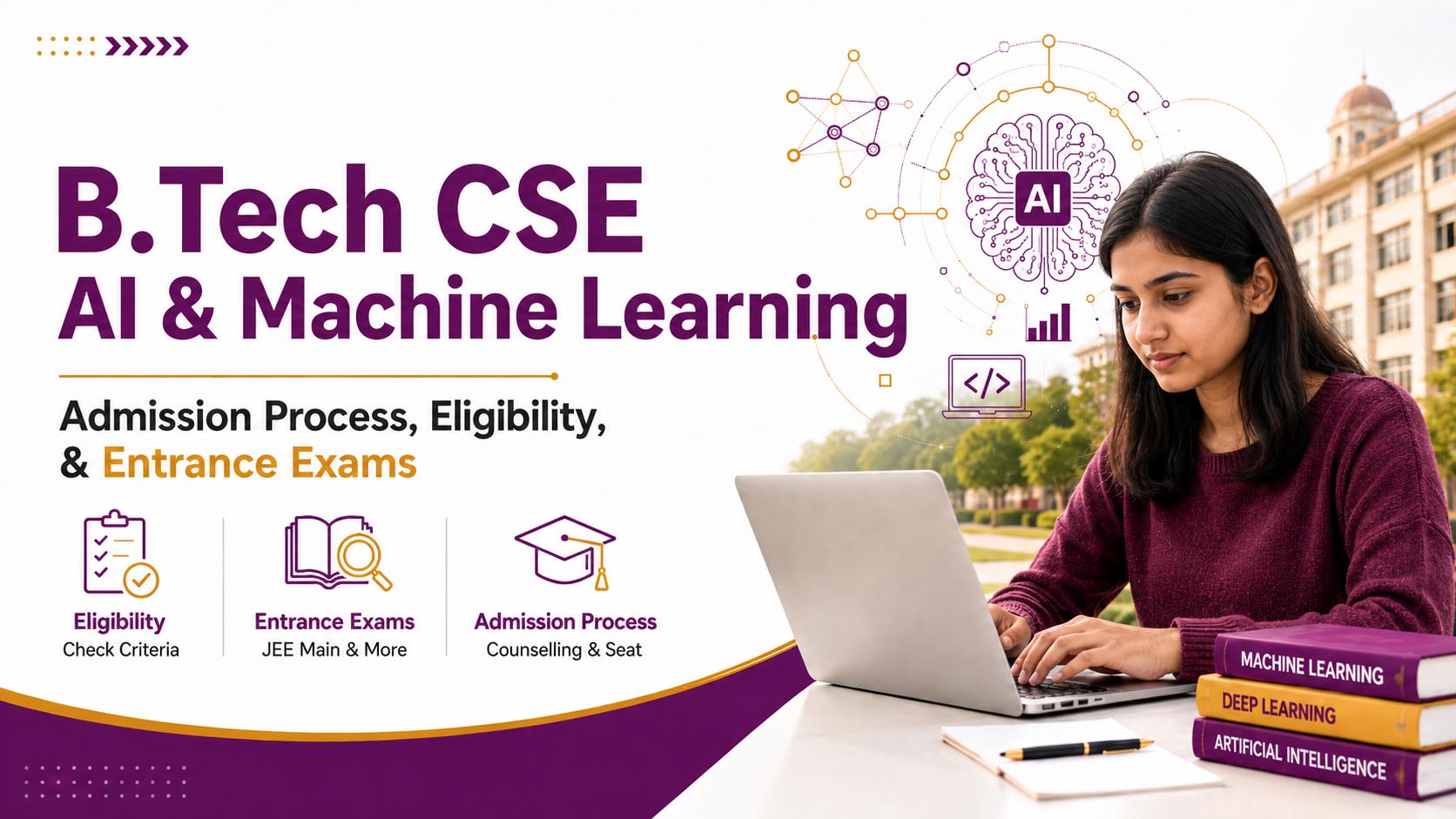
B.Tech CSE AI and Machine Learning Admission Process, Eligibility, & Entrance Exams
A recruiter once told me she sees AI and ML graduates command slightly stronger starting offers than plain CSE graduates from the same college when projects, internships, and coding depth line up. That is one reason B.Tech in AI and Machine Learning Admission has become such a high-intent search for students and parents.
The tricky part is this: many colleges use similar branch names, but the syllabus, cutoff, and admission route can differ a lot. One brochure says AI, another says AI & ML, and a third says CSE (AI & ML) — yet the seat matrix and placement outcomes are not the same.
By the end of this post, you will know the real eligibility, the entrance exams that matter, how the admission process works, and how to compare AI/ML colleges without getting distracted by marketing language.
Why AI and ML Admission Feels So Confusing
The confusion starts with naming. A student may see B.Tech in AI and Machine Learning, B.Tech CSE AI and ML admission, AI engineering admission, or even CSE with AI specialization, while the actual curriculum stays closer to computer science with added machine learning subjects.
That matters because admission decisions depend on more than branch names. You should look at PCM aggregate, entrance score, closing rank, and whether the college gives enough curriculum depth in Python, data structures, linear algebra, neural networks, and model deployment.
Placement data also explains the rush. AI and ML roles now show stronger salary traction at many private universities, especially when students build projects and internships before final year. But a good title alone does not create a strong outcome. The college, faculty, projects, and hiring network still decide most of the result.
Quick check: if a college talks only about the branch name and avoids syllabus detail, treat that as a warning sign. Ask for semester-wise subjects before you move ahead.
B.Tech CSE AI and Machine Learning Eligibility
B.Tech CSE AI and Machine Learning eligibility usually follows a simple base rule: you need Physics and Mathematics in Class 12, plus a qualifying aggregate that depends on the institute.
Minimum Qualification Table
| Requirement | Typical Criteria |
|---|---|
| Qualifying exam | Class 12 or equivalent from a recognized board |
| Compulsory subjects | Physics and Mathematics |
| Third subject | Chemistry, Computer Science, Biotechnology, or Information Technology, depending on institute rules |
| Minimum aggregate | Usually 45% to 60% |
| Reserved category relaxation | Often 5% lower than general category |
| Age rule | Usually no upper age limit for private universities |
This is the baseline qualification for B.Tech AI and Machine Learning programs. If you meet it, you can apply. If you do not, most colleges will reject the form even if your entrance score looks good.
Many private universities ask for a higher overall percentage, while several state and newer institutions keep the bar closer to 45%. That means your admission target should decide your eligibility strategy, not the other way around.
What Students Often Miss
Students often focus on percentage alone and ignore subject combinations. If you did not take Mathematics, you may lose access to most AI and ML engineering admission routes because the course relies on logic, probability, and optimization from day one.
If you are still in Class 11, this is the smartest moment to plan. Keep Mathematics, maintain strong PCM aggregate, and work on problem-solving early.
Need a quick reality check on your chances? Compare your Class 12 score with the previous year’s opening and closing rank for the exact AI/ML branch you want.
AI and Machine Learning Entrance Exams That Matter
You do not need every exam under the sun. You need the right ones for the colleges on your shortlist.
Entrance Exams Comparison
| Exam | Accepted By | Best For |
|---|---|---|
| JEE Main | NITs, IIITs, many state colleges, and private universities | Students targeting broad options |
| JEE Advanced | IITs | Top JEE Main rankers |
| BITSAT | BITS Pilani, Goa, Hyderabad | Fast and accuracy-based test takers |
| VITEEE | VIT campuses | Students wanting a strong private campus route |
| SRMJEEE | SRM Institute | Students targeting large private engineering campuses |
| MHT-CET | Maharashtra state colleges | Maharashtra domicile students |
| University entrance test | Private universities | Students who want direct campus-based admission routes |
JEE Main, remains the widest gateway for engineering admission 2026. Because it is accepted by many institutions, it keeps your options open even if one college closes earlier than expected.
Direct Admission in B.Tech CSE AI and ML
Direct admission in AI and ML is real at several private universities, but it is not a free pass. These colleges usually admit through merit, management quota, or their own entrance test, and they still expect minimum eligibility marks.
Do not confuse direct admission with a seat bought without verification. Legitimate colleges still check documents, academic scores, and sometimes a counselling round before confirming the seat.
Example: Private University Admission Cycle
Private universities often run multiple admission tracks at the same time. For example ALARD University presents AI and ML admission as part of a broader university counselling process, while other private institutions follow their own accepted-exam and merit routes. That comparison helps students see that branch quality depends on curriculum and outcomes, not just one promotional name.
Thinking about which exam route fits your profile? Shortlist three colleges first, then prepare only for the exams those colleges actually accept.
B.Tech CSE AI and ML Engineering Admission Process
The AI and ML engineering admission process looks complex from the outside, but it usually follows the same sequence.
Admission Process Flow
Application → Entrance Exam → Merit List / Rank → Counselling → Seat Allotment → Fee Payment → Document Verification
Step-by-Step Checklist
• Choose the branch carefully. Check whether the program is AI & ML, AI & DS, or CSE with AI electives.
• Check eligibility first. Confirm your PCM aggregate, subject combination, and category rules.
• Register for the right exam. Use JEE Main, BITSAT, VITEEE, SRMJEEE, or the college’s own test based on your shortlist.
• Track cutoffs. Compare your percentile or rank with previous closing rank data for the exact branch.
• Apply for counselling. Government seats usually go through JoSAA or CSAB, while private universities manage their own admission windows.
• Keep documents ready. Prepare Class 10 and 12 marksheets, admit card, scorecard, ID proof, and category certificate if needed.
• Lock the seat early. AI and ML seats can close faster than general CSE at many private colleges.
Documents You Should Keep Ready
Keep your marksheets, entrance admit card, scorecard, transfer certificate, migration certificate, and ID proof scanned and named properly. When counselling opens, speed matters.
Top AI and ML Colleges Admission View
| College | Admission Route | Notes |
|---|---|---|
| ALARD University | Merit + JEE Main + counselling | Good example of a private university cycle |
| VIT Vellore | VITEEE | Strong private engineering brand |
| SRM Institute | SRMJEEE | Large AI/ML intake and campus size |
| BITS Pilani | BITSAT | Strong reputation and selectivity |
| NITs / IIITs | JEE Main + JoSAA/CSAB | Competitive, lower fee structure |
You can also compare branch-wise placement packages before applying. Industry salary analyses show AI and ML graduates often start a little higher than general CSE graduates, especially at mid-tier private institutions where projects and internships are stronger.
What To Check Before You Choose
A good AI and ML college is not the one with the loudest advertising. It is the one that gives you actual academic and placement support.
Use This Quick Framework
• Curriculum depth: Look for mathematics, ML models, Python, data handling, and final-year projects.
• Placement quality: Ask for average package, median package, and branch-wise recruiter data.
• Faculty profile: Check whether the department has faculty with AI, data science, or research exposure.
• Industry exposure: Look for internships, hackathons, labs, and live projects.
• Admission clarity: Prefer colleges that publish eligibility, cutoffs, and seat matrix clearly.
If a college hides these details, move on.
Conclusion
B.Tech in AI and Machine Learning Admission comes down to three things: meeting the eligibility bar, choosing the right entrance exam, and comparing colleges by syllabus and outcomes rather than by branch name alone. AI and ML can offer stronger placement potential than plain CSE in many cases, but only when the college supports that branch with real curriculum depth and industry exposure.
Your next step is simple: shortlist the colleges you actually want, check their accepted exam list, and match your PCM aggregate against their previous cutoff range. If you want, review the syllabus and cutoffs together before you apply.
Frequently Asked Questions
1.What is the eligibility for B.Tech CSE in AI and Machine Learning Admission?
You usually need Class 12 with Physics and Mathematics, plus a qualifying aggregate of 45% to 60% depending on the college. Many private universities ask for 60% in PCM or overall marks, while some state and newer colleges accept lower percentages.
2. Which entrance exams are accepted for AI and ML admission 2026?
JEE Main is the widest accepted exam for AI and ML admission 2026, but many colleges also accept BITSAT, VITEEE, SRMJEEE, MHT-CET, or their own entrance test. The right exam depends on the exact college list you build.
3. Is direct admission in CSE AI and ML possible?
Yes, direct admission in CSE AI and ML is available in several private universities through merit, management quota, or university-level testing. You still need to meet minimum eligibility and submit the required documents during counselling or verification.
4. Does AI and ML give better placements than CSE?
Often yes, but not always. AI and ML can fetch higher starting packages when the college offers strong projects, internships, and recruiter access. The branch name alone does not guarantee a better salary.
5. What is the admission process for B.Tech CSE AI and Machine Learning?
The admission process for B.Tech CSE AI and Machine Learning usually follows application, entrance exam, merit list or rank, counselling, seat allotment, fee payment, and document verification. Private universities may add an interview or counselling call.
6. Which colleges are good for ai and ml colleges admission in India?
Good options include ALARD University, VIT, SRM, BITS Pilani, and selected NITs or IIITs, depending on your score and budget. Choose based on curriculum depth, placement records, and admission route, not only brand name.