

Career After B.Tech CSE Internet of Things: Top Jobs, Salary & Future Scope
Quick answer: A career after B.Tech CSE Internet of Things typically starts at ₹3.5–7 LPA as an IoT Developer, Embedded Systems Engineer, or IoT Support Engineer, with experienced professionals earning ₹15–35 LPA depending on industry and specialization. IoT sits at the intersection of hardware and software, which means fewer graduates compete for these roles compared to mainstream software development — a structural advantage worth understanding before you commit to a specialization.
If you're choosing a B.Tech CSE specialization and IoT keeps showing up as an option, here's the honest pitch: it's not the flashiest choice, and it won't get you the loudest recruiter buzz that AI or cybersecurity does. But it's also one of the few CSE paths where you're not just writing code — you're building things that sense, move, and report on the physical world. That's a genuinely different skill set, and it's why IoT professionals have historically commanded a real salary premium over general IT roles. This guide walks through what that career actually looks like, from your first job to where the field is headed.
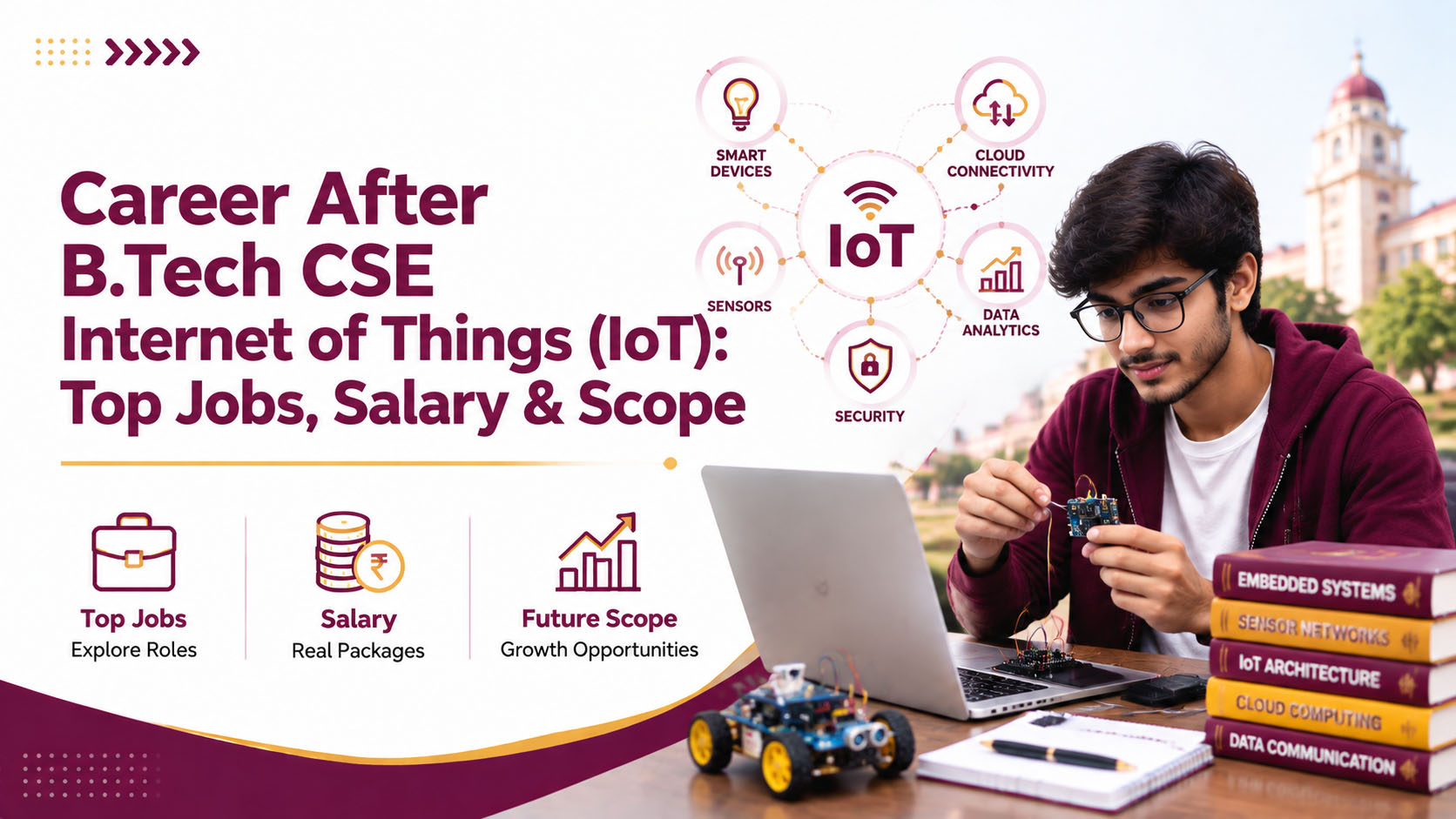
B.Tech IoT Career Scope: Why This Specialization Matters
B.Tech IoT career scope covers the full pipeline of connected devices — sensors and microcontrollers on one end, cloud platforms and data pipelines on the other, with networking and security holding it together. Unlike a pure software role, IoT work forces you to think about physical constraints: battery life, signal range, latency, and what happens when a device loses connectivity in the field.
This is precisely why the scope is broader than it first appears. A B.Tech CSE graduate with IoT training isn't limited to "IoT jobs" in the narrow sense — you're employable anywhere hardware meets software, which today includes automotive, healthcare devices, industrial automation, and smart infrastructure. Your core CSE training (data structures, networks, databases) still applies; IoT adds embedded systems and sensor-to-cloud data flow on top of it.
The practical implication: because fewer CSE graduates specialize this deeply in embedded-to-cloud integration, you face less direct competition for these roles than you would in generalist software development — while still keeping the option to pivot into mainstream software or cloud roles later, since your core skills transfer.
Jobs After B.Tech IoT: Where Freshers Start
Jobs after B.Tech IoT for freshers rarely carry the exact title "IoT Engineer" on day one. Most graduates enter through one of these routes:
• Junior IoT Developer: Building and testing firmware or device-to-cloud integrations under a senior engineer, typically at IoT product companies or industrial automation firms.
• Embedded Systems Trainee: Working on microcontroller programming and hardware-software integration — a common entry point at automotive and manufacturing companies.
• IoT Support/QA Engineer: Testing device connectivity, debugging sensor data pipelines, and validating firmware updates before wider rollout.
What actually gets freshers hired here is different from mainstream software hiring: a working hardware-software project (even a simple sensor-to-dashboard build using Raspberry Pi or Arduino) demonstrates competence that a purely theoretical coursework transcript can't. Recruiters in this space are checking whether you've actually made a physical device talk to software — that's the real filter.
Top B.Tech CSE IoT Jobs You Can Target
As experience builds, B.Tech CSE IoT jobs open up across a fairly specific role ladder that blends hardware and software skill sets:
| Role | Core Responsibility | Typical Entry Point |
|---|---|---|
| IoT Developer | Build firmware and device-to-cloud data pipelines | Fresher to 2 years |
| Embedded Systems Engineer | Program microcontrollers, optimize hardware-software interaction | Fresher to 2 years |
| IoT Data Analyst | Process and interpret sensor-generated data for business insights | 1–3 years |
| Network Engineer (IoT-focused) | Manage device connectivity, protocols (MQTT, Zigbee, LoRaWAN) | 1–3 years |
| Cloud IoT Specialist | Architect device-to-cloud infrastructure on AWS IoT, Azure IoT Hub | 2–5 years |
| IoT Solutions Architect | Design end-to-end connected systems across hardware, network, and cloud | 5+ years |
Notice the pattern: the roles that pay best (Cloud IoT Specialist, Solutions Architect) aren't purely hardware-focused — they combine embedded knowledge with cloud architecture. If you're planning your skill investment, that combination is where the ceiling is highest.
Career Options After B.Tech IoT Beyond Core Engineering
Before committing fully, it's worth comparing career options after B.Tech IoT against other CSE specializations, since the tradeoffs are genuinely different:
• AI/ML and data science often pay slightly more at senior levels and have more visible hiring demand, but require deeper statistics and math comfort daily — our Career After B.Tech CSE AI: Top Jobs, Salary & Future Scope guide breaks down exactly how much of that math-heavy work you'd face.
• Cybersecurity offers strong compliance-driven demand, especially as IoT devices themselves become security targets — our B.Tech CSE Cyber Security and Forensics career guide covers that compliance workload in detail, and it's worth reading if device security interests you, since IoT and cybersecurity increasingly overlap.
• Full stack development has far higher job volume and more flexibility across industries, but lacks IoT's structural advantage of lower competition — our Career After B.Tech CSE Full Stack Developer guide lays out that broader, higher-volume path.
• IoT itself trades some job-posting volume for a genuine hardware-software combination that's harder for generalist candidates to replicate — this is the appeal if you enjoy working close to physical systems, not just abstract code.
If you like the idea of a smaller, more specialized talent pool where hands-on hardware experience sets you apart, IoT is a defensible bet. If you want maximum job availability, full stack or general software roles still offer more postings.
IoT Career Opportunities in India Across Industries
IoT career opportunities in India span a wider set of industries than most CSE specializations, precisely because "internet-connected devices" now touches nearly every physical-world business:
• Healthcare: Remote patient monitoring devices, connected diagnostic equipment.
• Automotive: Connected vehicle systems, telematics, driver-monitoring sensors — one of the fastest-growing IoT hiring segments given India's EV push.
• Agriculture: Smart irrigation, soil-sensor networks, precision farming platforms.
• Manufacturing: Industrial IoT (IIoT) for predictive maintenance and factory automation.
• Smart cities: Traffic management systems, smart utility metering, public safety sensor networks.
• Logistics: Fleet tracking, cold-chain monitoring for pharmaceuticals and food.
This breadth is a genuine career advantage: unlike roles concentrated in tech-first companies, IoT skills are in demand at traditional manufacturing and automotive firms that are actively digitizing — meaning your job search isn't limited to IT-sector employers.
IoT Jobs in India: Demand and Hiring Trends
IoT jobs in India currently sit in a smaller, more specialized job market than mainstream software roles — job boards typically show a few dozen live listings specifically tagged "B.Tech CSE IoT" or "IoT Engineer" at any given time, compared to thousands for general software developer roles. That's not a red flag; it reflects how specialized the hiring is rather than weak demand overall, since IoT-adjacent roles (embedded engineer, network engineer, industrial automation engineer) often aren't tagged "IoT" at all.
Three hiring signals worth noting:
• 5G rollout is accelerating IoT hiring, particularly for connectivity and network roles, as India's 5G IoT market is projected to see notable growth through 2030, driven by government infrastructure investment and rising industrial automation adoption.
• Telecom and industrial IoT companies (like cellular IoT providers) are hiring senior architecture and backend roles at a premium, reflecting a shift from pure device engineering toward platform-level IoT infrastructure.
• Cross-listed roles are common — many companies hire for "Embedded Security Engineer" or "IoT Backend Developer" rather than a generic "IoT Engineer" title, so your job search should include these adjacent titles.
IoT Engineer Salary in India
IoT engineer salary in India varies significantly depending on which data source and role scope you're looking at — worth knowing upfront so you can calibrate expectations realistically:
| Experience Level | Typical Salary Range (Annual) |
|---|---|
| Entry-level (0–2 years) | ₹3.5–7 LPA |
| Mid-level (2–5 years) | ₹7–15 LPA |
| Senior (5–10 years) | ₹15–30 LPA |
| Architect/Lead (10+ years) | ₹30 LPA+ |
For context on the spread: AmbitionBox reports an average IoT Engineer salary of ₹5.9 LPA based on 800+ employee-reported salaries, while Indeed's smaller sample shows a lower average closer to ₹3.35 LPA — a gap that reflects how job title and company type (product company vs. small integrator) swing IoT pay more than in standardized software roles. A widely cited (though dated) 2017 IoT salary study found IoT professionals earning roughly 76% more than general IT engineers — ₹15.2 lakh median versus ₹8.65 lakh — which, even accounting for it being an older benchmark, illustrates the specialization premium that persists today. Globally, IoT engineers earn a median of around $95,000, rising to $135,000 at senior levels — useful context if you're weighing remote or international opportunities later in your career.
IoT Career After B.Tech: Growth Path From Junior to Senior
An IoT career after B.Tech follows a progression shaped by how quickly you combine hardware skills with software and cloud knowledge:
• Junior IoT Developer/Embedded Trainee (0–2 years): Learning firmware development, basic sensor integration, and device testing.
• IoT Engineer (2–5 years): Owning device-to-cloud pipelines independently, working across protocols like MQTT and CoAP.
• Senior IoT Engineer/Cloud IoT Specialist (5–8 years): Architecting connectivity and data infrastructure for multi-device deployments.
• IoT Solutions Architect/Technical Lead (8+ years): Designing end-to-end connected systems and making platform-level technology decisions.
The fastest progression typically comes from deliberately adding cloud platform certifications (AWS IoT, Azure IoT Hub) on top of embedded fundamentals — professionals who combine both tend to reach senior titles faster than those who stay purely hardware-focused.
Future Scope of IoT in India
The future scope of IoT in India is tied directly to two converging trends: 5G rollout and India's broader digital infrastructure push. As 5G networks expand, IoT deployments that were previously bottlenecked by connectivity — remote healthcare monitoring, precision agriculture, smart city sensors — become commercially viable at scale, and hardware currently accounts for the largest share of India's IoT market revenue, suggesting continued device-level hiring demand ahead of pure software roles.
Three shifts to track:
• AI-IoT convergence is accelerating — smart devices increasingly process data locally (edge AI) rather than only streaming to the cloud, creating demand for engineers who understand both domains.
• Industrial IoT (IIoT) is outpacing consumer IoT hiring in India, as manufacturing and logistics firms prioritize predictive maintenance and automation over consumer smart-home products.
• Security is becoming a mandatory IoT skill, not an add-on — as connected devices multiply, so does their attack surface, making IoT professionals with security awareness increasingly valuable.
The honest takeaway: IoT won't be the biggest job category in Indian tech, but it's positioned at a genuine growth intersection — 5G, industrial automation, and AI-IoT convergence — that's harder to automate away than pure coding work.
Your Next Step
Pick one small hardware-software project — a sensor reading data on Arduino or Raspberry Pi, pushed to a basic cloud dashboard — and build it end-to-end in the next 30 days. In a specialization where recruiters filter for genuine hands-on experience over coursework alone, one working project proves more than any certificate.
Frequently Asked Questions (FAQs)
1. Is IoT a good career after B.Tech CSE?
Yes. A career after B.Tech CSE Internet of Things offers a hardware-software combination with less competition than mainstream software roles, plus a documented salary premium over general IT positions. It suits graduates who enjoy working with physical systems, not just abstract code.
2. What is the starting salary for an IoT engineer in India?
IoT engineer salary in India for freshers typically ranges from ₹3.5–7 LPA, varying by company type and role scope. Product companies and telecom/industrial IoT firms tend to pay toward the higher end of this range.
3. What skills do I need for jobs after B.Tech IoT?
Beyond core CSE fundamentals, you need embedded systems programming (C/C++), microcontroller experience (Arduino, Raspberry Pi, ESP32), networking protocols (MQTT, Zigbee), and at least one cloud IoT platform (AWS IoT or Azure IoT Hub).
4. How does an IoT career after B.Tech progress over time?
An IoT career after B.Tech typically moves from Junior IoT Developer to IoT Engineer (2–5 years), then Senior/Cloud IoT Specialist (5–8 years), and IoT Solutions Architect beyond that, with salary and platform-level responsibility expanding at each stage.
5. Which industries offer the most IoT career opportunities in India?
IoT career opportunities in India concentrate in automotive, healthcare, manufacturing, agriculture, and smart city infrastructure. Automotive and industrial IoT (IIoT) are currently the fastest-growing hiring segments, driven by EV adoption and factory automation.
6. What is the future scope of IoT in India?
The future scope of IoT in India is strong, driven by 5G rollout, industrial automation, and AI-IoT convergence at the edge. Hardware and industrial IoT hiring are expected to lead growth, while security-aware IoT engineers will see increasing demand.