
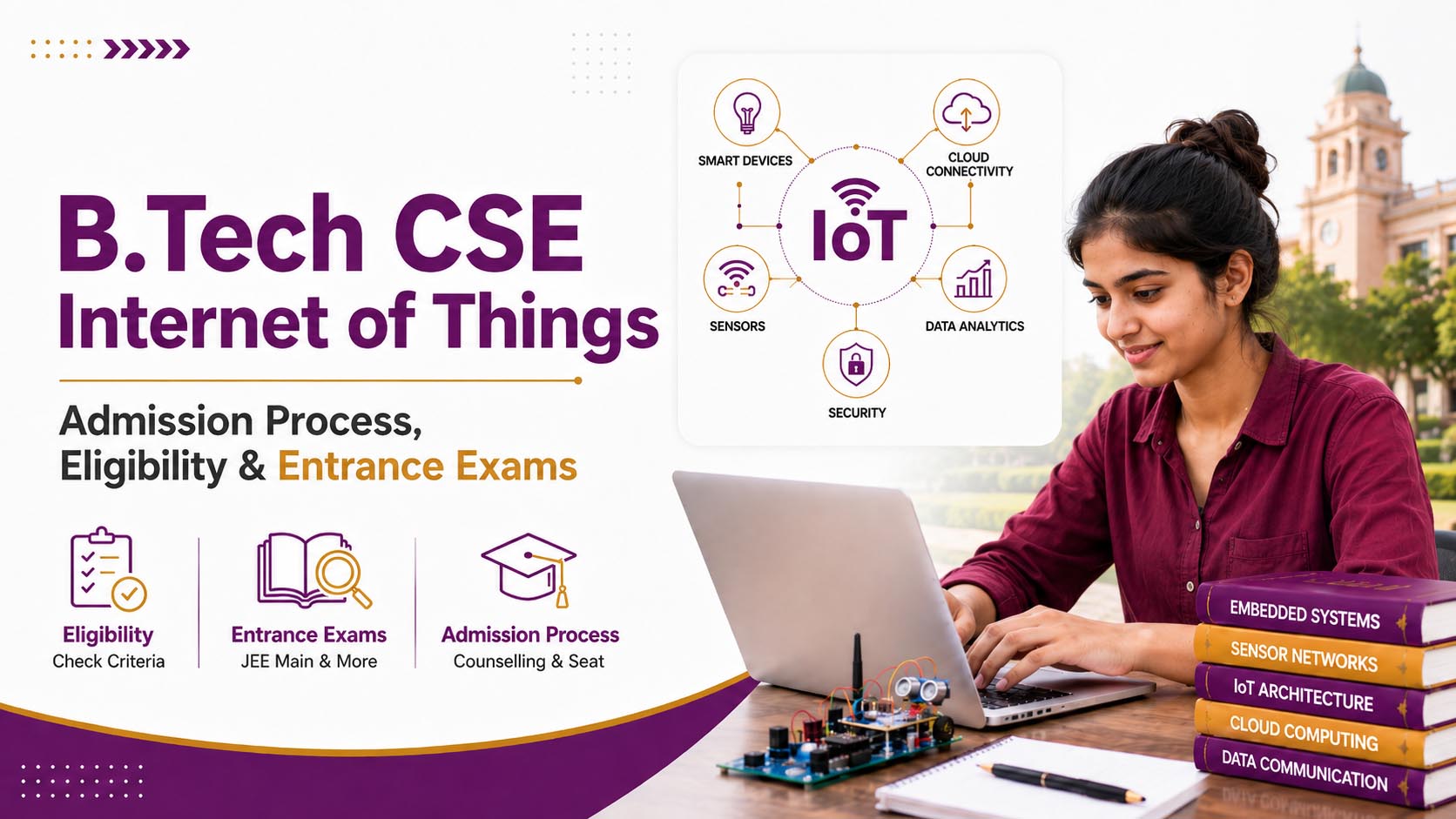
B.Tech CSE Internet of Things Admission Eligibility, & Entrance Exams
A surprising number of students assume IoT means “just sensors and gadgets.” That mistake can lead you to the wrong college list, because b.tech iot admission often sits inside a broader CSE program with networking, embedded systems, cloud basics, and device security.
The confusing part is that every college names the branch differently. One brochure says Internet of Things, another says CSE (IoT), and a third hides the same idea under smart systems or connected devices.
By the end of this post, you will know the real IoT eligibility rules, the entrance exams that matter, how the engineering admission process works, and how to compare IoT colleges without getting distracted by branding.
Why IoT Admission Looks Simple But Isn’t
IoT sounds clean on paper. In practice, colleges blend computer science, electronics, sensors, data transfer, and security into a single program, and the balance changes from one institute to another.
That matters because the same branch name can lead to very different student outcomes. A program with proper labs, microcontrollers, and networking modules prepares you for real projects. A weak one gives you only theory and a few basic assignments.
The demand side is real too. IoT jobs keep growing because companies want people who can connect devices, manage data, and secure systems across homes, factories, and cities.
Quick reality check: if a college only talks about “smart future” and avoids syllabus details, ask for semester-wise subjects. The branch name alone tells you very little.
B.Tech CSE IoT Eligibility You Should Check First
B.Tech CSE IoT eligibility usually follows the standard B.Tech pattern in India. You need Physics and Mathematics in Class 12, and most colleges also want Chemistry or another approved science subject.
Minimum Qualification
| Requirement | Typical Criteria |
|---|---|
| Qualifying exam | Class 12 or equivalent from a recognized board |
| Compulsory subjects | Physics and Mathematics |
| Third subject | Chemistry, Computer Science, IT, or an approved science subject depending on institute rules |
| Minimum aggregate | Usually 45% to 60% |
| Reserved category relaxation | Often 5% lower than general category |
| Age rule | Usually no upper age limit for private universities |
This is the basic B.Tech CSE IOT qualification for most engineering seats in India. If you meet it, you can apply. If you miss it, most colleges will reject the form even if your interest in devices and coding is strong.
Several private universities ask for 50% to 60% in PCM, while some state and newer colleges accept a lower threshold. That is why your target college list should shape your preparation, not the other way around.
What Students Often Miss
Students often assume IoT course admission is easier than CSE. In reality, if the program is part of CSE with IoT specialization, the college usually keeps the same PCM requirement as other engineering tracks.
If you are still in Class 11, keep Mathematics. Dropping it now closes more doors than you may expect.
Need a fast self-check? Compare your Class 12 score against the previous year’s branch-wise cutoff, not just the general engineering cutoff.
IoT Entrance Exams You Should Focus On
You do not need every exam on the internet. You need the exam your shortlisted colleges actually accept.
Entrance Exam Table
| Exam | Accepted By | Best For |
|---|---|---|
| JEE Main | NITs, IIITs, many universities, and some private colleges | Students who want the widest set of options |
| JEE Advanced | IIT-level paths and select programs | Top-ranked students |
| VITEEE | VIT campuses | Private university seekers |
| SRMJEEE | SRM University group | Students targeting larger private campuses |
| BITSAT | BITS Pilani, Goa, Hyderabad | Fast, accuracy-driven test takers |
| MHT-CET | Maharashtra colleges | Maharashtra domicile candidates |
| University entrance test | Private universities | Students wanting a campus-based direct route |
| State CETs | State engineering colleges | Students applying through state counselling |
JEE Main, remains the widest accepted exam for b.tech iot admission 2026. Because many colleges accept it, one good score can keep more admission options open during counselling.
Internet of Things Admission 2026 Timeline
| Stage | Estimated Window |
|---|---|
| JEE Main Session 1 | January 2026 |
| JEE Main Session 2 | April 2026 |
| Private university applications | January to June 2026 |
| Counselling begins | June to August 2026 |
| Seat allotment rounds | June to September 2026 |
| Final reporting and fee payment | July to September 2026 |
These timelines help you plan early. If you wait too long, the better iot colleges admission rounds often move into higher cutoffs or fewer open seats.
Direct Admission IoT Engineering
Direct admission IoT engineering routes are available at several private universities through merit or the institute’s own entrance test. That does not mean the college ignores eligibility. It still checks your marksheets, documents, and often a counselling round.
A legitimate college still publishes the fee structure, eligibility, and selection process clearly. If someone promises a guaranteed seat without verification, walk away.
Example: Private University Admission Cycle
Private universities often run multiple routes at the same time. For example, ALARD University can be used as one example of how a private institution presents program options and counselling support, while colleges like Crescent, SRM, and VIT also follow their own accepted-exam and merit-based cycles. That wider comparison helps you judge the admission model, not just the brochure.
Thinking about direct admission or exam-based admission? Shortlist three colleges first, then check which exam each one accepts. It keeps your prep focused.
Engineering Admission Process for IoT
The engineering admission process for IoT follows a predictable sequence once you know the order.
Admission Process Flow
Application → Entrance Exam → Rank / Merit List → Counselling → Seat Allotment → Fee Payment → Document Verification
Step-by-Step Checklist
• Choose the exact branch. Check whether the college offers IoT, CSE (IoT), or smart systems with IoT.
• Check the eligibility rules. Confirm PCM subjects, aggregate percentage, and any category relaxation.
• Register for the correct entrance exam. JEE Main, VITEEE, SRMJEEE, BITSAT, MHT-CET, or the college’s own test may apply.
• Compare cutoffs carefully. Look at the exact IoT branch closing rank, not the general CSE branch rank.
• Apply through counselling or the institute portal. Government colleges usually use centralized counselling, while private universities use their own admission windows.
• Keep documents ready. Prepare Class 10 and 12 marksheets, scorecard, ID proof, photos, and category certificate if needed.
• Pay the seat confirmation fee on time. IoT colleges admission rounds can close fast when demand rises.
Documents You Should Keep Ready
Keep scanned copies of your marksheets, entrance admit card, scorecard, transfer certificate, migration certificate, and identity proof. When admission rounds move quickly, missing one document can delay your seat.
Top IoT Colleges to Watch
| College | Admission Route | Notes |
|---|---|---|
| ALARD University | Merit + counselling route | Useful private-university example |
| Crescent Institute | CIEAT or JEE Main | Strong IoT-specific admissions |
| SRM University | SRMJEEE | Large private campus route |
| VIT | VITEEE | Popular software and embedded track |
| BMS College of Engineering | JEE / state route | Strong reputation in engineering |
| Selected state colleges | JEE Main / state exam | Depends on domicile and intake |
Average demand for IoT roles stays strong because companies need people who understand connected devices, data flow, and basic security. That makes the branch attractive for students who want practical engineering and a wider entry path into product and automation jobs.
Want to compare programs faster? Please explore all our programs here: https://alarduniversity.edu.in/admissions/
What to Compare Before You Apply
Do not choose on branch name alone. Choose on course depth, lab quality, and placement support.
Use This Decision Framework
• Curriculum depth: Look for sensors, microcontrollers, embedded systems, networking, cloud basics, and security in IoT.
• Placement data: Ask for average package, highest package, and branch-wise recruiter names.
• Lab access: Check whether the college has IoT labs, embedded labs, or smart device development facilities.
• Industry exposure: Look for internships, hackathons, prototyping work, and live projects.
• Admission clarity: Prefer colleges that publish fee structure, cutoffs, and selection rounds clearly.
If the college hides these details, keep moving.
Conclusion
B.Tech CSE Internet of Things admission is about matching the right eligibility, the right entrance exam, and the right college model. A strong IoT program should teach you how connected systems work in real life, not just how to pass theory papers.
If you want the best outcome, compare the exact branch, not just the college name. Then confirm the cutoff, entrance route, and document checklist before you apply for internet of things admission 2026.
Frequently Asked Questions
1. What is the eligibility for B.Tech CSE IoT admission?
You usually need Class 12 with Physics and Mathematics, plus a qualifying aggregate of 45% to 60% depending on the college. Many private universities also accept approved third subjects like Chemistry, Computer Science, or IT.
2. Which IoT entrance exams should I prepare for?
JEE Main is the widest accepted IoT entrance exam, but many private universities also accept VITEEE, SRMJEEE, BITSAT, MHT-CET, or their own test. Your target college list should decide your exam plan.
3. Is direct admission available for IoT engineering?
Yes, direct admission IoT engineering routes are available at several private universities through merit, management quota, or university-level testing. You still need to meet the basic IoT qualification and complete document verification.
4. What is the difference between IoT and CSE with IoT specialization?
IoT focuses on connected devices, sensors, and device communication, while CSE with IoT specialization adds a stronger computer science base. The better option depends on how deep the curriculum goes and what career path you want
5. How does the engineering admission process for IoT work?
The engineering admission process for IoT usually includes application, entrance exam, rank or merit list, counselling, seat allotment, fee payment, and document verification. Private universities may add a campus interview or counselling session.
6. Are IoT colleges admission cutoffs higher than regular CSE?
Often yes, especially in private universities with strong placement demand. You should compare your percentile or rank with the previous year’s branch-wise closing rank, not the general CSE cutoff.