
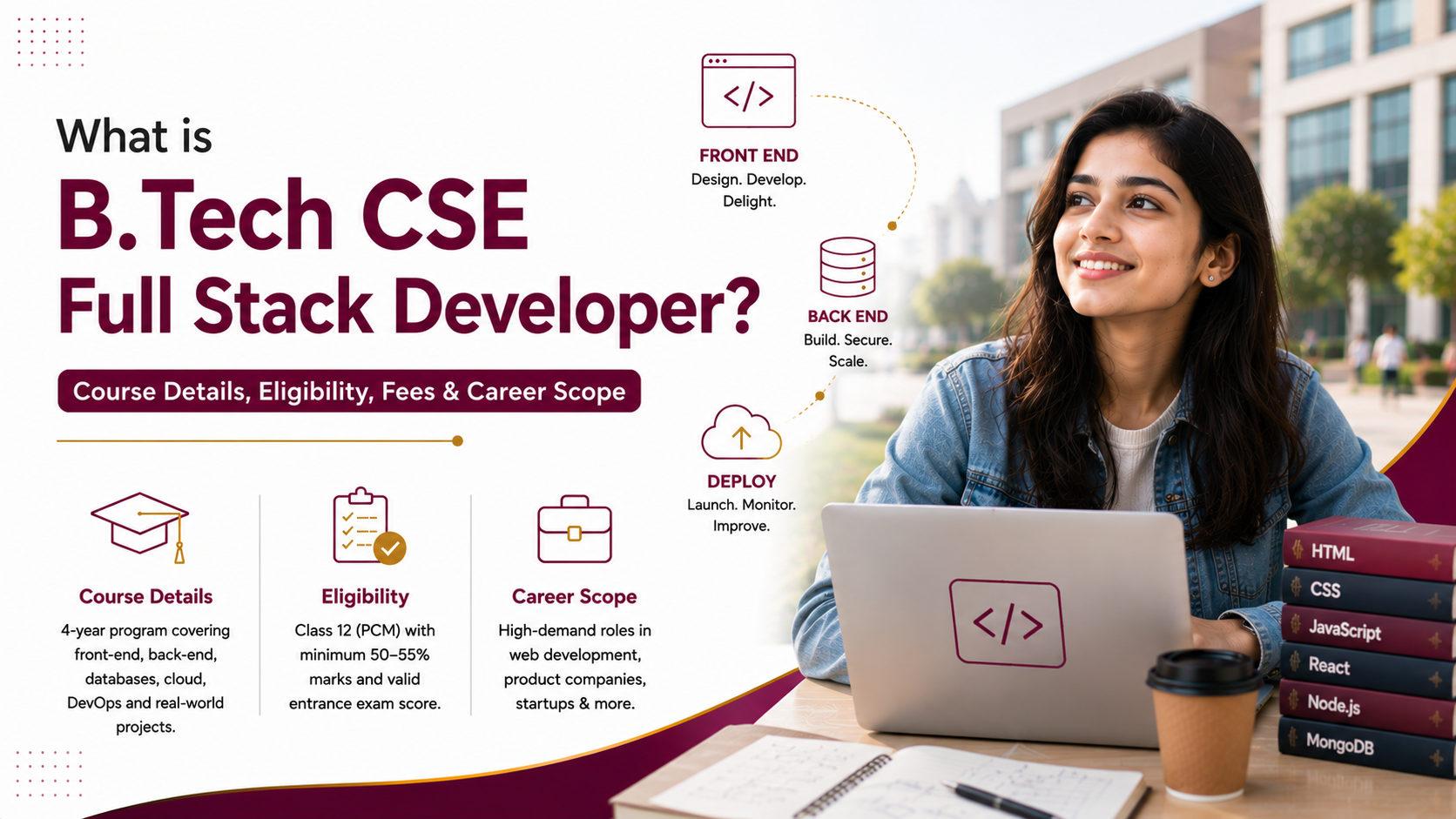
What is B.Tech CSE Full Stack Developer? Course Details, Eligibility, Fees & Career Scope
Most job listings for "full stack developer" list ten skills in the description. Nobody masters all ten by graduation, and that scares off good students before they even apply.
Here's the part nobody explains clearly: a B.Tech CSE Full Stack Developer program isn't designed to make you an expert in everything at once. It's designed to make you dangerous enough in both halves of the stack — front end and back end — to build a real product and keep learning fast on the job.
Stick with this guide, and you'll walk away knowing the actual syllabus, the eligibility numbers, what colleges charge across India, and what companies genuinely pay once you graduate.
The Myth Killing Full Stack Careers Before They Start
Here's a common misconception: that "full stack" means fluent in React, Node, Python, Java, AWS, Docker, and five databases on day one.
That's not how the degree works, and it's not how hiring works either.
AICTE's own model curriculum for undergraduate CSE builds specializations as "micro-specializations" — a core lead course plus two or three additional courses aligned to one clear goal, not an endless skill checklist. A full stack engineering course applies that same logic: you go deep on one front-end framework and one back-end language, then branch out once you're employed.
Think of it like construction. Front-end work is the interior — what a visitor sees, touches, and judges in the first five seconds. Back-end work is the plumbing and wiring behind the walls, invisible until something breaks.
Front End, Back End, and Where B.Tech CSE Full Stack Developer Fits
A B.Tech CSE Full Stack Developer program teaches both sides on purpose, inside one four-year structure:
- Front end: HTML, CSS, JavaScript, and a component framework such as React
- Back end: server logic, REST APIs, and a language like Node.js, Java, or Python
- The connective tissue: databases, cloud deployment, and version control tools like Git
A plain CSE degree touches these topics briefly. A full stack specialization builds entire semesters around shipping projects that use all three layers together.
Curious what a structured version of this looks like in practice? ALARD University's B.Tech CSE Full Stack Developer program lays out its front-end, back-end, and cloud modules semester by semester — worth a look before you compare anyone else.
Full Stack Engineering Course Details: What You Actually Build, Semester by Semester
Forget memorizing a syllabus PDF. Here's what changes year by year, in plain terms.
Years one and two build your foundation: math, programming logic, data structures, and database basics, shared with every other CSE branch.
Year three is where the full stack developer course identity kicks in — front-end frameworks, backend APIs, and your first multi-layer project.
Full Stack Developer Course: Semester-Wise Breakdown
| Year | Focus Area | Sample Subjects |
|---|---|---|
| Year 1 | Foundation | Mathematics, Programming in C/Python, Data Structures, Web Basics |
| Year 2 | Core CSE + Web Fundamentals | DBMS, Operating Systems, HTML/CSS/JavaScript, OOP Concepts |
| Year 3 | Full Stack Specialization | React/Angular, Node.js or Java Backend, REST APIs, Cloud Basics |
| Year 4 | Applied Development & Deployment | DevOps, Git & CI/CD, Capstone Project, Internship |
Most programs pair this with a semester-long internship and a capstone project — an e-commerce app, a booking platform, or a dashboard tool that actually runs end to end.
Hiring managers don't ask for your marksheet first. They ask for your GitHub link.
Eligibility, Fees and Admission: The Real Numbers Behind This Degree
Now for the part that actually decides where you apply: cutoffs, cost, and how you get in.
B.Tech Full Stack Eligibility Criteria
Three requirements show up across nearly every Indian university offering this specialization:
- A Class 12 pass with Physics and Mathematics, plus one of Chemistry, Computer Science, Electronics, or IT
- A minimum aggregate between 50% and 55%, depending on the institute
- A valid entrance score, or a direct-entry offer where the university skips exams for eligible marks
Some universities add a short personal interview after the entrance test, mainly to check basic coding comfort, not to filter aggressively.
Full Stack Developer Fees in India
Fees swing widely by institute type, and that swing changes your break-even math after placement.
| Institute Type | Approximate Annual Fee | Total 4-Year Cost | Typical Starting Salary |
|---|---|---|---|
| Government / State-Funded | ₹50,000 – ₹1,50,000 | ₹2L – ₹6L | ₹4–6 LPA |
| Private University | ₹1,20,000 – ₹2,80,000 | ₹5L – ₹11L | ₹5–9 LPA |
| Premium / Industry-Tied Programs | ₹3,00,000 – ₹4,50,000+ | ₹12L – ₹18L+ | ₹8–16 LPA |
These ranges come from current fee circulars and entry-level hiring data across Indian full stack programs. Verify the latest fee notification directly with your shortlisted college, since numbers shift every admission cycle.
Full Stack Developer Admission Process
Most seats in this specialization fill through one of these paths:
- JEE Main, accepted by NITs, IIITs, and most private universities
- JEE Advanced, relevant only where IITs offer this specific specialization
- State-level CETs such as Karnataka CET or MHT-CET
- University-specific entrance tests, often paired with a short interview
- Direct merit-based admission using Class 12 marks, where exams aren't mandatory .
Full stack development after 12th admissions typically open between April and June, with private university counseling stretching into August.
Wondering which admission route fits your Class 12 score? ALARD University runs both entrance-based and direct merit tracks for its B.Tech Full Stack Developer program — check your eligibility before the counseling window closes.
From Classroom to Codebase: How to Actually Land a Full Stack Job
Here's what separates graduates who get hired fast from ones who send fifty applications and hear nothing back.
Full Stack Career Scope and What Companies Pay
Entry-level full stack developers in India typically start between ₹4 and ₹9 LPA, with product-based companies paying toward the higher end.
Developers with two to four years of experience and a strong project portfolio commonly cross ₹10-16 LPA, and specialists in high-demand stacks can exceed ₹18 LPA.
Common roles after this full stack career scope discussion include:
- Full Stack Developer
- Frontend Developer
- Backend Developer
- Web Developer
- Application Developer
- DevOps Engineer
Dr. Pallavi Jha, a CSE faculty member at ALARD School of Engineering and Technology with over 17 years of teaching experience, has spent her academic career close to applied software engineering education. Faculty with that kind of long-term classroom exposure tend to push project-based evaluation over pure exam scores, which lines up with how the hiring market actually judges full stack candidates today.
The 3-Project Portfolio Rule
Use this as your personal framework for the four years, not just a checklist for placement season:
- Solo Project: build one end to end — front end, back end, and a live deployment link, no group help
- Team Project: build one that mirrors real workplace conditions — shared Git repo, code reviews, and a deadline
- Open-Source Contribution: contribute to one repo, even a small pull request, to prove you can read someone else's code
Graduates who can point to all three during an interview consistently outperform candidates with a higher GPA and zero shipped projects.
Conclusion
B.Tech CSE Full Stack Developer trains you to build and ship complete applications, not just memorize isolated front-end or back-end topics.
Check your eligibility, compare fees against realistic starting salaries, and pick an admission route that matches your Class 12 score before you commit four years.
Done right, this degree takes you from a solo GitHub project to a paid developer role, often faster than a generic CSE path.
If you're comparing programs this admission cycle, review ALARD University's B.Tech CSE Full Stack Developer curriculum and talk to their admission counselors about your specific score before the next counseling round closes.
Frequently Asked Questions
1. What is B.Tech CSE Full Stack Developer?
A B.Tech CSE Full Stack Developer is a four-year undergraduate engineering degree specializing in both front-end and back-end web application development. It builds on core CSE fundamentals and adds project-based full stack specialization from the third year onward.
2. What is the eligibility for B.Tech full stack programs?
The minimum eligibility is a Class 12 pass with Physics and Mathematics, plus one of Chemistry, Computer Science, Electronics, or IT. Most universities require 50-55% aggregate marks, along with a valid entrance score or a direct-merit offer.
3. How much do full stack developer fees cost in India?
Full stack developer fees range from around ₹50,000 per year at government institutes to over ₹4,50,000 per year at premium, industry-tied programs. Total four-year costs typically fall between ₹2 lakh and ₹18 lakh, excluding hostel charges.
4. What is the career scope after B.Tech CSE Full Stack Developer?
The career scope after B.Tech CSE Full Stack Developer spans roles like full stack developer, frontend developer, and DevOps engineer. Entry-level salaries typically range from ₹4-9 LPA, rising past ₹16 LPA for developers with strong portfolios and a few years of experience.
5. How is full stack engineering different from a regular CSE degree?
Full stack engineering focuses specifically on building complete applications across front end, back end, and deployment, while a regular CSE degree covers these topics more broadly. The full stack specialization dedicates entire semesters to shipping working projects rather than isolated theory modules.
6. Which entrance exams work for full stack developer admission?
JEE Main and JEE Advanced cover NITs, IIITs, and IITs offering this specialization, while state CETs like Karnataka CET or MHT-CET cover regional universities. University-specific entrance tests, short interviews, and direct merit-based admission cover most remaining private university seats.