
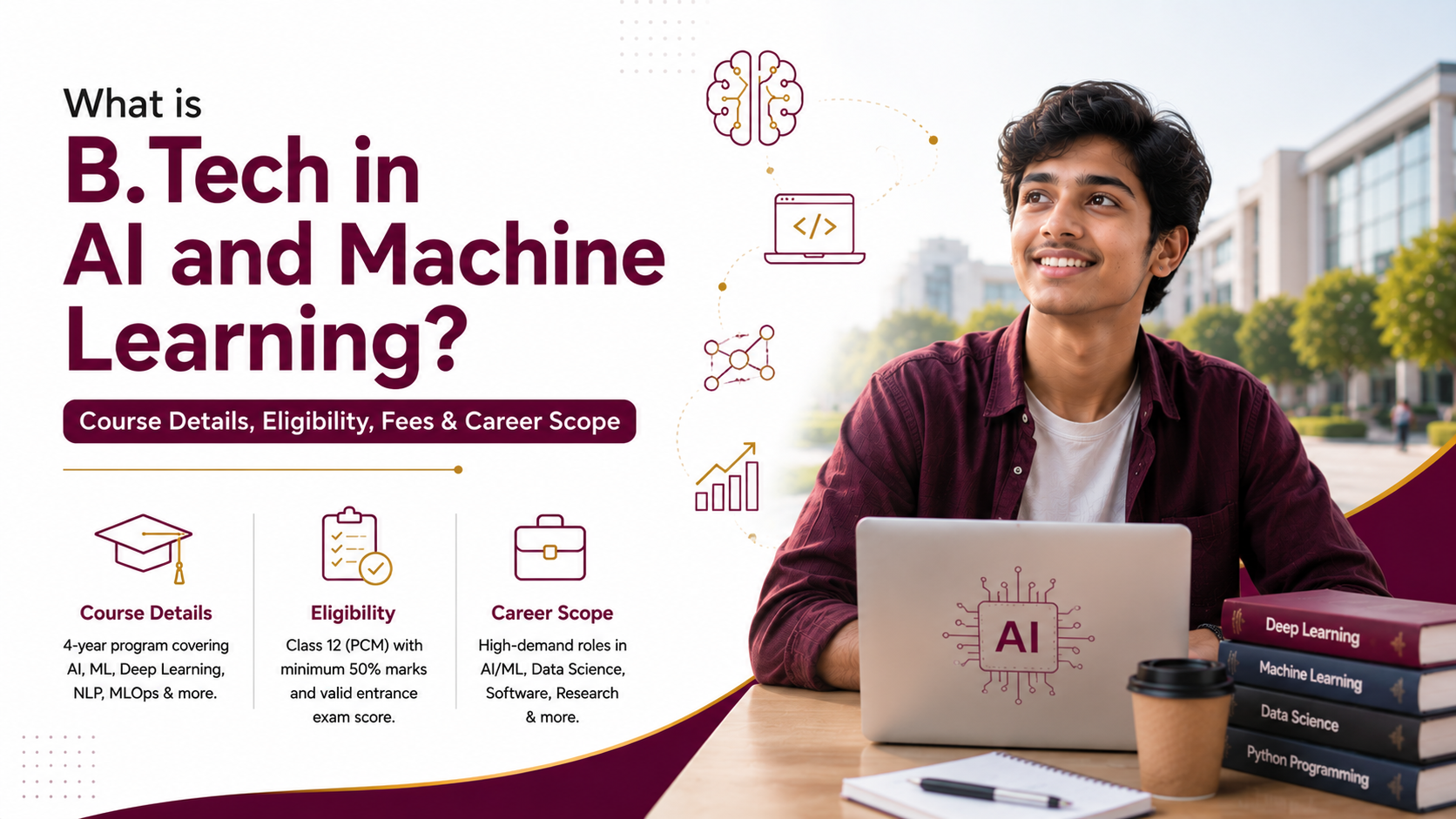
What is B.Tech AI and Machine Learning? Course Details, Eligibility, Fees & Career Scope
Should you pick B.Tech CSE, B.Tech AI and Machine Learning, or B.Tech AI and Data Science? Most Class 12 students can't tell these branches apart from the brochure alone.
That's not your fault. Colleges register these programs under different AICTE codes, price them differently, and rarely explain how the electives actually differ from one branch to the next.
B.Tech AI and Machine Learning is a dedicated four-year engineering program built around algorithms, data pipelines, and applied AI systems, not just a CSE degree with a new name.
By the end of this guide, you'll know what the course actually teaches, who qualifies for a seat, what it costs in India, and which jobs it realistically leads to.
Why B.Tech AI and Machine Learning Confuses So Many Applicants
Ask ten colleges what makes their AI and ML program different from a plain CSE degree, and you'll get ten different answers.
Part of that confusion is real, not manufactured by marketing teams.
AICTE approves several specialization codes that sound almost identical: "Artificial Intelligence, Machine Learning & IoT," "Artificial Intelligence and Data Science," and standalone "CSE with AI." Each one carries a different elective mix, even when brochures blur the lines.
A B.Tech artificial intelligence and machine learning program specifically leans toward algorithms, model training, and deployment. A data-science-labeled branch spends more time on statistics and analytics instead.
AI & ML vs AI & Data Science vs CSE (AI): What's Actually Different
Here's the fastest way to tell these branches apart before you apply:
- AI & ML focuses on building and training models: supervised learning, deep learning, and MLOps
- AI & Data Science focuses on extracting insight from data: statistics, visualization, and data engineering
- CSE with AI keeps a broader computer science base, with AI added as one specialization layer, not the entire branch identity.
If a college can't explain this difference clearly during a campus visit, that tells you something about how seriously it has invested in the branch.
Here's a concrete way to test it on a campus visit: ask the admission department for the specific tools taught in lab modules. If the lab work leans heavily on Tableau and SQL over PyTorch and TensorFlow, the course sits closer to Data Science than true machine learning model engineering.
Comparing colleges right now? Look at how ALARD University structures its B.Tech Artificial Intelligence & Machine Learning program before you shortlist anyone else — the elective list and lab access are public information.
AI and ML Engineering Course Details: Structure, Subjects and Duration
This program runs for four years across eight semesters, same as any other engineering degree in India.
Years one and two cover shared engineering fundamentals — mathematics, physics, and programming — before AI and ML-specific electives take over.
The AICTE model curriculum for AI-focused branches sits around 160-165 credits, split between core courses, professional electives, and a mandatory capstone project. This framework became the standard baseline for new AI and ML batches starting the 2025-26 academic cycle, so a college still teaching from a pre-2025 syllabus map is working off an outdated blueprint.
AI and ML Engineering Details: Semester-Wise Breakdown
| Year | Focus Area | Sample Subjects |
|---|---|---|
| Year 1 | Foundation | Mathematics, Physics, Programming in C/Python, Engineering Graphics |
| Year 2 | Core CSE + ML Basics | Data Structures, DBMS, Operating Systems, Introduction to Machine Learning |
| Year 3 | AI/ML Specialisation | Deep Learning, Neural Networks, NLP, Reinforcement Learning |
| Year 4 | Applied AI & Research | MLOps, AI Ethics, Capstone Project, Internship |
Most programs require a semester-long internship and a final-year capstone project, usually built around a working model — a recommendation engine, a fraud-detection system, or a computer vision tool.
A graduate of an AI and ML engineering course who ships two or three working models during college interviews far better than one who only submitted lab reports.
Eligibility, Fees and Admission Process for B.Tech AI and ML
When it comes to admissions, most of the real decision-making happens around eligibility and fees. Here's the breakdown.
B.Tech AI and ML Eligibility Criteria
You need three things to meet standard b.tech ai and ml eligibility rules in India:
- A Class 12 pass with Physics, Chemistry, and Mathematics (PCM) from a recognized board
- A minimum of 50% aggregate marks (45% for SC/ST/OBC candidates at many state universities)
- A valid entrance exam score, or a direct merit-based offer where exams aren't mandatory
Many colleges also reserve 10-15% of AI and ML seats for direct-entry admission, skipping the entrance exam entirely for students who meet the marks cutoff. Confirm this quota with the specific college, since policies shift yearly.
AI and ML Fees in India
Fees vary sharply based on institute type, and the gap directly affects your break-even timeline after graduation.
| Institute Type | Approximate Annual Fee | Total 4-Year Cost | Typical Starting Salary |
|---|---|---|---|
| Government / State-Funded | ₹40,000 – ₹1,50,000 | ₹1.6L – ₹6L | ₹5–9 LPA |
| Private University | ₹1,00,000 – ₹3,00,000 | ₹4L – ₹12L | ₹6–12 LPA |
| Top-Tier Deemed / IIT-Level | ₹2,50,000 – ₹6,00,000+ | ₹10L – ₹24L+ | ₹10–18 LPA |
These are broad national averages pulled from current fee circulars and entry-level hiring data. Always verify the latest fee notification for your target year, and treat the salary column as a comparison point rather than a promise.
AI and ML Admission Process and Entrance Exams
Most B.Tech AI and ML seats fill through one of these routes:
- JEE Main, used by NITs, IIITs, and many private universities
- JEE Advanced, required only for IIT programs offering the specialization
- CUET, used by several central universities
- State-level CETs such as MHT-CET, KCET, or WBJEE
- University-specific entrance tests, common at private universities
- Direct merit-based admission using Class 12 marks
AI and machine learning after 12th admissions typically open between April and July, with counseling rounds running into August for most private universities.
Unsure which admission route fits your Class 12 score? ALARD University runs both JEE-based and direct merit tracks for its B.Tech AI & ML program — check your eligibility before the counseling window closes.
AI and Machine Learning Career Scope: What To Do Next
Here's what actually happens after graduation, based on current hiring data rather than placement-brochure promises.
Career Scope and Salary After B.Tech AI and ML
Entry-level AI and ML engineers in India earn between ₹6 and ₹12 LPA, depending on college tier and project portfolio.
Professionals with two to five years of experience typically move into the ₹12-25 LPA band, and senior AI architects or specialists in deep learning can cross ₹25-50 LPA.
Industry estimates suggest India will need more than a million AI specialists in the coming years, a demand curve that keeps pulling salaries upward across experience levels.
Common job roles after this AI and machine learning career scope discussion include:
- Machine Learning Engineer
- AI Engineer
- Data Scientist
- NLP Engineer
- Computer Vision Engineer
- AI Software Developer
Dr. Sonali V. Patil, Head of the CSE/AIML Department at ALARD School of Engineering and Technology, brings 15 years of experience across teaching and industry, along with research expertise in Artificial Intelligence and Machine Learning. Her work in areas such as quantum-resistant cryptography and energy-efficient AI reflects the practical, research-driven skills increasingly valued in today's AI industry.
How to Choose the Right AI & ML College — A Quick Checklist
Before you commit four years and a meaningful fee, verify these five things about any artificial intelligence and machine learning course:
- The exact AICTE specialization code, not just the marketing name on the brochure
- The share of credits dedicated to ML/AI subjects versus generic CSE filler
- Placement data specific to the AI & ML branch, not a blended CSE average
- Real industry partnerships, GPU labs, or active AI research projects
- Faculty with genuine AI/ML research or industry background, not just teaching credentials
Skip any college that dodges questions about branch-specific placement numbers. That usually means the numbers aren't good.
Conclusion
B.Tech AI and Machine Learning gives you focused training in model-building and deployment, distinct from a generic CSE degree or a data-science-labeled branch.
Confirm your eligibility, compare fees against realistic starting salaries, and pick the admission route that fits your score before you commit.
Done right, this degree can take you from machine learning engineer to AI architect, with entry salaries that often beat generic CSE outcomes.
If you're comparing programs this admission cycle, review ALARD University's B.Tech AI & Machine Learning curriculum and talk to their admission counselors about your specific JEE or Class 12 score before the next counseling round closes.
Frequently Asked Questions
1. What is B.Tech in AI and Machine Learning?
B.Tech in AI and Machine Learning is a four-year engineering degree focused on building and deploying intelligent systems, covering subjects like deep learning, neural networks, and MLOps. It follows AICTE guidelines and usually requires a Class 12 PCM background for admission.
2. What is the eligibility for B.Tech AI and ML?
The minimum eligibility is a Class 12 pass with Physics, Chemistry, and Mathematics, plus at least 50% aggregate marks. Most universities also require a valid entrance exam score, such as JEE Main, or offer a direct-entry quota based on merit.
3. How much do AI and ML fees cost in India?
The average annual fees for a B.Tech in AI and Machine Learning in India range from ₹40,000 at government institutes to over ₹3,00,000 at private universities. Total four-year costs typically fall between ₹1.6 lakh and ₹12 lakh, excluding hostel charges.
4. What is the career scope after B.Tech AI and Machine Learning?
The career scope after B.Tech AI and Machine Learning spans roles like machine learning engineer, AI engineer, and computer vision engineer. Entry-level salaries range from ₹6-12 LPA, rising past ₹25 LPA for professionals with several years of specialized experience.
5. What is the difference between AI & ML and AI & Data Science?
AI & ML centers on building and training models, while AI & Data Science centers on extracting insight from raw data. Both fall under AICTE-approved specializations, but their elective subjects, lab work, and typical job outcomes differ meaningfully.
6. Which entrance exams work for AI and ML admission?
JEE Main and JEE Advanced cover NITs, IIITs, and IITs offering the specialization, while CUET applies to several central universities. State-level CETs, university-specific tests, and direct merit-based admission cover most private institutions.