
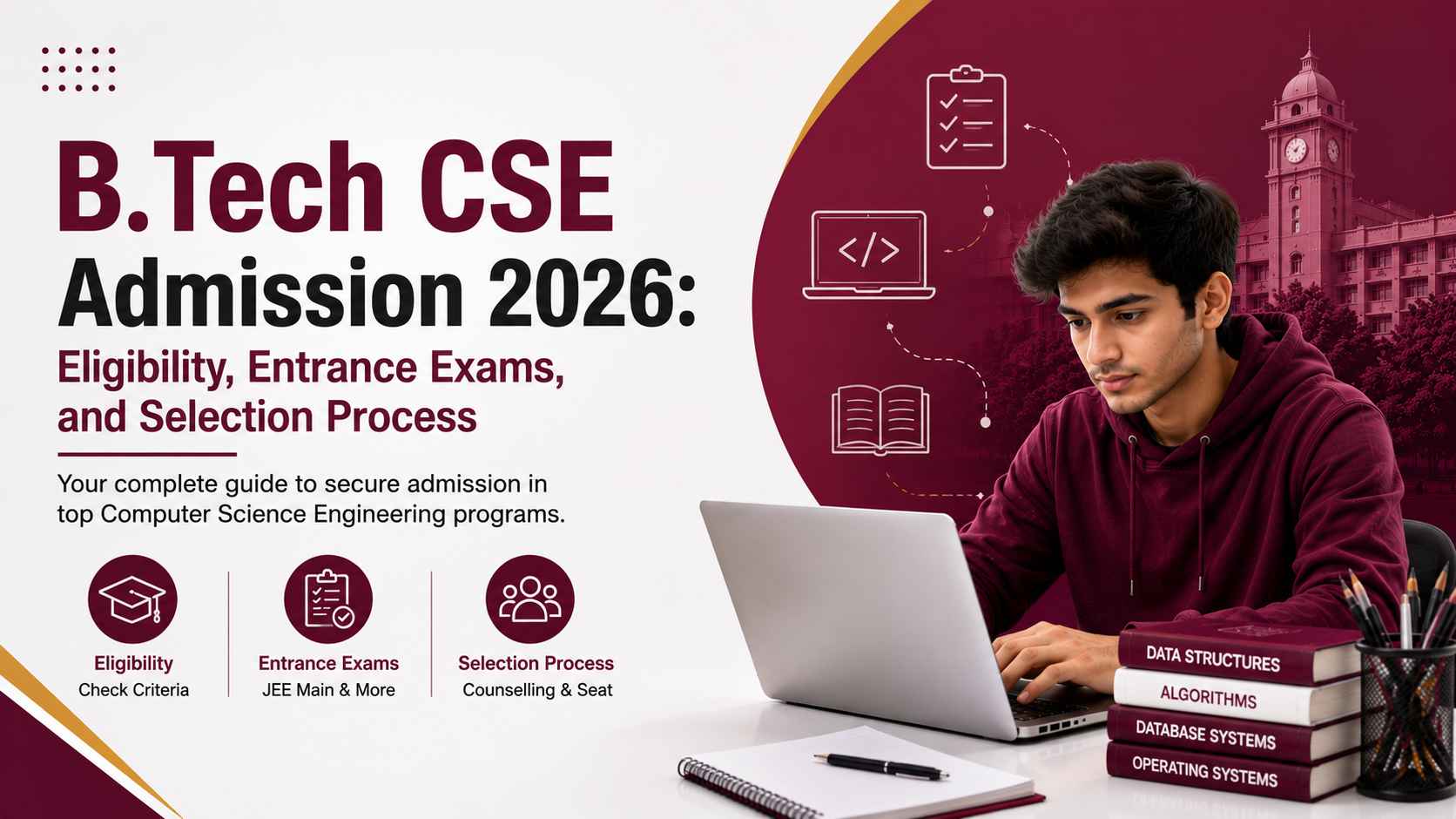
B.Tech CSE Admission 2026: Eligibility, Entrance Exams, and Selection Process
Every year, over 15 lakh students appear for JEE Main alone — and Computer Science Engineering remains the single most applied-for branch across India. Yet thousands of students lose a full academic year simply because they misunderstood one eligibility condition or missed a critical deadline by a single day.
Understanding the eligibility for BTech CSE admission is harder than it sounds. Rules vary between central universities, state boards, deemed institutions, and private colleges — and the wrong information at the wrong time costs you an entire year, not just a seat.
By the end of this post, you'll know exactly who qualifies for BTech CSE in 2026, which entrance exams matter and why, what the actual marks requirements look like across different college tiers, and how the complete selection process works from application to final seat confirmation.
Why So Many Students Get the Eligibility Criteria Wrong
Most students assume BTech CSE eligibility is simple: pass Class 12 with PCM and you're in. The reality is considerably more layered than that.
Different institutions set different thresholds. A government-aided college in Maharashtra may require 45% in PCM for general category students, while an NIT requires you to clear JEE Main with a competitive percentile on top of your board marks. A private deemed university may run its own entrance test entirely — and accept that score independently of JEE.
The Three Layers of BTech CSE Eligibility You Must Clear Simultaneously
Think of eligibility not as a single checkbox but as three distinct layers — and you need to clear all three at the same time:
• Layer 1 — Academic Qualification: Your Class 12 stream, subjects studied, and minimum percentage secured.
• Layer 2 — Age Criteria: The upper and lower age limits set by the admitting institution or the exam authority conducting the entrance test.
• Layer 3 — Entrance Exam Performance: Your score or percentile in national, state, or institution-level entrance exams relevant to your target colleges.
Miss any one layer and your application gets rejected — regardless of how strong you are on the other two. Most students spend 100% of their energy on entrance exam preparation and completely overlook the academic qualification layer until results are out and it's too late to fix anything.
BTech CSE Eligibility Criteria 2026: The Academic Requirements
Let's break down the exact academic eligibility for BTech CSE admission in India for 2026 — clearly, with no vague generalities.
Minimum Qualification Required
You must have passed Class 12 or an equivalent examination from a recognized board — CBSE, ICSE, any state board, or a recognized international qualification. The mandatory subject combination is:
• Physics — Mandatory across virtually all institutions
• Mathematics — Mandatory across virtually all institutions
• Chemistry / Computer Science / Elecronics / Information Technology Informatics Practices / Biotechnology / Technical Vocational Subjects — Any one as the third subject (exact requirement varies by institution)
This is where many students get tripped up. Most top engineering colleges accept PCM (Physics, Chemistry, Mathematics) as the standard combination. However, several institutions — including select NITs and many private universities — now accept Physics, Mathematics, and Computer Science as a valid combination for CSE specifically.
Always verify directly from the institution's official admissions brochure — not from student forums or third-party websites.
Minimum Marks Required for CSE Engineering Admission
The percentage threshold varies significantly depending on which tier of institution you're targeting:
| Institution Type | General Category | OBC | SC / ST |
|---|---|---|---|
| IITs (via JEE Advanced) | 75% in Class 12 OR Top 20 Percentile of Board | 75% or Top 20 Percentile | 65% in Class 12 |
| NITs & IIITs (via JEE Main) | 75% in Class 12 OR Top 20 Percentile | 75% or Top 20 Percentile | 65% in Class 12 |
| State Government Colleges | 45%–60% (Varies by State) | 40%–55% | 40%–45% |
| Private / Deemed Universities | 45%–60% Aggregate in PCM | 40%–55% | 40%–50% |
For 2026: The 75% board marks criterion for JEE-based admissions through JoSAA has been consistently applied across recent cycles. Confirm the final criterion once NTA officially releases the JEE Main 2026 notification, expected in November 2025, on the official NTA website.
Age Limit for BTech Engineering Admission in India
The age limit question generates more confusion than almost any other eligibility point.
As per the current JEE Main eligibility framework — confirmed across the 2024 and 2025 admission cycles — there is no upper age limit for JEE Main. NTA officially removed the upper age cap, making the exam open to candidates of any age who meet the academic qualification criteria. You can verify this directly on the official JEE Main information brochure archive.
For the lower age limit: candidates must be at least 17 years of age at the time of admission, meaning you must have been born on or before October 1, 2009 to appear for JEE Main 2026.
For JEE Advanced (IIT admissions specifically), a date-of-birth eligibility window applies. For the 2026 cycle, candidates must have been born on or after October 1, 2001. Confirm this once the official JEE Advanced 2026 brochure is released by the conducting IIT.
Private institutions typically set their own age criteria, usually requiring candidates to be between 17 and 23 years at the time of admission.
Can a Commerce Student Do BTech CSE? The Honest Answer
This is one of the most searched questions every admission season — and most websites either give a flat "no" or a misleading "yes, through bridge courses." The truth sits carefully between both.
The direct answer: In most cases, no. BTech CSE programs across India require Physics and Mathematics as mandatory Class 12 subjects. A commerce student without these subjects does not meet the basic eligibility for BTech CSE admission at the vast majority of institutions — including all IITs, NITs, IIITs, and most state government colleges.
However, your options are not zero.
Option 1: Lateral Entry After a Polytechnic Diploma
If you completed a three-year polytechnic diploma in a relevant engineering or computer science discipline after Class 10, you can apply for lateral entry admission directly into the second year of BTech CSE at many state universities and private colleges. Your Class 12 commerce background becomes largely irrelevant because the diploma establishes a separate, recognized eligibility pathway.
Option 2: Bridge Courses at Select Private Universities
A small number of private deemed universities offer bridge courses that allow non-PCM students to qualify for engineering admissions by completing foundational Physics and Mathematics modules. These programs are not widespread, carry limitations on available specializations, and vary significantly in quality. Research each institution individually before committing.
Option 3: BSc Computer Science Followed by MCA or MTech
This isn't BTech — but it's worth knowing. A BSc in Computer Science is accessible to students from various Class 12 backgrounds depending on the university, and an MCA (Master of Computer Applications) or MTech afterward can lead to equivalent career outcomes in software and technology roles.
The practical takeaway: If you're currently in Class 10 and you already know you want BTech CSE, choose PCM in Class 11. That single decision at age 15 removes every eligibility barrier at the admission stage and gives you access to the widest possible range of colleges, entrance exams, and specializations in 2026.
Between changing age limits, varying board percentage rules, and tier-specific exam requirements, calculating your exact eligibility can feel genuinely stressful. If you want to skip the confusion, talk to our admission counsellors for a free, personalized college shortlist built around your actual 2026 academic profile — not generic cutoffs.
Entrance Exams for BTech CSE in 2026: National, State, and Private
The BTech CSE admission process in India runs through multiple entrance exam channels simultaneously. Which exams you prioritize depends entirely on which tier and type of colleges you're targeting.
National-Level Entrance Exams
JEE Main 2026
• Conducted by NTA across two sessions — typically January and April
• Scores used for NITs, IIITs, GFTIs, and most participating state government colleges
• Also serves as the qualifying exam for JEE Advanced
• Paper 1 covers Physics, Chemistry, and Mathematics in a computer-based format
• Best of the two session scores is considered for merit list preparation
JEE Advanced 2026
• Conducted by one of the IITs on a rotational basis each year
• Only the top 2.5 lakh JEE Main qualifiers become eligible to appear
• The exclusive gateway to all IIT admissions across India
• In 2025, approximately 1.8 lakh students appeared and around 48,000 qualified — a competitive ratio that demands specific, focused preparation beyond JEE Main coaching
State-Level Entrance Exams for BTech CSE
Each state conducts its own engineering entrance exam for admissions to state government and state private colleges:
| State | Entrance Exam | Approximate Schedule |
|---|---|---|
| Maharashtra | MHT CET | February–March 2026 |
| Karnataka | KCET | March–April 2026 |
| Andhra Pradesh | AP EAMCET | April–May 2026 |
| Telangana | TS EAMCET | April–May 2026 |
| West Bengal | WBJEE | February–March 2026 |
| Tamil Nadu | TNEA | Merit-based, Post Class 12 Results |
Strategic advice: Don't appear for just one exam. Students who secure good CSE seats almost always apply for JEE Main, their state CET, and at least one or two private university exams simultaneously. Application fees are low. The cost of having only one option is high.
Private University Entrance Exams
Several prominent private universities run their own admission tests:
• BITSAT — BITS Pilani, Goa, and Hyderabad campuses
• VITEEE — VIT University (Vellore, Chennai, Bhopal, AP campuses)
• SRMJEEE — SRM Institute of Science and Technology
• MET — Manipal Academy of Higher Education
• KIITEE — KIIT University, Bhubaneswar
Many of these institutions also accept JEE Main scores directly for admissions, so a strong JEE Main performance opens multiple doors without requiring separate exam preparation for each.
How to Get Admission in Top CSE Colleges: The Step-by-Step Selection Process
This is the part most students treat casually — and then regret during counselling season. The selection process is sequential. Missing or mishandling any step affects the next one directly.
Here is the complete BTech CSE admission process for 2026, structured in the exact order it happens:
Step 1 — Clear Class 12 with the Required Percentage Your Base Eligibility
Your board results form the non-negotiable foundation. Aim for above 75% in PCM if you're targeting NITs or IITs. Don't sacrifice board exam preparation to focus entirely on entrance exam coaching — both carry equal weight in the final eligibility calculation, and a board shortfall cannot be compensated by a high JEE score.
Step 2 — Register and Appear for Relevant Entrance Exams November 2025 Onward
JEE Main 2026 Session 1 registration typically opens in November 2025 on the NTA portal. Register the moment applications open — the window is short and there is no provision for late registration under any circumstance. Simultaneously register for your state CET and target private university exams within their respective windows.
Step 3 — Check Your Score and Shortlist Colleges Realistically Post Results — January and May 2026
Once JEE Main results release, use the official JoSAA opening and closing rank data from the previous two to three years to identify colleges where your rank is genuinely competitive. Study this data systematically — not based on college brand recognition or what your friends are applying to. Matching your rank to historical data gives you a realistic probability assessment before counselling begins.
Step 4 — Participate in Centralized Counselling JoSAA / State Counselling Portals
For NIT, IIIT, and IIT admissions, JoSAA counselling runs across multiple rounds. Fill your college and branch preferences carefully in priority order — this choice directly determines your allotted seat. For state college admissions, register separately on your state's counselling portal and follow their specific round schedule.
Step 5 — Document Verification Critical — Do Not Treat This as Routine
After a seat is allotted, you must complete document verification — either physically at the reporting center or online through the portal, depending on the institution's process. Keep every required document ready before counselling begins, not after your seat is allotted:
• Class 10 Mark Sheet and Certificate (Date of Birth proof)
• Class 12 Mark Sheet and Passing Certificate
• JEE Main / State CET Admit Card and Score Card
• Category Certificate (OBC/SC/ST/EWS) — issued by a competent authority, current financial year
• Domicile / State Residency Certificate (for state quota seats)
• Transfer Certificate from previous institution
• Passport-size photographs — minimum 10 copies
• Aadhaar Card or other government-issued photo ID
Missing even one document at the verification stage — physically or in an online upload — results in automatic forfeiture of your allotted seat. There are no second chances at this step.
Step 6 — Pay Seat Acceptance Fee and Complete Enrollment Lock Your Seat Within the Exact Window Given
Pay the seat acceptance fee within the exact stipulated time window displayed in your allotment letter. Late payment — even by a few hours — results in seat cancellation. Once paid, complete your enrollment formalities, hostel application, and remaining fee payment directly with the institution before the academic session begins.
What Actually Separates Students Who Get Top CSE Seats from Those Who Don't
This is the insight most admission guides skip entirely — and it's the part that makes the real difference.
Getting into a top CSE college isn't only about clearing the eligibility threshold. It's about how deliberately you play the selection process once you're inside it.
Students who secure top CSE seats appear for multiple exams. They don't rely on JEE Main alone. They appear for their state CET and at least two private university exams simultaneously. Each exam is an independent door to a good seat.
They study historical rank data before counselling, not during it. JoSAA and state counselling portals publish opening and closing rank data from previous years. Students who study this data fill their preferences strategically — not emotionally or alphabetically.
They don't mishandle the upgrade rounds. Many students reject their Round 1 allotment hoping for a better college in Round 2, without fully understanding how the floating and sliding options work in JoSAA. Read the counselling rules document completely before making any round decisions.
They stay alert through spot admission rounds. After main counselling ends, most state and private universities conduct spot admission rounds for remaining vacant CSE seats. These rounds regularly place students at good institutions. Keep your documents ready and track notifications through August.
Want to know your realistic chances at specific CSE colleges based on your actual JEE percentile and board marks? Use our free college predictor tool for an instant, data-driven shortlist built on real 2025 JoSAA closing ranks — updated for the 2026 admission cycle.
Conclusion
The eligibility for BTech CSE admission in 2026 rests on three things working together: the right Class 12 subjects and a qualifying percentage, a competitive entrance exam score through the right channel for your target colleges, and a clear, step-by-step understanding of how the selection and counselling process actually works. Students who secure the best CSE seats aren't always the ones with the highest scores — they're the ones who understood every rule, prepared every document, and made smart decisions at every stage of counselling.
Start your entrance exam preparation now, without waiting for Class 12 boards to finish. Register for JEE Main 2026 the moment applications open in November 2025. Simultaneously target your state CET and at least one private university exam. And treat the counselling process with the same discipline you brought to your exam preparation — because that's where your actual seat gets decided.
Speak to our admission experts today — get a personalized, step-by-step roadmap for BTech CSE 2026 based on your current marks, target colleges, home state, and category. No generic advice. No assumptions.
Frequently Asked Questions
1. What is the eligibility for BTech CSE admission in India in 2026?
The eligibility for BTech CSE admission in 2026 requires candidates to have passed Class 12 with Physics and Mathematics as mandatory subjects, along with Chemistry, Computer Science, or Biology as a third subject from a recognized board. Most institutions require a minimum of 45%–75% aggregate marks in these subjects depending on the college tier, and candidates must qualify in a relevant entrance exam such as JEE Main, a state CET, or a private university test.
2. What is the minimum percentage required for CSE engineering admission at NITs?
NITs require a minimum of 75% aggregate marks in Class 12 PCM for general category candidates — or placement in the top 20 percentile of their respective state board, whichever criterion is lower. SC and ST candidates require a minimum of 65%. This board percentage requirement applies in addition to clearing JEE Main with a rank competitive enough for the specific NIT and CSE branch combination you're targeting.
3. Which entrance exams do I need to appear for BTech CSE admission in 2026?
For BTech CSE admission in 2026, the primary national-level exams are JEE Main for NITs, IIITs, and GFTIs, and JEE Advanced exclusively for IIT admissions. State-level exams like MHT CET, KCET, WBJEE, and AP EAMCET cover government colleges in their respective states. Private universities like BITS Pilani, VIT, SRM, and Manipal conduct BITSAT, VITEEE, SRMJEEE, and MET respectively — though many also accept JEE Main scores directly.
4. Can a commerce student apply for BTech CSE admission in India?
Generally, a commerce student cannot apply for BTech CSE admission because Physics and Mathematics at the Class 12 level are mandatory requirements at the vast majority of institutions, including all IITs, NITs, and state government engineering colleges. However, students who completed a polytechnic diploma in a relevant computer science or engineering discipline after Class 10 can apply for lateral entry directly into the second year of BTech CSE at eligible institutions.
5. Is there an upper age limit for BTech engineering admission through JEE Main?
There is no upper age limit for JEE Main as of the 2024 and 2025 admission cycles — NTA officially removed this restriction. Candidates must, however, be at least 17 years of age at the time of admission. For JEE Advanced, which governs IIT admissions, a specific date-of-birth eligibility window applies, so verify the exact criteria once the official JEE Advanced 2026 brochure is released by the conducting IIT.
6. How do I get admission in top CSE colleges with a moderate JEE rank?
Getting admission in top CSE colleges with a moderate JEE rank requires a strategic approach to the BTech CSE admission process in India. Study JoSAA's historical opening and closing rank data for your target colleges before counselling begins. Fill preferences based on data, not brand recognition alone. Participate in all counselling rounds including upgrade rounds, and simultaneously apply through state CET and private university channels to maximize the total number of realistic options available to you.